There are numerous monuments to visit during a trip or weekend in Bucharest. Don’t miss the Palace of Parliament, the world’s largest building after the Pentagon in Washington, constructed entirely from Romanian materials – from marble and wood to carpets, curtains and chandeliers – the Ateneul Roman Auditorium, in neoclassical style, which hosts the magnificent concerts of the George Enescu Philharmonic, and plan a tour of the Old Town where, among other interesting buildings, you’ll find the Old Court Church, built in the 16th century and decorated with wonderful frescoes.
Numerous Byzantine art churches can be found in Bucharest, such as Curtea Veche, Antim Monastery, Stavropoleos and Spiridon. Walk along Șoseaua Kiseleff, Bucharest’s main thoroughfare, visit the important squares of Piața Universității, Piața Revoluției and Piața Unirii, and reach the Triumphal Arch. Admire Kretzulescu Church, one of Bucharest’s most beautiful, built in 1722, in Republic Square, relax in Cismigiu Park, the city’s oldest park, and visit the Village Museum, in Herastrau Park, one of Europe’s largest and most famous open-air ethnographic museums.
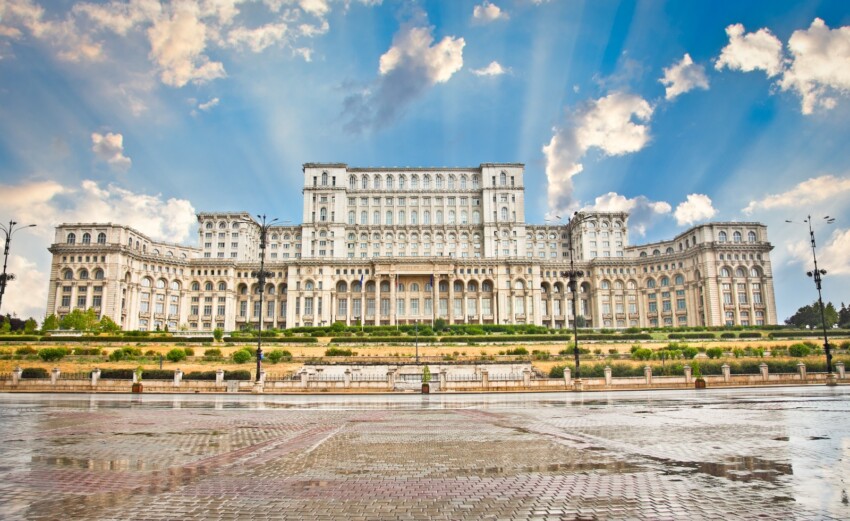
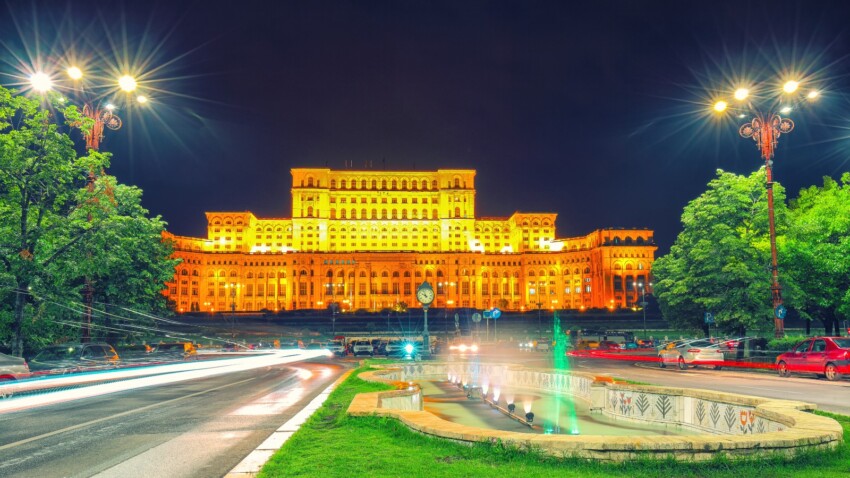
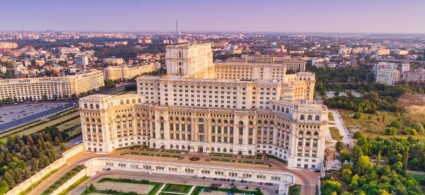
The Palace of Parliament in Bucharest, Palatul Parlamentului in Romanian, was constructed in 1984 by Nicolae Ceaușescu, leader of the Communist Party, during the “golden period” of the authoritarian regime. This colossal building is the world’s second-largest administrative palace after the Pentagon and the third largest by volume after Cape Canaveral in the United States and the Great Pyramid in Egypt.
The building, in eclectic style, was designed by architect Anca Petresc and comprises 12 storeys, including 4 underground levels and a massive nuclear bunker, 3,100 rooms and features chandeliers with 7,000 light bulbs. Built and furnished exclusively with Romanian materials, the building, one of the latest examples of socialist classicism, reflects the work of the country’s finest craftsmen and today houses the Romanian Parliament and serves as a conference centre.
You can enter the Palace of Parliament thanks to guided tours that will lead you through luxurious rooms decorated with mosaics, oak panels, marble, gold leaf and carpets.
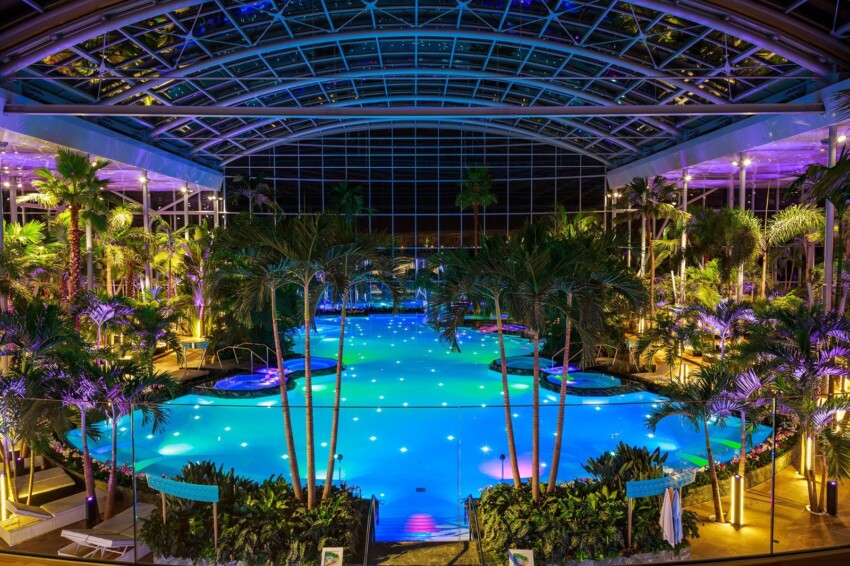
The Bucharest Thermal Baths, or “Termale Bucuresti” in Romanian, are hugely popular with both local residents and tourists – an oasis of wellness and relaxation, a true delight for the senses! Imagine immersing yourself in thermal waters, feeling the enveloping warmth ease muscle tension and rejuvenate your mind: the saunas and steam baths will pamper you with an experience of pure pleasure, whilst massages and thermal treatments will transport you to a world of absolute wellbeing.
It is divided into 3 areas – called Galaxy, The Palm and Elysium – and comprises 10 pools, 6 saunas, 4 Turkish baths and 16 water slides. Within the park you’ll also find Europe’s largest palm grove and Romania’s largest botanical garden.
Whether you’re a traveller seeking a rejuvenating break or a local craving an escape from daily hustle, the Bucharest Thermal Baths are the perfect place to renew your body, mind and spirit!
South of Piața Universității lies Bucharest’s old Old Town, with the ruins of the Court of the Princess, built in the 15th century by Vlad Țepeș, better known as Dracula, and the city’s trendiest venues. Also known as the Lipscani district after the name of one of its main streets, this area has a unique charm thanks to a perfect blend of history, culture and nightlife.
This maze of streets, which in the 1400s bustled with artisans and merchants, has been transformed after decades of neglect into a luxury quarter, highlighting the mix of architectural styles – from baroque to neo-gothic, from neoclassical to Art Nouveau – of its palaces. Today the area abounds with art galleries, antique shops and cafés.
Worth seeing is the Church of the Old Court, or Biserica Curtea Veche, dating to 1559 and considered Bucharest’s oldest church, where Romanian princes were crowned for two centuries, the Church of Stavropoleos, tiny and enchanting, and the National Museum of History. In the Lipscani district you’ll also find the National Bank of Romania, housed in one of Romania’s most famous buildings, designed by French architects Cassien Bernard and Albert Galleron in 1885. Built in French neoclassical style, the building boasts a façade with Corinthian columns and an enormous central hall.
Piața Universității
4Bulevardul Regina Elisabeta, București 030167, Romania
Bucharest University Library
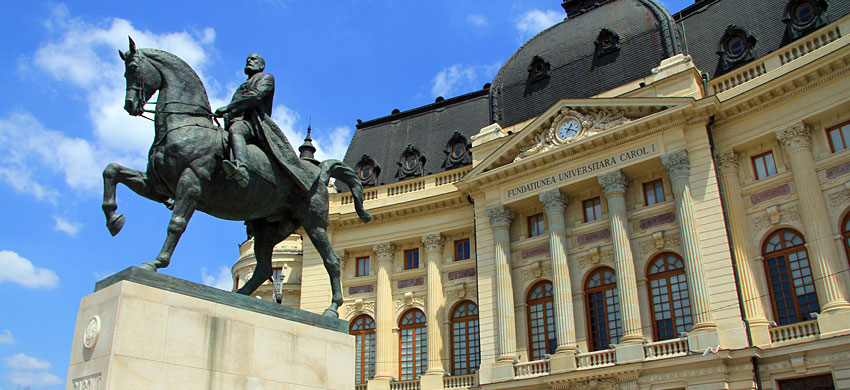
University Square in Bucharest is the beating heart of the capital and was one of the key locations of the 1989 revolution and the miners’ uprising in June 1990. The 10 stone crosses at the centre of the square commemorate the victims of the revolution, with the black cross marking the spot where the first was killed on 21 December.
The square brings together several architectural masterpieces, one at each of the 4 corners: Bucharest University, built in 1859 and featuring 4 statues of illustrious statesmen and educators, the National Theatre, the neoclassical Hospital building with its beautiful church, and Sutu Palace, home to the Museum of History.
Beneath the square you’ll find shops, restaurants and access to the underground railway. The city’s main arterial roads intersect at Piața Universității, which marks the north-western boundary of the Old Town.
In the centre of Bucharest stands Revolution Square, the place where on 21 December 1989 Nicolae Ceaușescu’s communist regime began to collapse. The dictator appeared on the balcony of the former headquarters of the Communist Party Central Committee, now the Senate, and delivered what would be his last public speech before fleeing the enraged crowd by helicopter. On the building opposite, you can still see today a reminder of the madness of those days – bullet holes from the shots fired by Ceaușescu’s loyal followers in an attempt to disperse the crowd – while the Rebirth Memorial, a 25-metre-high monument built to commemorate those events, towers over the square.
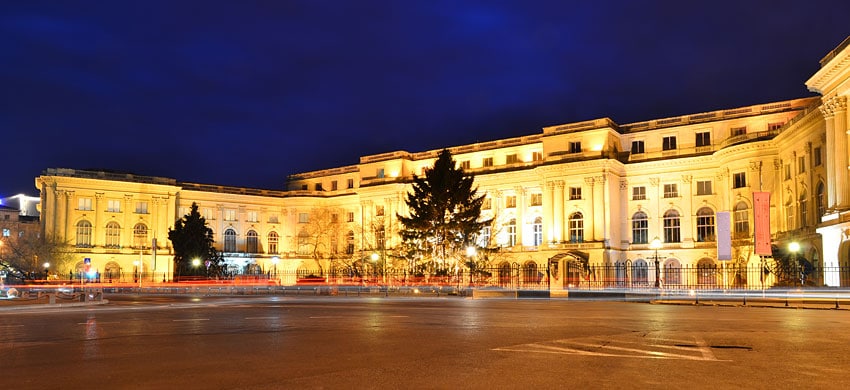
On the opposite side of Revolution Square stands the 19th-century former Royal Palace, built between 1927 and 1937 in neoclassical style, now home to the National Art Museum, and the splendid Ateneul Roman Auditorium. South of the square is the small and beautiful Kretzulescu Church, built in red brick in 1722 in Brâncovenesc style, which blends Byzantine and Western architectural elements.
Also impressive is the University Library building, which was set ablaze during the revolution but is now restored and operational, and the Military Club, a neoclassical palace built in the early 20th century and used for art exhibitions and cultural events.
In the heart of the socialist city, built by dictator Ceaușescu who demolished much of Bucharest’s old town, lies Union Square, one of the capital’s largest squares. A central hub for surface and underground public transport, Union Square is dominated by the Unirea shopping centre, whilst in its central section sits a small park with fountains where you can relax.
Nearby you’ll find the Patriarchal Cathedral, the church consecrated in 1658 and dedicated to Saints Constantine and Helen, which forms part of an architectural complex that also includes the Patriarchate Palace and the former monastery, the Princess Balasa Church, a splendid large building constructed between 1881 and 1885 in a mix of neo-Romantic and neo-Byzantine style, and the 16th-century Prince Mihai Monastery, resembling a fortress, relocated in 1985 by 285 metres eastward on Ceaușescu’s orders.
Between Victory Square and Free Press Square lies Șoseaua Kiseleff, one of Bucharest’s most important thoroughfares. This grand tree-lined avenue was created in 1832 by the commander of Russian occupation troops in Wallachia and fortunately escaped Nicolae Ceaușescu’s demolition plans.
Șoseaua Kiseleff is flanked by beautiful villas, some of the capital’s most important museums, several parks and, halfway along, the Triumphal Arch, 27 metres high, built in 1935 as an inspiration from the Parisian monument.
Along the avenue you can visit:
the Romanian Peasant Museum, one of Bucharest’s finest museums, housing everyday objects, traditional clothing, artworks and partially restored churches and houses, including an 18th-century Transylvanian church;
the Geology Museum, housed within an early 20th-century building and displaying Romania’s mineral wealth;
the Grigore Antipa Natural History Museum, ideal for those visiting Bucharest with children, featuring projections, games and interactive exhibitions;
the Dimitrie Gusti Village Museum, located on the shores of Herastrau Lake and boasting a magnificent collection of houses, churches and windmills from throughout the country.
Ateneul Român
8Strada Benjamin Franklin 1-3, București 010287, Romania
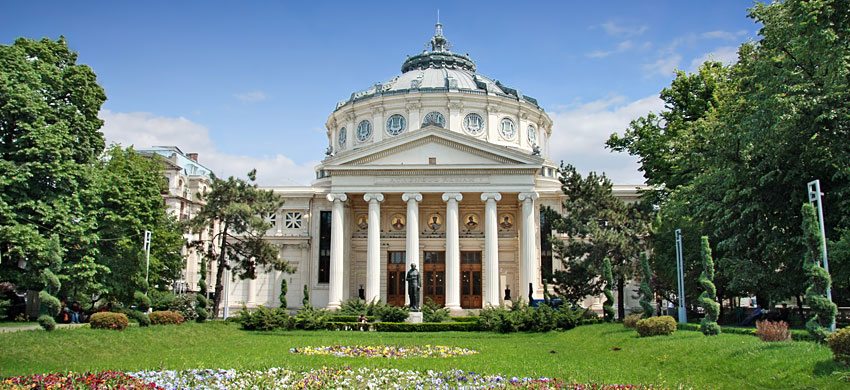
Among Bucharest’s finest architectural works is the Ateneul Român, Romania’s most prestigious concert hall, renowned worldwide for its exceptional acoustics.
Inaugurated in 1888 and designed by French architect Albert Galleron, the building impresses with its 40-metre-high dome and the 12 Ionic columns that embellish the entrance, in neoclassical style.
Inside, on the ground floor is a conference hall adorned with stuccowork and statues, whilst the main concert hall can accommodate around 650 people. Inside is a massive fresco running around the entire circumference of the building, depicting the most important moments in Romanian history from Roman times to 1918.
In front of the Ateneul Român stands a small park and a statue of Mihai Eminescu, Romania’s greatest poet of all time.
The Muzeul Național de Artă al României, or National Museum of Romanian Art, is housed within Bucharest’s Royal Palace, one of the city’s most important buildings. The palace was the residence of Romania’s kings until 1947, the year the communist regime was established, and is the country’s largest and most important royal residence. Since 1948 it has housed the national art museum and holds over 70,000 works of art.
The museum is divided into two sections: the National Gallery, featuring works by major Romanian artists including Brancusi, Grigorescu, Aman, Luchian, Palladi and Ion Jalea, and the European Gallery comprising works by Rubens, Rembrandt, Veneziano, Titian, Tintoretto, El Greco, Pissarro, Delacroix and Sisley.
There is also a section dedicated to medieval art, showcasing works saved from destruction during the communist period, and two galleries hosting temporary exhibitions. Also noteworthy is the area dedicated to modern art, featuring sculptures and paintings by Romania’s most celebrated artists.
The Tineretului Park, or Youth Park, is one of Bucharest’s largest public parks. Located south of the city, in sector 4, it’s an oasis of peace and tranquillity where you can escape the chaos of the metropolis. The park dates to 1965, planned by architect Valentin Donose, and was built in an area that underwent rapid development during those years.
The park features a navigable lake, where pedalos and rowing boats are hired during summer, and the Polivalenta Hall, a space used for indoor concerts and sporting events. In the south-east section of the park is an area dedicated to children, with a small amusement park, plus an area for older children with open-air bars and various attractions. For convenient movement around the park, there’s an electric train available.
The National Museum of History is housed in a building that was once Bucharest’s main post office and traces Romania’s history from the Palaeolithic period. Of particular interest is the Treasure Room, which holds jewels and prehistoric objects.
Village Museum
12Şoseaua Pavel D. Kiseleff 30, București 011347, Romania
Within the verdant Herastrau Park, on the shore of the lake of the same name, stands the Village Museum, inaugurated in 1936. With over 350 traditional buildings brought from throughout the country and more than 100,000 original domestic objects, the museum succeeds in recreating Romanian peasant life between the 17th and early 20th centuries. Additionally, the museum periodically welcomes Romanian craftspeople to showcase their work. Today the Village Museum is also an institution conducting ethnographic research.
Other Museums
Among Bucharest’s most important museums are the Museum of the Peasant, which houses traditional wooden agricultural tools and household objects, and the Museum of Art Collections, which features renowned works from both private and international collections. Also worth visiting are the Natural History Museum, the George Enescu Museum, dedicated to Romania’s most celebrated composer, the Cotroceni Museum housed in a wing of the President’s official residence, and the Museum of the Jewish Community.
Free tour of Bucarest
Discover Bucarest through the eyes of expert guides who will take you on a tour of the city's hidden treasures. Participating in a free tour will allow you to capture the true essence of Bucarest.
The free tours are a viable alternative to traditional guided tours. They work like this: participation is free and at the end of the visit you can leave a tip at your discretion. Below you will find our favourite free tour, otherwise you can see the full list by visiting this page.
Start your weekend in Bucharest with a stroll along Kiseleff Avenue, the city’s most important boulevard, and head towards the impressive Triumphal Arch and Liberty Press Square, where you can visit the Museum of the Romanian Peasant to discover ancient local traditions, and Aviators’ Square.
From Victoria Square and the Government Palace, you’ll enjoy excellent views over the end of Calea Victoriei and the Military Circle. Walking along the banks of the Dambovita River, you’ll reach the Romanian Opera House and the statue of the great Romanian composer George Enescu. Finally, arrive at the Palace of Parliament, where Italian-speaking guides are available to tour the House of the People, built under Ceaușescu’s rule.
Near the Palace of Parliament lies Cismigiu Park, perfect for relaxation and refreshments at one of its kiosks.
In the afternoon, head to Bucharest’s Old Town, known as the Old Court, founded by Vlad the Impaler, better known as Count Dracula. Don’t miss the Manuc Palace and the neo-Gothic Caru cu Bere building, named after the beer wagon. You can shop for souvenirs along Victoriei Street or at the Uniri Center in Union Square.
In the evening, we recommend dining at one of Bucharest’s many traditional restaurants to taste authentic Romanian cuisine, enjoy live music and traditional dances.
Day Two
On the morning of your second day in Bucharest, especially if the weather is fine, head to Herastrau Park, in the north of the city, where you can take a boat ride and visit the Village Museum or Muzeul Satului, Europe’s largest open-air ethnographic park.
In the afternoon, as you make your way back through Bucharest along Calea Victoriei, admire the George Enescu Music Museum and Cantacuzino Palace.
Don’t miss the Romanian Athenaeum Auditorium, one of Bucharest’s most iconic landmarks and home to the George Enescu Philharmonic Orchestra, the National Museum of History with its precious Treasury Hall, and finally, the National Theatre.
 Hotel
Hotel  Budget accommodations
  Apartments
  Family Hotel
  Luxury Hotel