Bestseller
Bucharest: Parliament Palace Skip-the-line Ticket
From 25,00 €
Buy the ticket
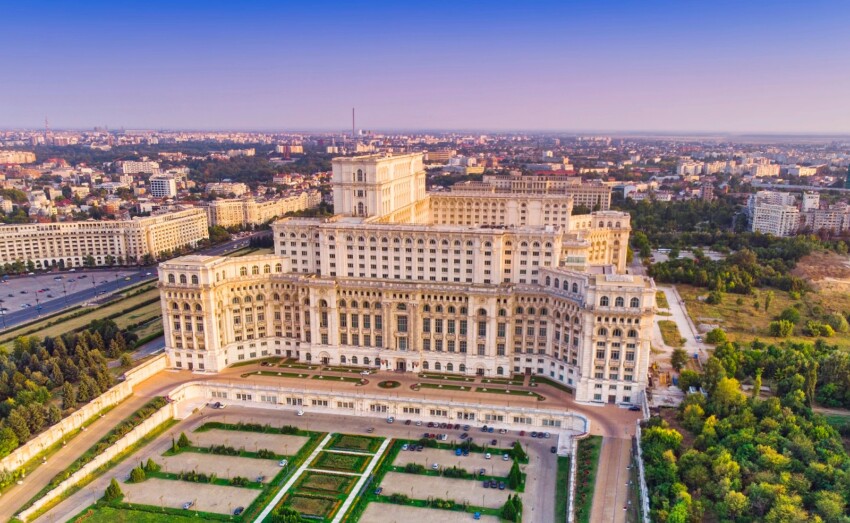
With 365,000 square metres of built surface and 1,100 rooms, the Palace of Parliament in Bucharest is the world’s largest administrative building and the second largest structure by volume after the Pentagon. Built at the behest of Nicolae Ceaușescu from 1984 onwards, it is also known by its original conception: Casa Poporului, the House of the People. A name that sounds almost paradoxical, considering that its construction led to the demolition of an entire historic Bucharest neighbourhood — the Uranus district — with the destruction of over 40,000 homes and the forced displacement of thousands of families.
Today the palace houses both chambers of the Romanian Parliament and is open to visitors with regular guided tours. Walking through its halls is an experience that inevitably blends admiration for the architectural proportions with critical reflection on the history of the communist regime that commissioned its construction. The building’s figures are so extreme as to seem almost unbelievable: 480,000 cubic metres of marble, 900,000 cubic metres of wood, one million cubic metres of glass and 3,500 tonnes of Murano crystal in the chandeliers.
In this guide you’ll find everything you need to organise a visit to the Palace of Parliament: the most significant halls, the construction history, tickets, opening times and answers to frequently asked questions.
The guided tour typically covers a selected section of the main halls — the entire building is not accessible to the public, as it remains in active use as an institutional seat. The areas open to visitors are nonetheless sufficient to convey the scale and ambition of the original project.
It is the largest hall in the entire palace and one of the most imposing interior spaces in Europe. The Hall of Union is 53 metres long, 16 metres wide and 16 metres high, with a frescoed ceiling and crystal chandeliers each weighing several tonnes in total. The walls are lined with marble from Ruşchiţa, extracted from quarries in the Romanian Carpathians, with manual work that required years of labour from skilled craftsmen from across the country.
The hall is used for official ceremonies, international conferences and, during the guided tour, offers the most effective opportunity to understand the difference in scale between this building and any other architectural space you may have visited previously. A photograph from the entrance towards the back of the hall conveys the most effective perspective of its length, especially with natural light filtering through the side windows in the morning hours.
One of the palace’s most richly decorated ceremonial halls, named after the 19th-century Romanian revolutionary and historian. The Nicolae Bălcescu Hall is lined with carved walnut wood and houses one of the most elaborate crystal chandeliers in the entire building: it weighs over two tonnes and is composed of thousands of hand-blown glass elements. The geometric parquet flooring is made with over thirty different types of wood, inlaid by hand according to a design that required months of planning.
This hall is particularly interesting to observe in close detail: the ceiling mouldings, marble pilasters and original furnishings allow you to appreciate the genuinely high level of craftsmanship that characterises the palace’s interiors, regardless of historical and political judgements on its construction.
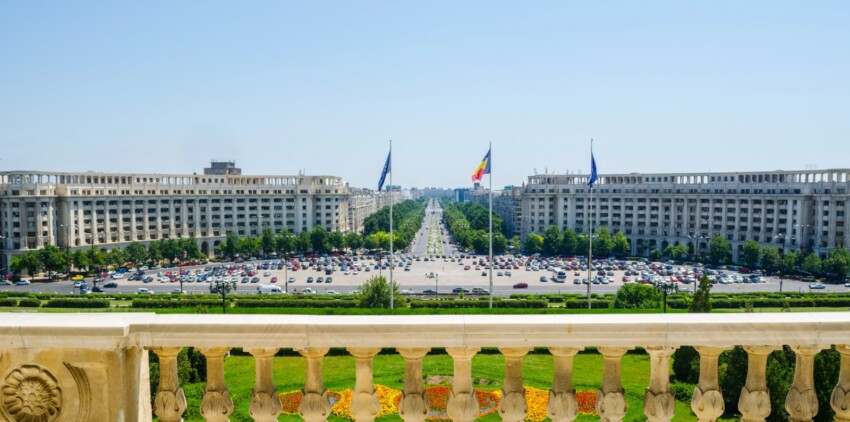
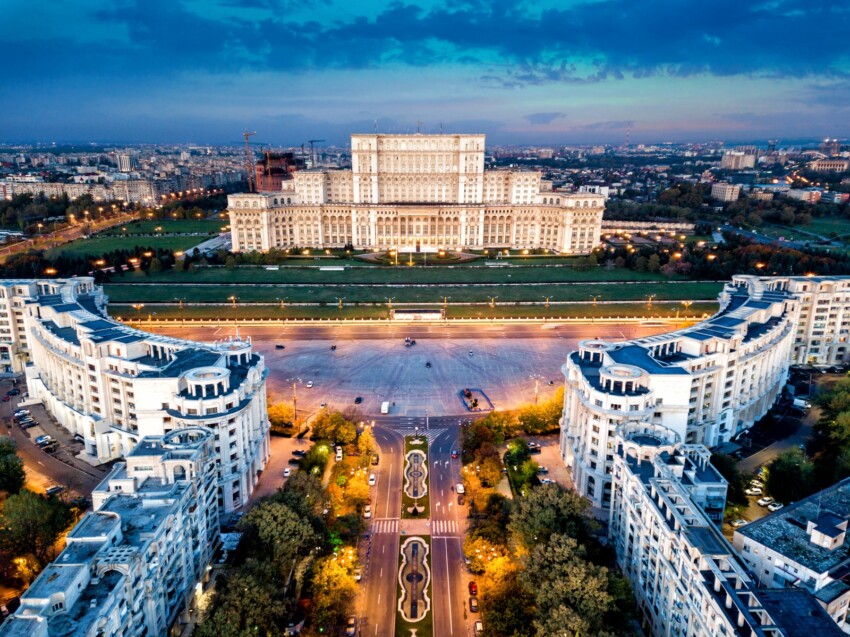
For those wishing to understand the palace’s position within Bucharest’s urban fabric, the panoramic terrace offers the most effective viewing point. From here you can clearly see the Bulevardul Unirii, the long avenue that Ceaușescu had built as a direct perspective axis towards the palace, explicitly inspired by the Champs-Élysées in Paris — though 700 metres longer. The view also allows you to grasp the scale of the urban intervention that accompanied the building’s construction: the Uranus neighbourhood that once extended across this area has disappeared, replaced by a line of Socialist-style buildings framing the avenue on both sides.
The terrace is accessible only on certain tours and in favourable weather conditions. It is the ideal location for overhead photographs and video footage of the main façade, which extends 270 metres in width. The afternoon light, when the sun directly illuminates the western façade, is most favourable for architectural photography.
Named after the Romanian liberal prime minister who led the country in the second half of the 19th century, this hall is among the most used for institutional events and is one of the few where the original decoration commissioned by Ceaușescu has remained substantially intact since 1989. The burgundy velvet curtains, carved wooden panels and gilded bronze details evoke the atmosphere of late Romanian communist aesthetics, which blended art deco references with a taste for decorative accumulation typical of 20th-century totalitarian regime architecture.
A little-known curiosity: during construction, all of the palace’s halls were fitted with an audio surveillance system, later dismantled after the regime’s fall. Technicians involved in the decontamination reported finding hidden microphones even within decorative bas-reliefs and behind picture frames — a detail that says much about the nature of the power this building was constructed to celebrate.
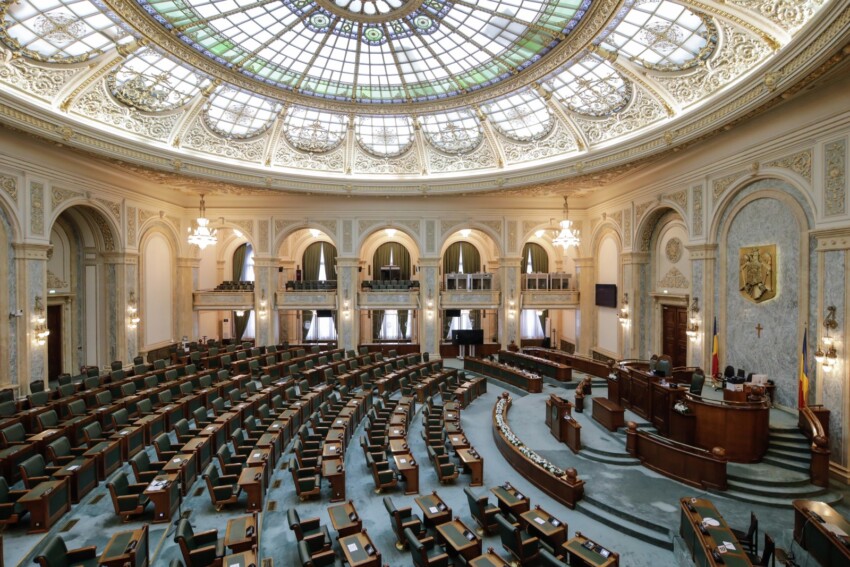
The palace currently houses both chambers of the Romanian Parliament: the Chamber of Deputies in the north section and the Senate in the south section. When not in session, some parliamentary chambers are included in the visit route. Entering the chamber where Romanian deputies convene is an experience that connects the palace’s past to its current institutional present, making the transformation from a monument to Ceaușescu’s megalomania to the seat of a parliamentary democracy more tangible.
The chambers are furnished more soberly compared to the ceremonial halls: the contrast between functional institutional spaces and the baroque-style galleries of the rest of the building is one of the most interesting aspects from both an architectural and symbolic perspective.
Visits to the Palace of Parliament are exclusively through guided tours; independent access is not permitted. The standard adult ticket costs approximately 45-60 lei for the basic interior tour, with a surcharge for access to the panoramic terrace. Reduced tickets are available for students, pensioners and children.
Advance online booking is strongly recommended, especially during summer months and weekends, when tours sell out quickly. Tours are available in several languages, including Italian, English, French and German: verify the availability of your preferred language when booking, as not all time slots offer guides in all languages.
The Palace of Parliament is open to visitors every day of the year, with hours varying slightly depending on the season. In summer (April-October) tours generally depart from 10:00 to 16:00, finishing around 17:00. In winter (November-March) the last tour typically departs at 15:00. On days when Parliament is in session, some halls may be temporarily closed to the public: this is indicated on the official website with brief notice, but rarely affects the entire tour route.
The basic interior tour lasts approximately 1 hour. Adding the panoramic terrace extends the visit by about 30 minutes. Those viewing the palace exterior — the main façade, the forecourt and Bulevardul Unirii — before or after the guided tour can easily spend an additional half hour. Adding everything together, half a day is the ideal timeframe for a complete experience.
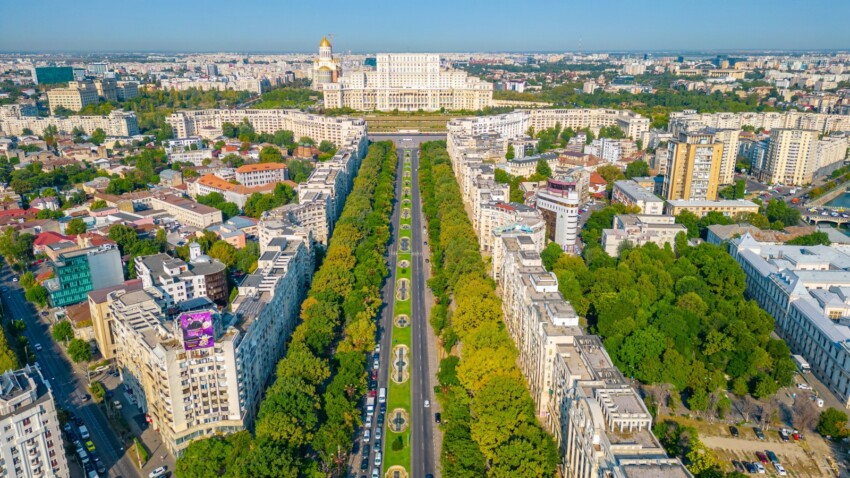
The palace is located in the Dealul Arsenalului neighbourhood, in the south-west part of central Bucharest, and is visible from many points across the city thanks to its size.
The most convenient stop is Izvor on the M3 line, approximately 10 minutes’ walk from the palace’s main entrance on the north side. Alternatively, the Tineretului stop on the M2 line allows you to reach the south side entrance in approximately 15 minutes’ walk through Parcul Tineretului. Metro tickets can be purchased from automatic machines at every station.
From Bucharest’s historic centre the palace is reachable on foot in approximately 20-25 minutes, crossing Union Square and walking up Bulevardul Unirii. The route is flat and allows you to appreciate the urban scenography of Ceaușescu’s civic centre. By taxi or Bolt, the journey from the historic centre or main Gara de Nord station takes approximately 10-15 minutes and is reasonably priced.
No, visits to the Palace of Parliament are possible exclusively through guided tours. Independent access to the interiors is not permitted. Tours depart at scheduled times from the main entrance and are conducted by accredited guides. You can book online on the official website or purchase a ticket directly at the ticket office on the day, subject to availability.
Yes, to enter the palace you must produce a valid identification document — passport or identity card. This requirement applies to all visitors, adults and minors alike. Minors accompanied by an adult not resident in Romania must have their own document. The check takes place at the entrance, before the tour begins.
The palace was built as a monument to Nicolae Ceaușescu’s personal power and as a symbol of the grandeur of the Romanian socialist regime. Its realisation came at an enormous human cost — the forced displacement of tens of thousands of families — and an economic cost that contributed to Romania’s impoverishment in the 1980s. After the fall of communism, the palace became an ambivalent symbol: on one hand a tourist attraction and functional institutional seat, on the other an involuntary memorial to the excesses of a regime that used it as a propaganda instrument.
The history of the Palace of Parliament begins in 1978, when Nicolae Ceaușescu visited North Korea and was impressed by the monumental architecture with which Kim Il-sung had redesigned Pyongyang. Upon his return to Romania, the dictator began developing a similar project for Bucharest, which was to culminate in the construction of a civic centre of unprecedented proportions. The project was entrusted in 1983 to a 28-year-old architect, Anca Petrescu, selected from candidates whom Ceaușescu himself had examined. Petrescu remained in charge of the project until Ceaușescu’s death in 1989 and continued to defend her design choices until her own death in 2013.
Work began in 1984 with the demolition of the Uranus neighbourhood, one of Bucharest’s oldest and most characteristic districts, which included churches, monasteries, hospitals and tens of thousands of homes. According to historical estimates, more than 40,000 families were forced to abandon their homes within a matter of months, often with only 24 hours’ notice. Sixteen Orthodox churches and three historic synagogues were demolished; some were dismantled stone by stone and relocated elsewhere to escape destruction.
During the five years of work preceding the regime’s fall, up to 20,000 workers laboured on the construction site simultaneously, many in night shifts illuminated by powerful floodlights, to meet deadlines imposed by Ceaușescu. Materials were exclusively Romanian, at the dictator’s explicit will: marble came from Ruşchiţa and Deva quarries, wood from Carpathian forests, crystal from Mediaş manufacturing plants.
When Ceaușescu was arrested and executed on 25 December 1989, the palace was approximately 70% complete. Work continued even after the regime’s fall, amid controversy over its economic and moral appropriateness: post-communist Romania found itself inheriting an unfinished and extremely costly building, which could not be demolished for structural reasons and was too large to be left unused. The decision to use it as a Parliament seat, adopted in the early 1990s, was contested by many, but ultimately proved the most pragmatic solution.
In 1994 the palace was entered into the Guinness Book of Records as the world’s largest administrative building, a recognition that paradoxically contributed to its revival as an international tourist destination.
 Hotel
Hotel  Budget accommodations
  Apartments
  Family Hotel
  Luxury Hotel