Gardenia Park Hotel
Bansko - 72 Tsar Simeon Str.
Book now
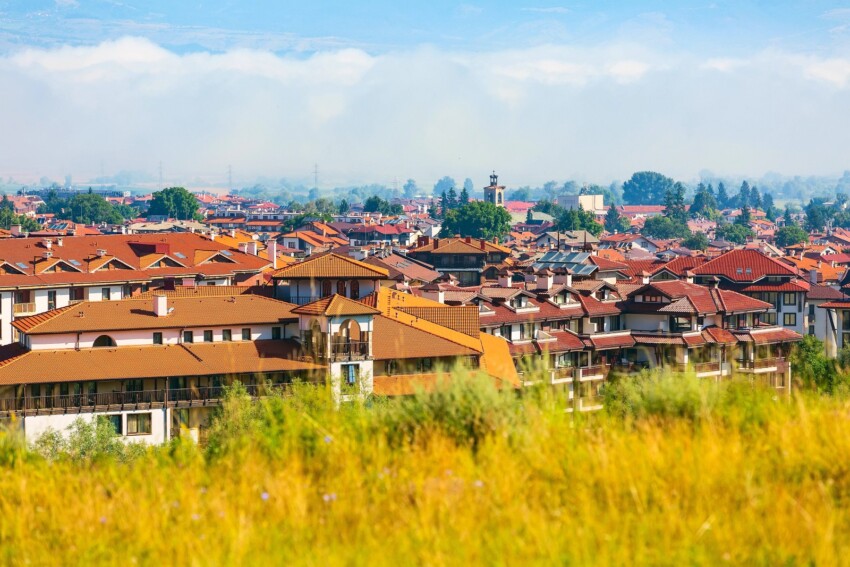
Bansko is one of the most fascinating and versatile destinations in Bulgaria: a city that serves as a leading international ski resort in winter and an ideal base for high-altitude trekking in summer, whilst preserving one of the best-kept 18th and 19th-century old towns in the entire country. Located 160 km south of Sofia, at the foot of the Pirin Mountains in the heart of Bulgaria’s geographical Macedonia, Bansko combines in an unusual way the modernity of major Alpine resorts with the authenticity of a stone-built village that has preserved its Bulgarian Renaissance architecture almost entirely intact.
Bansko’s old town has been designated a national architectural reserve and contains over 130 historic stone houses, featuring the characteristic tower-cellars that merchants built as secure refuges for their goods during frequent Ottoman raids. It is within this ancient urban setting that some of Bulgaria’s finest traditional restaurants are located — the mehane, characteristic taverns with stone walls, dark wooden ceilings and wood-burning stoves that remain lit throughout the winter season.
The Pirin National Park, which surrounds Bansko with 45 peaks over 2,500 metres, has been a UNESCO World Heritage Site since 1983 and offers Alpine scenery of rare integrity. The combination of the old town’s cultural richness, the Pirin’s natural beauty and modern ski infrastructure — featuring a cable car departing from the centre that reaches 1,600 metres in just a few minutes — makes Bansko a destination capable of satisfying travellers with widely different interests.
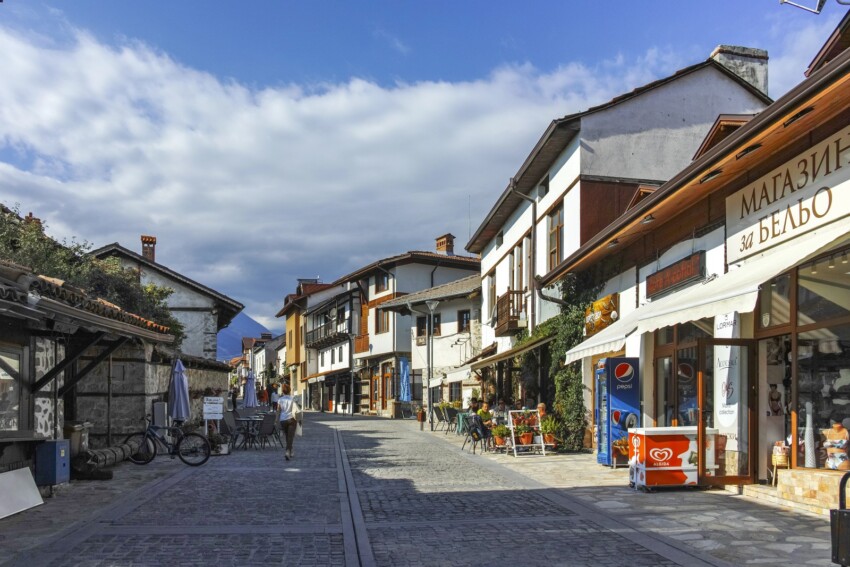
Bansko can be explored on two distinct levels: the old town, clustered around the central square and stone-paved narrow streets, and the modern ski resort, accessible by cable car just minutes from the historic centre. Between these two focal points lies an urban fabric that includes churches, museums, historic mehane and one of the Balkans’ most ecologically intact natural parks.
The beating heart of Bansko is Nikola Vaptsarov Square, named after the Bulgarian poet and revolutionary born in the city in 1909 and executed by the Nazis in 1942. The square is a broad cobbled space surrounded by low grey stone buildings with characteristic sloping roofs and covered arcades that shelter pedestrians from winter snowfall. At its centre stands a fountain and a monument to the poet, whilst the perimeter is lined with some of Bansko’s oldest mehane, frequented equally by locals and tourists.
From this square, the narrow streets of the historic centre branch out towards the city’s main cultural attractions: Pirin Street, the main pedestrian axis, is lined with local handicraft shops, boutiques selling regional specialities such as Rhodope honey, plum rakija and sheep’s cheese, and the stone facades of 18th-century noble houses. Walking through the historic centre early in the morning, before tourists from newer hotels flood into the square, allows you to experience the authentic atmosphere of a Bulgarian mountain village that survives with dignity the pressures of mass tourism.
Overlooking Nikola Vaptsarov Square, the Church of the Holy Trinity — Sveta Troitsa in Bulgarian — is Bansko’s most important religious monument, built in 1835 during the height of the Bulgarian Renaissance. Like many churches erected under Ottoman rule, it is deliberately low-key and unassuming from the outside, with perimeter walls that blend almost seamlessly with the walls of adjoining houses: an architectural choice forced by Ottoman restrictions that prohibited Christian churches from exceeding the height of surrounding buildings.
The interior is extraordinarily rich: the central nave is entirely frescoed with New Testament scenes, carved wooden pillars support an elevated gallery originally reserved for women, and the iconostasis is one of the finest pieces of 19th-century Bulgarian woodcarving. The church also preserves a small collection of 17th and 18th-century icons, some attributed to the Debar school, the same school that created the iconostasis for the Rila Monastery. Entry is free and the church is open daily; during weekend morning services you can experience the Bulgarian Orthodox liturgy in a setting of great authenticity.
Just a short walk from the church, down one of the old town’s narrow streets, stands the Neofit Rilski House-Museum, dedicated to the monk, linguist and educator born in Bansko in 1793 who is considered the founder of modern Bulgarian public education. Neofit Rilski opened the first secular Bulgarian school in the city in 1835 and compiled the first Bulgarian-Greek-German dictionary, a seminal work in the standardisation of modern written Bulgarian. His birthplace, carefully restored, preserves original furnishings from the period, manuscripts, textbooks and teaching materials used in the school.
The museum offers valuable insight into the daily life of Bansko’s merchant bourgeoisie in the 19th century: the carved coffered ceilings, walnut parquet floors, windows with greenish glass and Ottoman-Bulgarian style furniture recreate a domestic environment that visitors rarely encounter in such well-preserved contexts. Entry is modest and a visit takes approximately thirty minutes.
Housed in one of the finest stone houses in the historic centre, Bansko’s Local History Museum houses materials spanning three thousand years of human presence in the region, from prehistory to modern times. The collection includes Thracian artefacts from the Agrianes civilisation — the Thracian tribe that inhabited these mountains in antiquity and resisted even Alexander the Great — alongside Roman ceramics, medieval Bulgarian coins, weapons and traditional costumes from the Pirin region.
A section dedicated to the Bansko School of Painting deserves particular attention: between the 18th and 19th centuries the city produced a school of icon painting of considerable quality, with masters such as Toma Vishanov-Molera and his son Dimitar Molerov working for churches and monasteries throughout Bulgaria and neighbouring Balkan countries. Some of the icons displayed in the museum rank among the finest testimonies to this local painting tradition, which blends Orthodox iconographic elements with stylistic influences from Western European painting filtered through merchants trading with Venice and Vienna.
The Pirin National Park, a UNESCO World Heritage Site since 1983, is Bansko’s principal natural attraction and one of the Balkans’ most important protected areas. It spans 40,356 hectares and encompasses 45 peaks over 2,500 metres, 176 glacial lakes, waterfalls, karst caves and forests of exceptional ecological integrity. The park’s symbolic species is the Pinus peuce, the Macedonian pine, a Balkan endemic tree that can live over a thousand years and in the Pirin reaches specimens of exceptional size and age: some trees near the Vihren summit have been dated to over 1,300 years old.
The Vihrensko Lakes, accessible from Banderitsa in approximately three hours on a marked trail, are the park’s most popular trekking destination: a series of glacial lakes at altitudes between 2,000 and 2,400 metres, with waters ranging from turquoise to emerald green depending on depth and season. The ascent to the Vihren summit (2,914 m), technically undemanding in summer but requiring good fitness and proper equipment, is one of the most rewarding treks in the Balkans, with panoramic views that on clear days extend from Greece to North Macedonia and across to the Rhodope range.
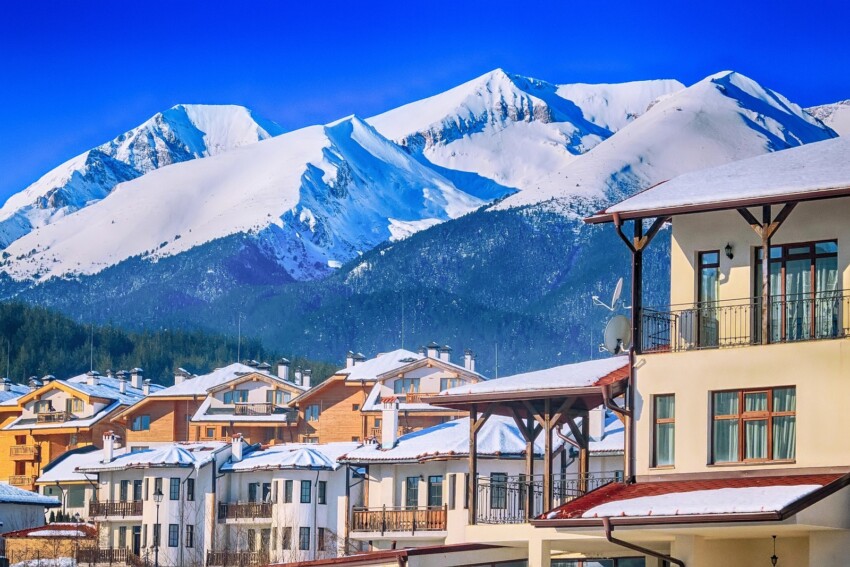
The Bansko ski resort is Bulgaria’s largest and most modern, with 75 km of slopes spanning an elevation range from 925 metres in the town centre to 2,560 metres at the Todorka summit. The cable car — locally called the Gondola — departs from a terminal located approximately one kilometre from the historic centre and reaches Banderitsa station at 1,600 metres in about eight minutes: from here, lift systems branch out towards the higher slopes and mountain restaurants.
In summer the cable car continues to operate as a privileged access point to the Pirin National Park: from Banderitsa station, marked trails lead to the Vihrensko glacial lakes, to the Vihren summit (2,914 m, Bulgaria’s second highest peak) and to the Bezbog plateau, with its Alpine pastures and pine forests — the Pinus peuce, a Balkan endemic species — among Europe’s oldest. Trail difficulty ranges from family-friendly walks to demanding treks requiring Alpine equipment.
Bansko is renowned throughout Bulgaria for the quality of its traditional cuisine, and the mehane — characteristic taverns with wooden furnishings, wood-burning stoves and live folk music — are the city’s principal gastronomic attraction. The signature dish is kapama, a stew of mixed meat (pork, poultry and game) slow-cooked in a sealed earthenware pot with fermented sauerkraut: a preparation requiring hours of cooking that is served only in Bansko’s historic mehane, where the recipe is passed down through generations. Authentic kapama cannot be tasted anywhere else.
Equally characteristic is Bansko’s banitsa, the filo pastry filled with sirene cheese and eggs that here reaches a particularly rich and crispy version, served hot as breakfast or a snack. The old town’s mehane also offer excellent local interpretations of classic Bulgarian dishes such as kebapche, kyufte and šopska salad, accompanied by locally produced plum or grape rakija. The gastronomic experience in Bansko’s mehane is significant enough to justify a visit to the city on its own, regardless of the season.
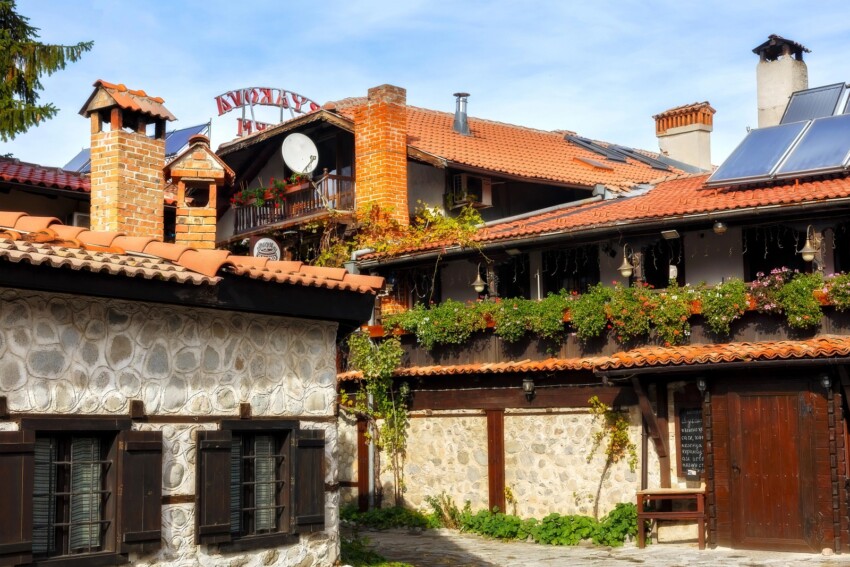
Bansko’s accommodation is distributed across two distinct clusters serving very different travel needs. The historic centre and its immediate surroundings host small boutique hotels, guesthouses and mehane with rooms, often housed within 18th and 19th-century historic buildings: authentic spaces with dark wooden furnishings, coffered ceilings and traditional stoves. Staying in this area means having the best restaurants, the Church of the Holy Trinity and museums within easy reach, with the main square accessible on foot in minutes. This is the ideal choice for those visiting Bansko in spring, summer or autumn with a primarily cultural and natural interest.
The cable car zone, developed over the past twenty years about one kilometre from the historic centre, is a completely different world: large international chain hotels, resorts with wellness centres, indoor pools and direct access to ski lifts. Prices are generally higher than the historic centre during peak winter season, but convenience for skiers is maximal. This is also where Bansko’s winter nightlife concentrates, with bars and clubs open until dawn along the avenue leading to the cable car terminal. Those prioritising modern comfort and skiing over the authenticity of the ancient village will find the most convenient accommodation here during the December to April months.
Bansko is located in south-western Bulgaria, in the upper Mesta River valley, 160 km from Sofia, 95 km from Blagoevgrad and approximately 220 km from Thessaloniki Airport in Greece. The town is accessible primarily by road, as it has no airport of its own. Its mountain location makes it particularly easy to reach from the Bulgarian capital, to which it is connected by good-quality roads and a scenic railway line.
Sofia Airport (SOF) is the main international gateway for reaching Bansko by air. It is about 160 km away and the transfer by car or private taxi takes roughly one hour and forty-five minutes on the A3 Struma motorway heading south, with the exit towards Razlog and then Bansko. Numerous private transfer companies offer fixed-price Sofia Airport–Bansko services, which are particularly good value for groups or families. There is no direct coach service between Sofia Airport and Bansko: those preferring public transport should first reach Sofia’s central bus station and catch a direct coach from there.
Thessaloniki International Airport — Macedonia International Airport, code SKG — is a viable alternative for those arriving from Western Europe with direct flights to Greece, given the excellent range of air connections between major European airports and Thessaloniki. It is approximately 220 km from Bansko via the Greek–Bulgarian border crossing at Kulata-Promachonas, reachable by car in around two and a half hours. There are no direct coach or train connections between Thessaloniki and Bansko.
The Sofia–Bansko railway line is among Bulgaria’s most scenic routes, passing through impressive mountain landscapes with viaducts, tunnels and hairpin bends that make the journey an experience in itself as well as a means of transport. Trains depart from Sofia’s central station and reach Bansko in approximately three and a half hours, changing at Septemvri, where you board the distinctive narrow-gauge railway on the Septemvri-Dobrinishte line, which winds through the Mesta valley with stops at small villages in the Pirin mountains. The train is slow — averaging around 30 km/h — but the route through the Struma gorges and then along the Mesta valley floor is one of the finest in the entire Bulgarian railway network.
What's the weather at Bansko? Below are the temperatures and the weather forecast at Bansko for the next few days.
Bansko is located in southwestern Bulgaria, in Blagoevgrad Province, at the foot of the Pirin Mountains at an altitude of 925 metres. It is 160 km from Sofia, 95 km from Blagoevgrad, 60 km from Melnik and approximately 220 km from Thessaloniki Airport in Greece. The border with North Macedonia can be reached in under two hours by car through the mountain passes of the western Pirin.
 Hotel
Hotel  Budget accommodations
  Apartments
  Family Hotel
  Luxury Hotel