Sofia
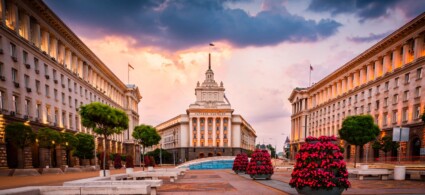
Sofia is Bulgaria's most affordable capital in Europe, boasting three thousand years of history spanning Roman ruins, the Alexander Nevsky Cathedral and the world's oldest Thracian gold.
Bulgaria is one of Europe’s richest and least explored destinations, capable of surprising those who expect merely a stopover and instead find themselves face to face with millennia of layered history, mountainous landscapes of rare beauty, and cities that hold traces of Thracians, Romans, Byzantines and Ottomans. Situated in the heart of the Balkans, it borders Romania to the north along the Danube, faces the Black Sea to the east, and touches Greece and Turkey to the south: a geographical position that made it a crossroads of civilisations for centuries.
Visitors to Bulgaria find a variety of experiences difficult to match in such a small area: the vibrant metropolitan life of Sofia, the labyrinthine alleys of Plovdiv, the medieval fortresses of Veliko Tarnovo, Orthodox monasteries clinging to mountains and the golden beaches of the Black Sea. Nature, in turn, offers the Pirin National Park, the Arda Gorge and the celebrated Valley of Roses, where every May the raw materials for the world’s finest perfumes are harvested.
Bulgarian cultural heritage includes seven UNESCO sites, among them the rock paintings of the Church of Boyana, the Thracian tombs of Kazanlak and the historic centre of Nessebar. The cuisine, little known abroad, is genuine and hearty: banitsa, kavarma, shopska salad and sirene cheese accompany every meal with simplicity and substance. Prices remain among the lowest in the European Union, making this country a particularly cost-effective choice even for extended travels.
In this guide you will find the ten must-see attractions and destinations in Bulgaria, with practical information and advice for organising your itinerary at its best, from the capital to the remotest destinations.
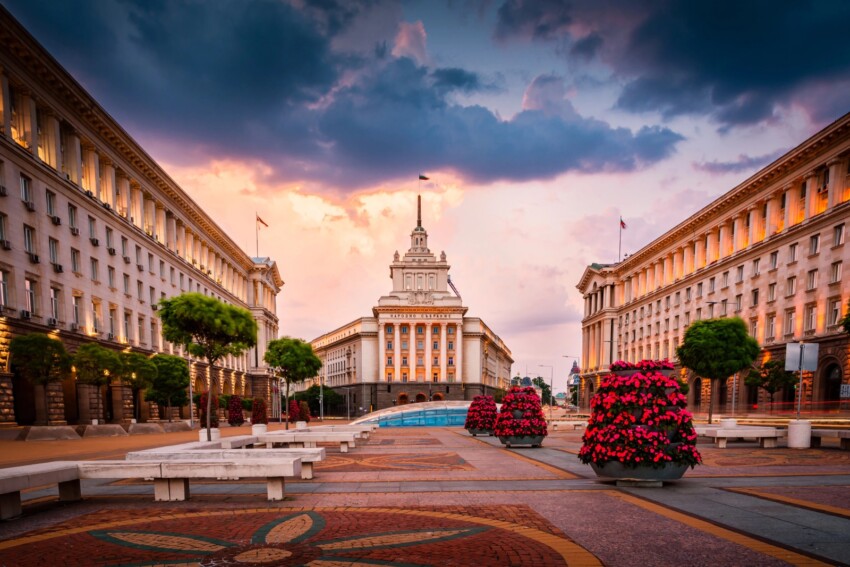
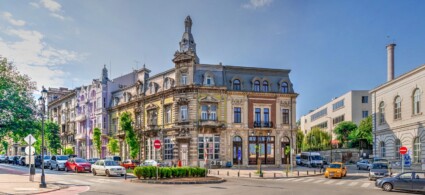
Sofia is the most affordable capital in the European Union and one of Europe’s oldest cities, continuously inhabited for over 7,000 years. The historic centre gathers an extraordinary concentration of architectural layers in just a few blocks: the Alexander Nevsky Cathedral, completed in 1912 with its golden dome visible from almost anywhere in the city, dominates the main square alongside the small Church of Saint Sofia, dating from the 6th century and giving its name to the entire capital. Just a short walk away are the remains of the Roman walls of Serdica, visible beneath modern pavements and inside the Serdika metro station.
The National Museum of History houses the world’s most important collection of Thracian gold, with pieces dating from the 4th–3rd century BC that are an absolute must-see. Walking through the Vitosha Boulevard district, the pedestrian shopping avenue, you always have Mount Vitosha in the background, a massif reaching 2,290 metres that offers summer hikes and winter skiing just 30 minutes by bus from the centre. Sofia deserves at least two full days of exploration.
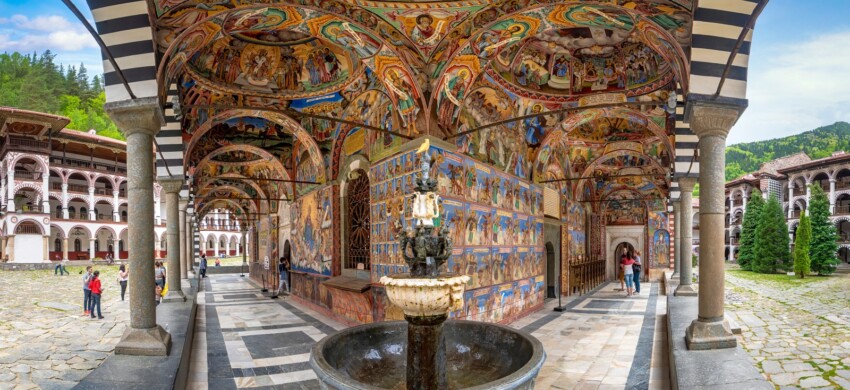
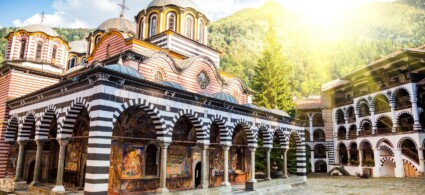
The Rila Monastery is the spiritual and cultural symbol of Bulgaria, founded in the 10th century by monk Ivan Rilski and rebuilt in its present form between 1834 and 1862 following a devastating fire. A UNESCO World Heritage site since 1983, it stands 117 km from Sofia, nestled within the coniferous forests of the Rila Mountains at 1,147 metres altitude. The facade of the main portico, with its striped black and white arches and frescoes covering over 1,200 square metres of surface, ranks among the most significant pictorial works of the Bulgarian Renaissance.
Within the complex are Hrelyo’s Tower, the sole structure surviving from the medieval period, and the principal church dedicated to the Nativity of the Virgin, with a wooden iconostasis hand-carved by artisans from Debar. The monastery still hosts an active monastic community and welcomes visitors every day of the year. For the most authentic atmosphere, arrive early in the morning, before tour coaches from Sofia unload organised groups.
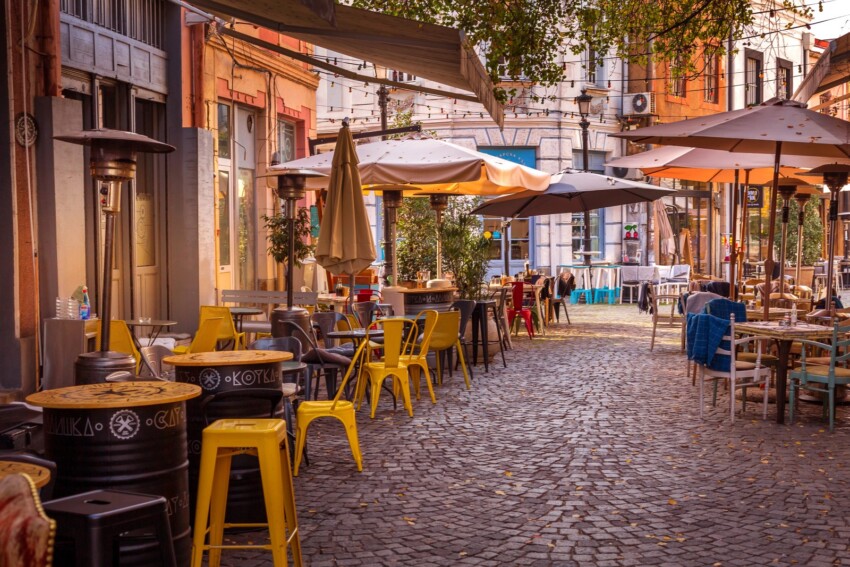
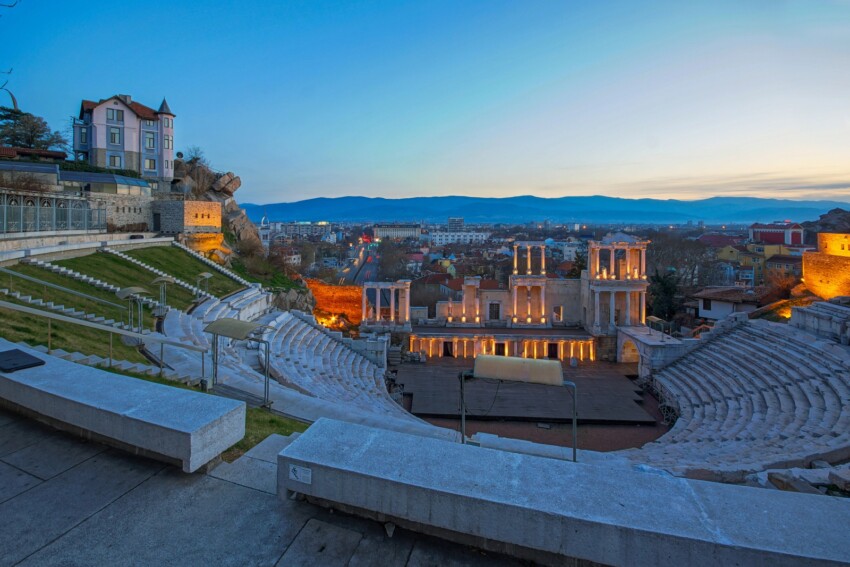
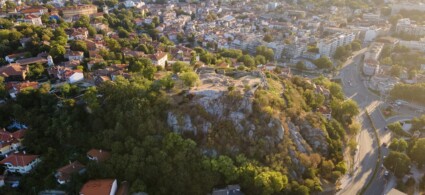
Plovdiv is Bulgaria’s second-largest city by size but arguably the first for charm. European Capital of Culture in 2019, it boasts a historic centre, the Kapana quarter and the old town perched on the Three Hills, telling two thousand years of history with rare continuity. The 2nd-century Roman theatre, uncovered during 1972 excavations and now perfectly restored, hosts summer concerts with a capacity of 7,000 seats: its acoustics and natural scenography make it one of Europe’s most evocative open-air venues.
The Historic Quarter of Plovdiv, dating from the Bulgarian Renaissance period (18th–19th centuries), is a labyrinth of coloured houses with characteristic overhanging stone and painted timber facades. Hindlyan House, Balabanov House and Kuyumdzhioglu House, now home to the Ethnography Museum, are open to the public and display original interiors with period furniture, ceramics and textiles. The Kapana quarter, the old craftsmen’s district, has transformed in recent years into a creative hub with art galleries, cafés and artisanal workshops deserving an evening visit.
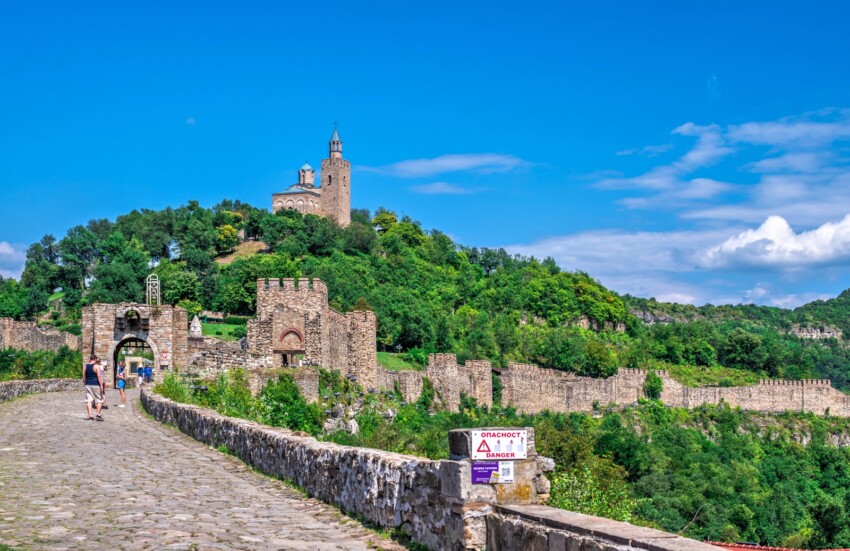
Veliko Tarnovo was capital of the Second Bulgarian Empire from 1185 to 1393 and still retains that aura of a medieval fortress city distinguishing it from all other Bulgarian destinations. The Tsarevets Fortress, perched on a promontory surrounded on three sides by the Yantra river, is Bulgaria’s most-visited monument after Rila Monastery. Its walls, towers and the Transfiguration Cathedral, restored in 1985 with highly controversial expressionist frescoes, offer an immediate vision of medieval Bulgarian power.
The city develops across three hills connected by picturesque bridges, and the view from the viewpoint on the Yantra’s left bank — where pastel-coloured houses cascade towards the river forming a natural amphitheatre — ranks among the country’s most photographed scenes. A few kilometres from the centre lies the Preobrazhenski Monastery, Bulgaria’s fourth in importance, with frescoes by master Zahari Zograf dating to 1851. Every Friday and Saturday evening in summer, Tsarevets Fortress hosts the Sound and Light show, a play of lights and music reconstructing the medieval capital’s history.
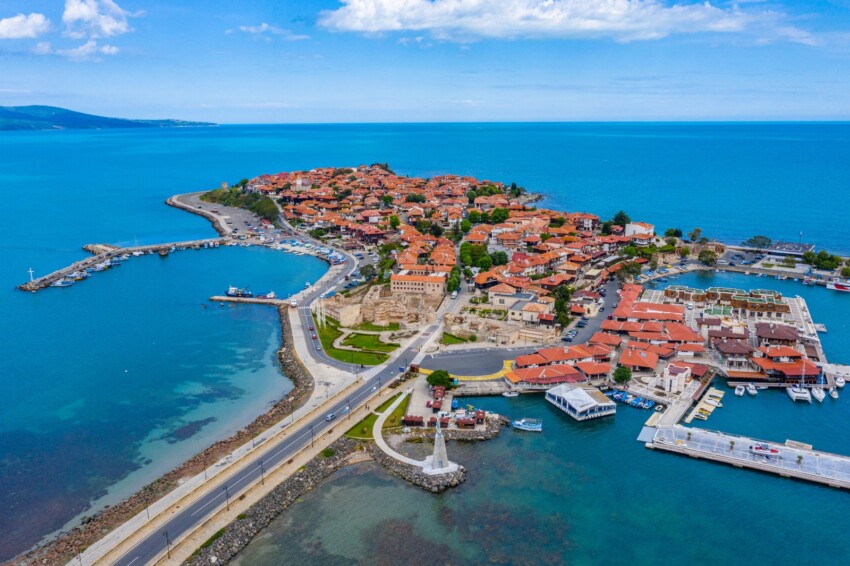
Nessebar is a peninsula of just 0.4 km² connected to the mainland by a thin artificial isthmus, yet encompasses over three thousand years of continuous history. Founded by Thracians as Menebria, it later became a Greek colony, Roman city and finally one of the most important centres of the Byzantine Empire in the Balkans. Its historic centre has been a UNESCO World Heritage site since 1983, and it’s easy to see why: along the cobbled streets are the ruins of over forty Byzantine churches, some dating to the 11th–14th centuries, with characteristic polychromatic stone and brick facades typical of the ecclesiastical architecture of the Pontus region.
The Church of Christ Pantokrator and the Basilica of Saint Sofia, now roofless and transformed into an open-air museum, are mandatory stops on any visit. Nessebar’s historic centre is best explored early morning or late afternoon, when tourists from nearby Sunny Beach and Sveti Vlas return to their hotels and the peninsula regains a more authentic atmosphere. Its location on the Black Sea makes it ideal as a base for combining cultural tourism with bathing at nearby beaches.
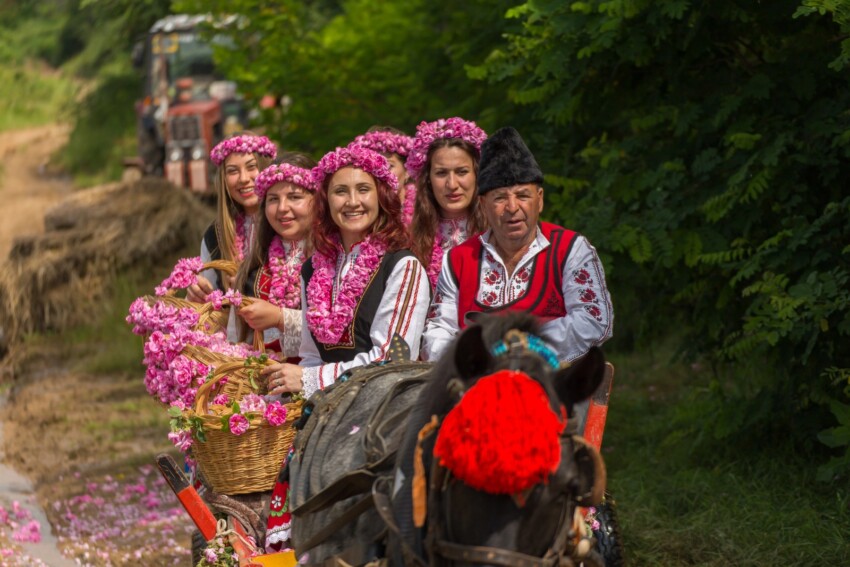
The Valley of Roses, stretching approximately 130 km between the Balkan and Sredna Gora mountains, produces over 60% of the world’s damask rose and nearly 80% of the rose oil used by the international cosmetics industry. The city of Kazanlak is the heart of this region and hosts the Perfume Museum and Rose Festival, which every year in late May and early June attracts tens of thousands of visitors for the traditional early morning petal harvest, which occurs at dawn to preserve their aroma.
In Kazanlak stands the Thracian Tomb of Kazanlak, one of Bulgaria’s UNESCO sites, dating to the 4th–3rd century BC and decorated with extraordinary-quality frescoes depicting a funerary banquet and battle scenes. Access to the original is limited to preserve the paintings, but a faithful replica is viewable just metres away. The best time to visit the valley is between late May and the first week of June, when fields of blooming roses create a chromatic landscape difficult to forget.

The Belogradchik Rocks, in northwestern Bulgaria, are among the Balkans’ most spectacular geological formations: red sandstone spires and pillars reaching up to 200 metres, shaped by erosion over 230 million years, extend for approximately 30 km in length and 3 km in width. The Romans first understood this natural labyrinth’s defensive potential and built a fortress among the rocks in the 2nd–3rd centuries AD, later enlarged by the Bulgarians in the Middle Ages and by the Turks during Ottoman occupation. The Belogradchik Fortress, integrated into the rocks themselves, is among Bulgaria’s best-preserved examples of medieval military architecture.
The rocks bear evocative names evoking local legends: the Virgin, the Little Bear, the Monk, the Knight. The Rock Natural Park is crossed by hiking trails of varying difficulty and can be explored independently or with local guides. Belogradchik lies approximately 200 km from Sofia: the distance is manageable with a hire car, and the road crossing the Balkan Mountains adds further scenery of great landscape value to your journey.
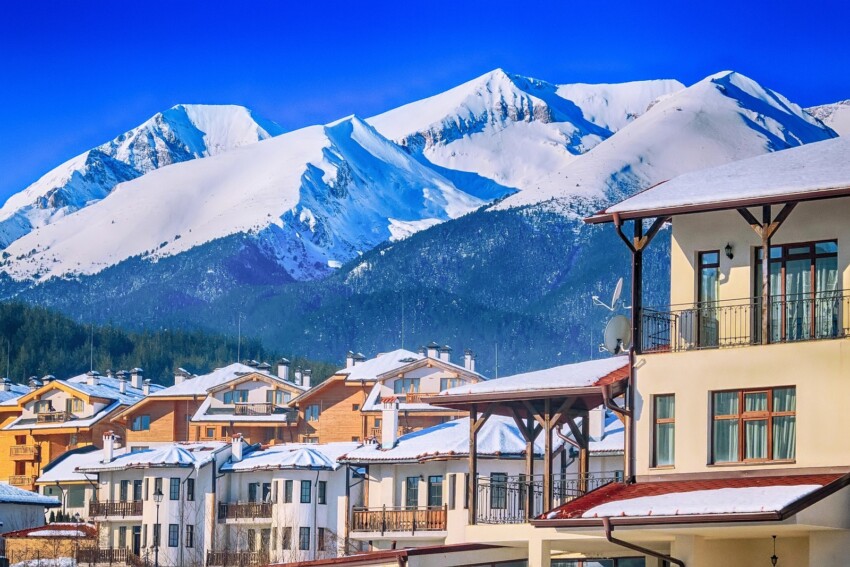
Bansko is Bulgaria’s primary ski resort, but reducing it to a winter destination would be a mistake. The old town, protected as a national architectural reserve, preserves over 130 houses from the Bulgarian Renaissance built in stone, featuring characteristic cellar-towers that served to defend possessions during frequent Ottoman raids. The Rilski Metoh Monastery, founded by the same Ivan Rilski of Rila Monastery, stands just minutes’ walk from the centre and houses a collection of 18th and 19th-century icons of rare value.
The Pirin National Park, a UNESCO World Heritage site since 1983, surrounds Bansko with 45 peaks above 2,500 metres, 176 glacial lakes and Bosnian pine forests among Europe’s oldest. In summer the park offers hikes on well-marked trails, with Vihren (2,914 m) as the principal destination. The cable car departing from Bansko’s centre reaches 1,600 metres in minutes and opens access to a plateau traversable even without advanced mountaineering equipment.

Sozopol is Bulgaria’s oldest coastal city, founded by Greeks from Miletus in 610 BC as Apollonia Pontica. The peninsula on which the historic centre stands preserves 19th-century wooden fishermen’s houses opening directly onto the sea, with an atmosphere entirely different from nearby, more commercial Nessebar. The city hosts the Apollonia Arts Festival each September, Bulgaria’s most important performing arts festival, bringing theatre, classical music and contemporary art to this medieval setting.
Sozopol’s beaches rank among Bulgaria’s finest on the Black Sea coast: the Central Beach and Artillery Beach are most frequented, while north of the peninsula are more secluded bays accessible on foot or by kayak. The Sozopol Archaeological Museum displays the most significant artefacts from underwater excavations in the gulf, including anchors, amphorae and wrecks of Greek and Roman merchant ships. Sozopol makes an excellent base for visiting the Strandzha Nature Park as well, extending towards the Turkish border with rare oak and hornbeam forests virtually unique in Europe.
“`html

Koprivshtitsa, situated 110 km from Sofia on the Sredna Gora plateau, is the best-preserved town of the Bulgarian National Revival and the birthplace of the uprising against Ottoman occupation on 20 April 1876 — the April Uprising — which led to Bulgaria’s liberation following the Russo-Turkish War of 1877–78. Almost every building in the historic centre is a museum or monument: six of the most important 19th-century mansions are open to the public with a combined ticket and display original interiors, intricately carved coffered ceilings and collections of period weapons and household objects.
The Oslekov House, with its striking three-coloured symmetrical façade and frescoes depicting Venice, Padova and other Mediterranean ports visited by the original owner during his travels as a textile merchant, is the most visited. The town has remained virtually unchanged thanks to its isolated mountain location and now holds the status of national architectural-historical reserve. A visit pairs well with nearby Etara village, an open-air museum of traditional Bulgarian crafts near Gabrovo.

The Trigrad Gorge, in the heart of the Rhodope Mountains roughly 160 km from Plovdiv, is one of Bulgaria’s least-known geological wonders. The Trigrad River flows for 8 km between towering white marble walls up to 300 metres high, carving out a canyon of almost ethereal beauty that you can traverse on foot along a dirt path beside the riverbed. Within the gorge lies the Devil’s Throat Cave — Dyavolsko Garlo in Bulgarian — a 2,000-metre karst cavern featuring an underground waterfall plummeting 42 metres into an interior lake: it ranks among the most spectacular natural attractions across the entire Balkan region.
The Devil’s Throat waterfall is the second-highest in Europe among publicly accessible cave systems. The Rhodopes are home to a Turkish-speaking Muslim minority, the Pomaks, who have developed a distinctive culture and culinary tradition visible in the markets and modest tavernas of villages along the gorge. A visit to the gorge combines naturally with nearby Shiroka Laka village, notable for its traditional Rhodope architecture and the country’s most celebrated folk music school.
In the following map you can see the location of the main places of interest mentioned in this article.
“`
 Hotel
Hotel 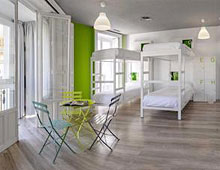 Budget accommodations
  Apartments
  Family Hotel
 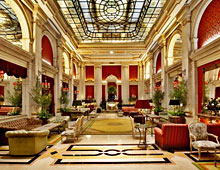 Luxury Hotel