Business Hotel Plovdiv
Plovdiv - 11, Naicho Tsanov St.
Book now
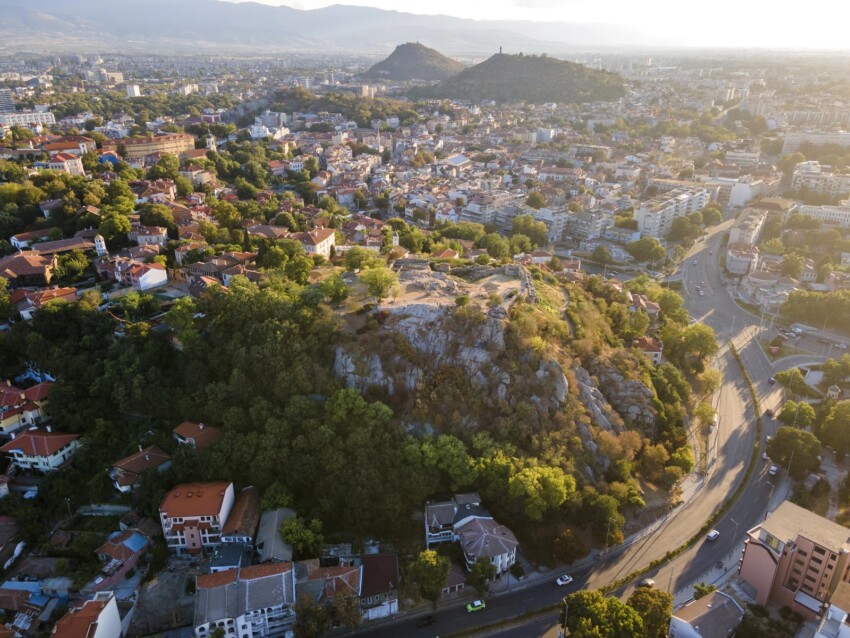
Plovdiv is Bulgaria’s second-largest city by size and population, yet for many travellers it ranks first in charm. European Capital of Culture in 2019, it carries over three thousand years of layered history across seven hills — the Tepe, as they’re known in Bulgarian — rising from the Thracian plains like islands of stone and brick amid the city’s modern streets. It ranks among Europe’s oldest continuously inhabited cities: first a Thracian settlement called Eumolpias, then a Hellenistic city renamed Philippopolis by Philip II of Macedon in 342 BC, then Trimontium under Roman rule, and subsequently an Ottoman Balkan capital for four centuries.
Plovdiv’s historic centre, perched across the Three Hills, is a national architectural reserve preserving some of the finest dwellings of the Bulgarian Renaissance from the 18th and 19th centuries: houses with projecting stone and painted wooden facades, elaborately coffered ceilings, inner courtyards with fountains and hidden gardens. Within walking distance, a 2nd-century Roman theatre hosts summer concerts with a 7,000-seat capacity, whilst the Kapana district — the old artisans’ quarter — has transformed in recent years into the liveliest creative hub across the southern Balkans.
Plovdiv is simultaneously a university city, the country’s gastronomic capital and an increasingly significant cultural destination. Its human scale — the centre is easily explored on foot — combined with an extraordinary variety of experiences make it one of eastern Europe’s most complete destinations, suited to all types of traveller and every season.
Plovdiv naturally unfolds on foot, following the historical thread connecting the Roman city to the Ottoman settlement, from the Bulgarian Renaissance to the contemporary creative quarter. Major attractions cluster within a two-kilometre radius of the centre, yet each warrants time and attention: you cannot rush through Plovdiv without missing the details that make it unique.
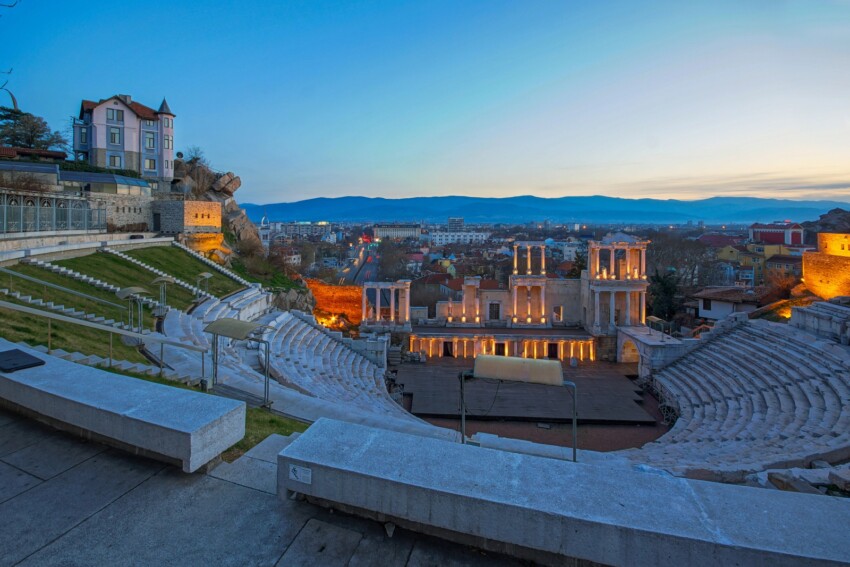
The Roman Theatre of Plovdiv ranks among eastern Europe’s best-preserved ancient amphitheatres and is undoubtedly the city’s most iconic monument. Built during Emperor Trajan’s reign, between the late 1st and early 2nd century AD, when Plovdiv was the Roman province of Thrace’s capital under the name Trimontium, the theatre was discovered almost by chance in 1972 during roadworks in the historic quarter. Buried for over fifteen centuries, excavation and restoration spanning more than a decade revealed a complex of extraordinary integrity: the semicircular cavea in white and grey marble accommodates up to 7,000 spectators, the two-storey stage features Corinthian columns and decorative friezes still in place, and the panorama across Plovdiv’s hills and the Thracian plain southwards is unforgettable.
The theatre remains fully functional as a performance venue: each summer it hosts Plovdiv’s Opera Open Festival, featuring opera and symphonic concerts under the stars, alongside numerous rock and pop concerts by international acts who choose this ancient setting as their backdrop. Attending a performance at the Roman Theatre on a summer evening is among Plovdiv’s most memorable experiences. Daytime entry to the site is paid; the best photographic vantage point is from the cavea’s upper balustrade, with the stage in the foreground and the old town’s rooftops beyond.
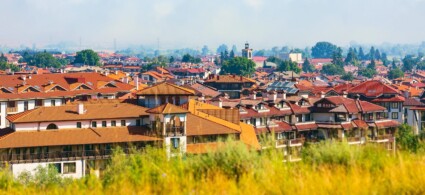
Stariat Grad — literally “old town” in Bulgarian — is Plovdiv’s historic quarter perched across the Three central Hills, declared a national architectural-historical reserve in 1956. It represents one of the Balkans’ best-preserved 18th and 19th-century urban complexes: over two hundred Bulgarian Renaissance buildings constructed by wealthy merchants trading with Vienna, Venice and Istanbul form a labyrinth of cobbled lanes, courtyards with pergolas and wells, facades painted in blue, yellow, green and ochre that shimmer in afternoon light.
Old town houses are recognised by their distinctive overhanging facades: upper storeys project progressively over the street, so in some lanes houses across upper levels nearly touch. This Bulgarian Renaissance architectural scheme maximised interior space without increasing ground footprint, respecting Ottoman building restrictions. Some finest dwellings — the Hindlyan, Balabanov and Georgiadi houses — are open to the public as furniture museums or art galleries, allowing access to extraordinary interiors with coffered ceilings and salons decorated with images of European cities visited by their owners during commercial travels.
Among the old town’s historic houses, the Hindlyan House is considered Plovdiv’s finest and best-preserved. Built in 1835 by Simon Agop Hindlyan, a wealthy Armenian leather merchant trading across half of Europe, it stands as an extraordinary example of what a 19th-century Bulgarian entrepreneur could afford to build from international commerce proceeds. The exterior facade is relatively modest, as was typical of Bulgarian Renaissance houses to avoid Ottoman officials’ attention, but the interior is breathtakingly opulent.
Every room features frescoes depicting European cities Hindlyan visited on business travels: Venice, Istanbul, Alexandria, Trieste’s port. The main salon boasts a coffered and gilded wooden ceiling with rosettes at the centre from which oil lamps hung, whilst coloured-glass windows cast multicoloured light patches across white marble floors during midday hours. The ground-floor fountain feeding the underfloor heating system — surprisingly advanced technology for its era — completes the picture of a home that was ahead of its time.
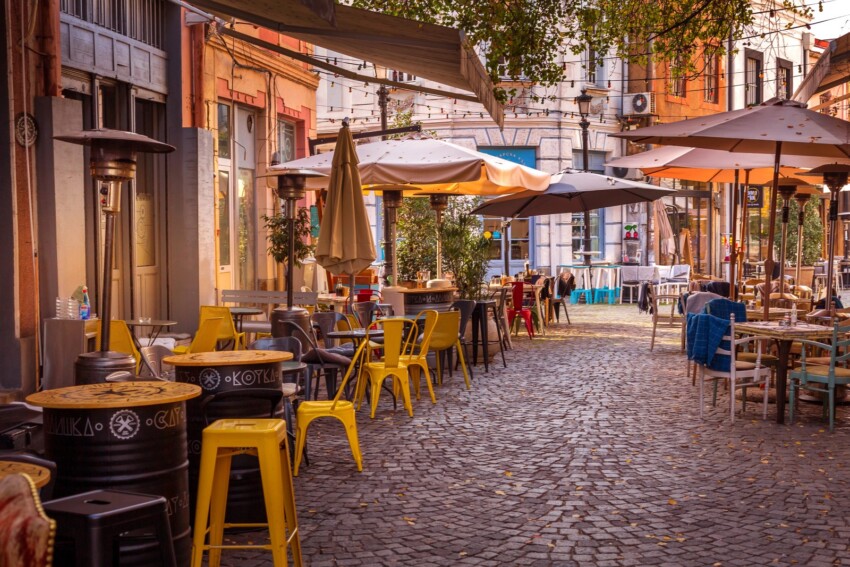
Kapana literally means “trap” in Bulgarian, referencing the intricate lanes that once made finding an exit difficult. Once an artisans’ district — blacksmiths, cobblers, tanners, carpenters — Kapana fell into decline during the second half of the 20th century, emptying of craft workshops and filling with abandoned warehouses. Transformation began around 2015, when young creatives and entrepreneurs began occupying vacant spaces, accelerating after Plovdiv’s 2019 European Capital of Culture designation.
Today Kapana ranks among the Balkans’ most vibrant quarters: contemporary art galleries, designer studios, new-generation craft workshops, stylish cafés, fusion-cuisine restaurants and late-night bars. Building facades are covered in murals by local and international artists, stone lanes host weekly markets and street performances, and the district’s energy is that of somewhere growing without losing authenticity. Saturday mornings offer the best visit: vintage and record markets coincide with café tables and shops opening for the week’s first time.
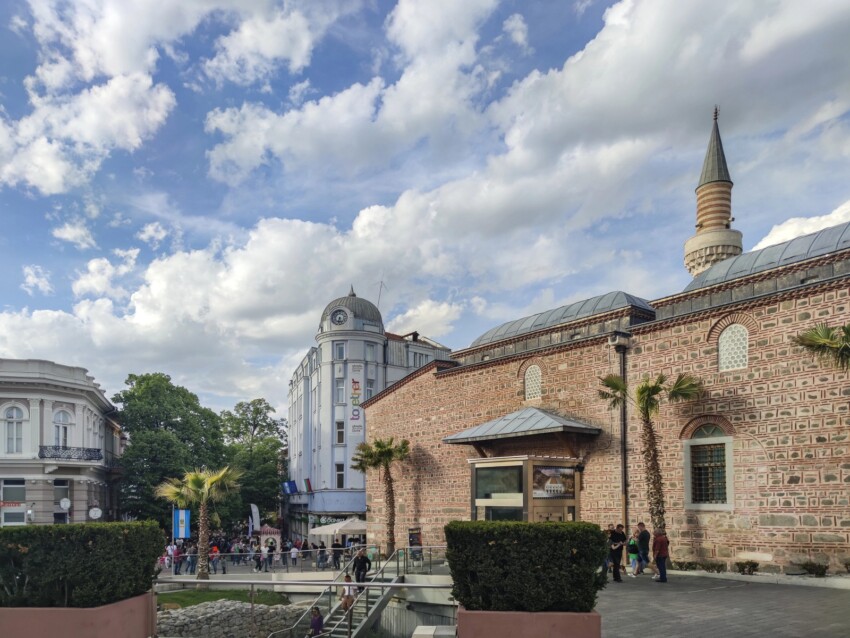
At the boundary between the 19th-century historic centre and the city’s modern commercial heart stands the Dzhumaya Mosque, among the Balkans’ best-preserved Ottoman mosques. Built in the early 15th century, shortly after Plovdiv’s Ottoman conquest in 1364, it features a grand portico of nine lead cupolas and a slender minaret rising above surrounding buildings. The mosque remains an active place of worship for Plovdiv’s Muslim community — approximately 10% of the city’s population — and welcomes non-Muslim visitors outside prayer hours.
Directly facing the Dzhumaya Mosque, below Central Square’s street level, lie visible remains of the Roman Stadium, a large 2nd-century AD sports facility accommodating 30,000 spectators that hosted the Pythian Games, antiquity’s second-most important athletic event after the Olympics. The stadium is partially accessible through an underground passage beneath the square, with its northern curve’s tip emerging above ground, strikingly illustrating the overlap between ancient and modern city.
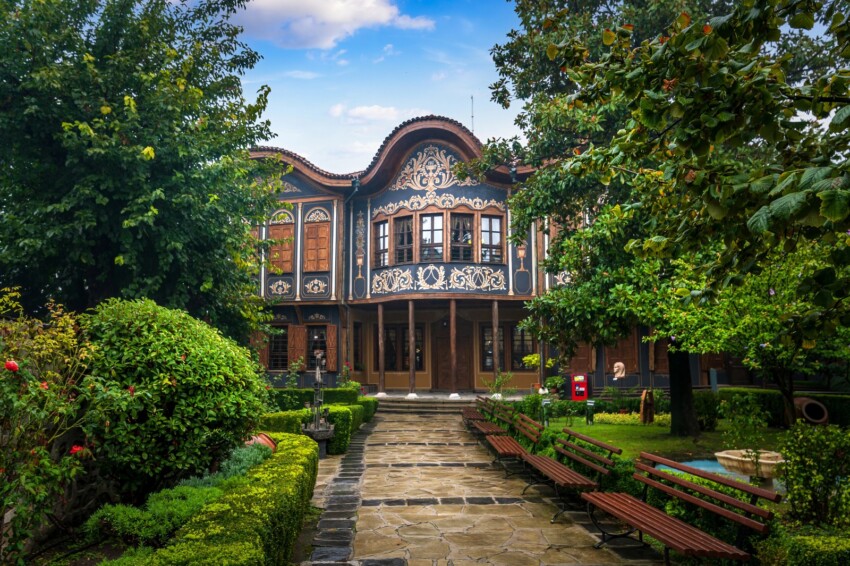
The Ethnographic Museum of Plovdiv, housed in the magnificent Kuyumdzhioglu House built in 1847, ranks among the city’s most-visited museums and among Bulgaria’s finest for collection quality and architectural setting. The house itself — with its symmetrical blue-painted facade, monumental portal and three superimposed loggias — is already a work of art, but the interior proves even more extraordinary: exhibition spaces preserve original mid-19th-century furnishings and hold extensive collections of traditional costumes, jewellery, musical instruments, ceramics and everyday objects from the Thracian region.
Steps away stands the Regional Archaeological Museum, housing one of Bulgaria’s richest Thracian gold collections after Sofia’s. The celebrated piece is the Panagyurishte Treasure — or rather, a faithful reproduction, the original being in Sofia’s National Museum — solid gold rhyta from the 4th-3rd century BC decorated with extraordinarily refined mythological scenes. The museum also displays Greek ceramics, Roman coins and medieval Bulgarian artefacts spanning three millennia of the region’s history.
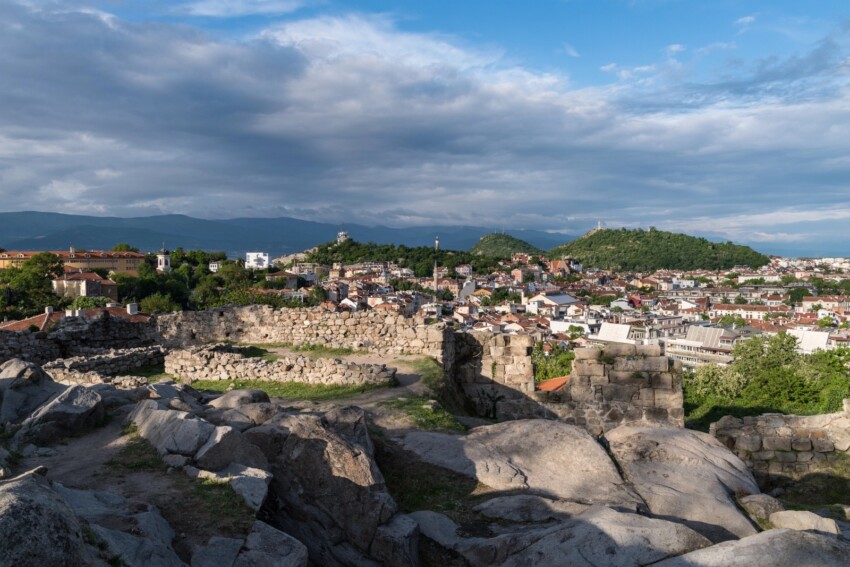
The old town’s highest hill, Nebet Tepe, has been continuously inhabited for over six millennia and is where Plovdiv’s deepest roots lie. Significant stretches of 4th-3rd century BC Thracian walls remain visible at the site of the original Eumolpias settlement, built with impressively sized grey granite blocks, alongside remnants of 3rd-century AD Roman walls that followed and expanded their line. Atop the hill at 250 metres elevation, a panoramic terrace offers 360-degree views across the city, the Thracian plain and, on clear days, the Rhodope range to the south.
Nebet Tepe proves particularly evocative at sunset, when slanting light highlights the grey stone blocks of ancient walls and old town facades glow with warm tones. From the hill departs the panoramic walk connecting the three main old town hills — Nebet, Taksim and Djambaz Tepe — along a paved pedestrian path offering different city views at every point.
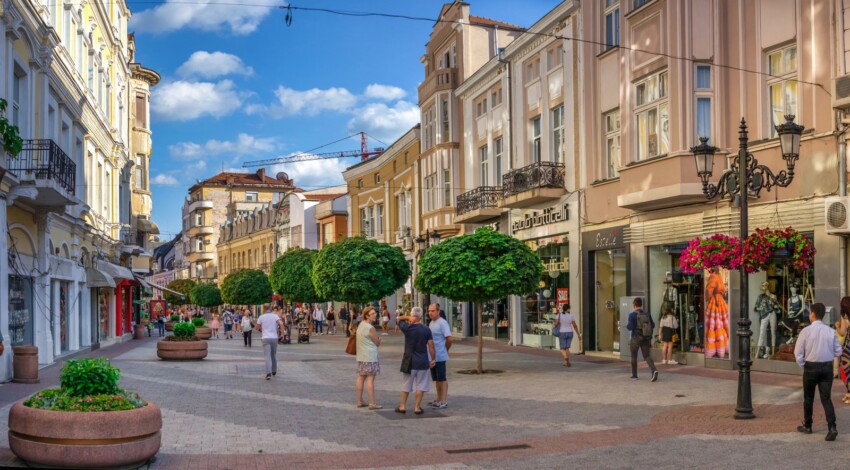
Alexander I Street, known to locals simply as “the Glavnata” — “the main” — is Plovdiv’s shopping and civic life axis: a roughly twenty-metre-wide paved pedestrian street running about a kilometre through the modern centre, flanked by shops, outdoor café tables, bookshops, jewellers and patisseries. It’s where Plovdivians spend their afternoons regardless of season, and Bulgaria’s liveliest promenade after Sofia’s Vitosha Boulevard.
Along the Glavnata sit some of Plovdiv’s historic patisseries, where you can sample baklava and dried-fruit Ottoman sweets that remain a constant in local cuisine alongside modern Bulgarian desserts. Halfway along opens Central Square, with the Dzhumaya Mosque and underground Roman stadium, serving as a natural junction between the commercial promenade and the old town historic quarter. The street particularly animates on weekend evenings, becoming a long outdoor aperitif crowded with university students.
The Old Town is the most sought-after and most expensive area for visitors interested in Plovdiv’s cultural heritage: small boutique hotels nestled within Bulgarian Renaissance houses offer a unique stay, with frescoed ceilings, ancient wooden floors and inner courtyards adorned with wisteria and pomegranate trees. The location is unbeatable — the Roman Theatre, museums and best restaurants are all within easy reach — but limited bed spaces mean booking well in advance is essential, especially during summer months and the Opera Festival.
The Kapana neighbourhood and streets immediately north of the Old Town host a growing selection of guesthouses and small independent hotels, often run by young entrepreneurs with an eye for design and authentic hospitality. Prices are slightly lower than the Old Town, nightlife is closer at hand, and the atmosphere reflects a neighbourhood buzzing with creative energy. It’s the ideal choice for younger travellers or those wanting to be at the heart of contemporary Plovdiv.
The modern city centre along Glavnata and parallel streets offers international hotel chains and larger establishments with all modern amenities and convenient proximity to the railway station and bus terminals. It’s the preferred zone for business travellers and those passing through for just one night. Prices are in line with Bulgarian averages and generally more affordable than Old Town boutique hotels.
Plovdiv sits in the heart of the Thracian Plain, at Bulgaria’s geographical centre, 150 km east of Sofia along the Thrace motorway (A1), the country’s main arterial route. It’s Bulgaria’s best-connected city after the capital: just over an hour’s drive from Sofia, it’s also a primary railway hub and home to a small international airport with seasonal flights. Its central position makes it an excellent base for exploring both the Rhodope Mountains to the south and the Thracian plains to the east.
Plovdiv International Airport (PDV) is just 12 km from the city centre, northeast along the road to Sofia. Though modest in size, it operates seasonal charter flights from various European cities — particularly in summer — and budget airline routes with Ryanair and Wizz Air on select European routes.
For those unable to find direct flights to Plovdiv, Sofia International Airport (SOF) — 150 km away — is the main alternative. It’s reachable from Plovdiv in approximately one hour twenty minutes via the Thrace A1 motorway heading west. Direct coaches between Sofia and Plovdiv depart from Sofia’s central bus station every thirty to forty minutes during peak hours and take about two hours; some services make intermediate stops, extending journey times to two and a half hours.
The Sofia–Plovdiv railway line is among Bulgaria’s busiest, with around twenty daily services in both directions and journey times between two and two and a half hours depending on train type. Direct InterCity trains are the fastest and most comfortable; regional services make more stops. Plovdiv railway station is about 1.5 km south of the centre, reachable on foot in twenty minutes or by short taxi ride. The same line continues east from Plovdiv to Stara Zagora, Karnobat and finally Burgas on the Black Sea, making a rail itinerary across Bulgaria from west to east possible in under five hours.
Plovdiv is one of Bulgaria’s best bases for exploring central and southern regions: the Rhodope Mountains to the south, the Valley of Roses to the northeast, Thracian archaeological sites inland and historic towns across the Maritsa plain are all within day-trip distance. A hire car is the most effective way to combine multiple destinations in a single journey, especially for mountain destinations where bus connections are limited or seasonal.
Just 30 km south of Plovdiv, nestled in the wooded gorges of the Asenitsa River in the Rhodope Mountains, Bachkovo Monastery is Bulgaria’s second most important after Rila and among the country’s most visited. Founded in 1083 by Georgian generals serving the Byzantine army, Grigori and Abasius Bakuriani, it preserves 17th and 18th-century frescoes of exceptional quality — including works by renowned painter Zahari Zograf — and a medieval ossuary with 12th-century murals among the Balkans’ best preserved. The main church, dedicated to the Virgin of Bachkovo, houses a miraculous icon of the Madonna revered by pilgrims throughout Orthodox Bulgaria.
20 km south of Plovdiv, the town of Asenovgrad serves as gateway to the northern Rhodopes and guards one of Bulgaria’s most strategically positioned medieval fortresses. Asenova Fortress, perched on a red-rock promontory plunging into the Asenitsa River gorge, was the 13th-century residence of Tsar Assen II and a strategic control point on the route linking Plovdiv to the Rhodope monasteries. Partially restored and open to visitors today, the Church of Saint John the Theologian inside retains well-preserved medieval frescoes, and views from the fortress across the gorge below and forested Rhodope hills are extraordinary.
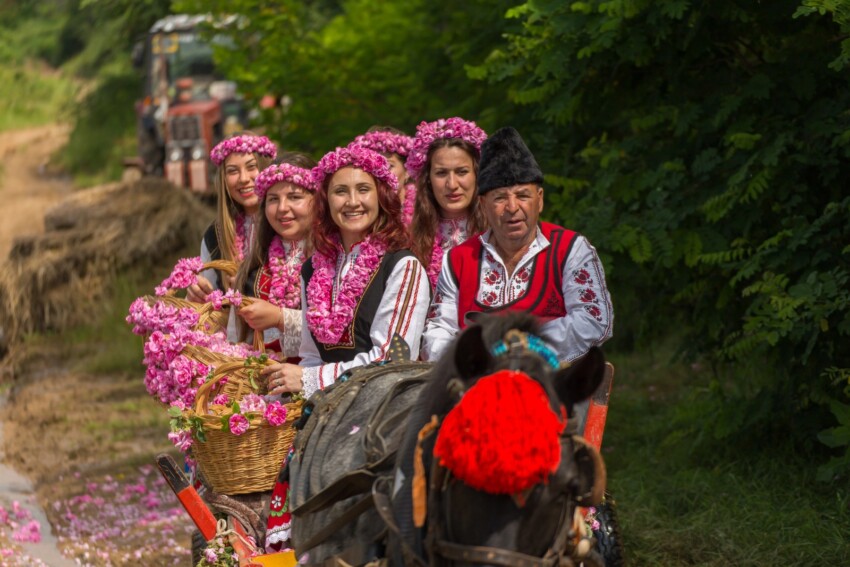
Approximately 100 km northeast of Plovdiv, the Valley of Roses near Kazanlak produces over 60 per cent of the world’s rose oil using the precious damask rose. The best time to visit is late May through the first week of June, when blooming fields and the Rose Festival create a unique sensory spectacle. Kazanlak is also home to the Kazanlak Thracian Tomb, a UNESCO World Heritage site with 4th–3rd-century BC frescoes considered among Thracian art’s most important works, and the Perfume Museum documenting the millennia-long history of rose cultivation in the region.
40 km north of Plovdiv, the small town of Hisar stands within an imposing 4th-century AD Roman fortification wall stretching over 2.3 km and reaching 7 metres high in places: among Bulgaria’s best-preserved Roman walls. The city was an important thermal centre in antiquity — its hot springs were frequented before the Romans arrived — and remains so today, with modern bathing facilities using the same mineral waters. Inside the walls lies an open-air park-museum with freely accessible remains of Roman temples, baths and necropolises.
What's the weather at Plovdiv? Below are the temperatures and the weather forecast at Plovdiv for the next few days.
Plovdiv lies in central-south Bulgaria, in the Thracian Plain, 150 km east of Sofia along the Thracian motorway, 100 km from the Valley of the Roses, 30 km from Bachkovo Monastery in the Rhodope Mountains and approximately 250 km from the Black Sea coast. It is the most important city in southern Bulgaria and a central communication hub between the capital and the eastern regions of the country.
 Hotel
Hotel  Budget accommodations
  Apartments
  Family Hotel
  Luxury Hotel