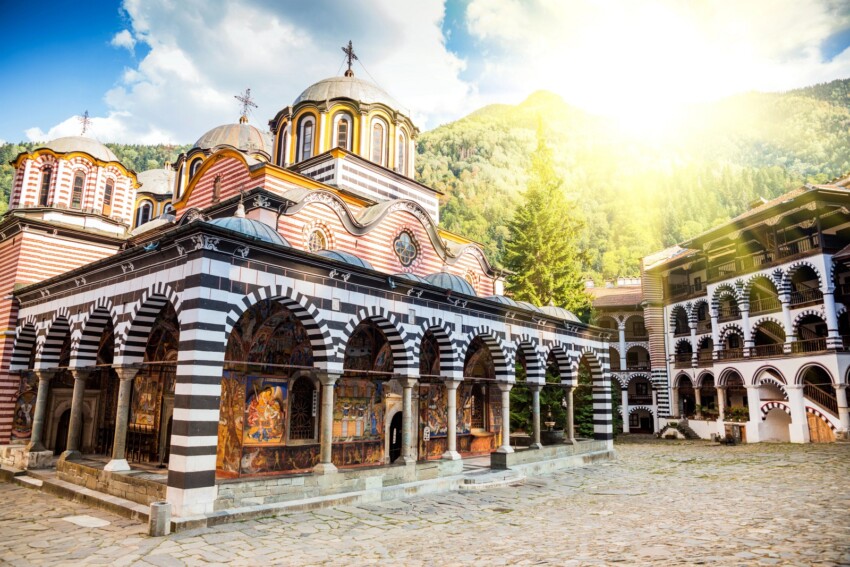
The current complex, rebuilt after the fire of 1833 and completed in 1862, is a masterpiece of the so-called Bulgarian Renaissance: a collection of architectural works, frescoes, carved iconostases and sacred furnishings that represent the pinnacle of 19th-century Bulgarian art. In this guide you will find everything you need to plan your visit: what to see, the monastery’s history, tickets, opening hours, photography tips and how to reach the site from Sofia and the main Bulgarian cities.
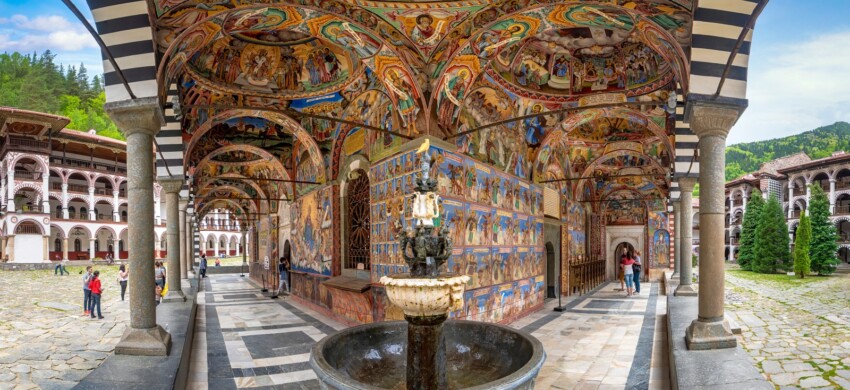
The monastic complex develops around a large irregular internal courtyard of approximately 8,800 square metres, surrounded by four-storey residential buildings that create a kind of fortress with a characteristic black and white striped facade. Every corner of the monastery holds something extraordinary: it is worth spending at least three or four hours here to see everything essential.
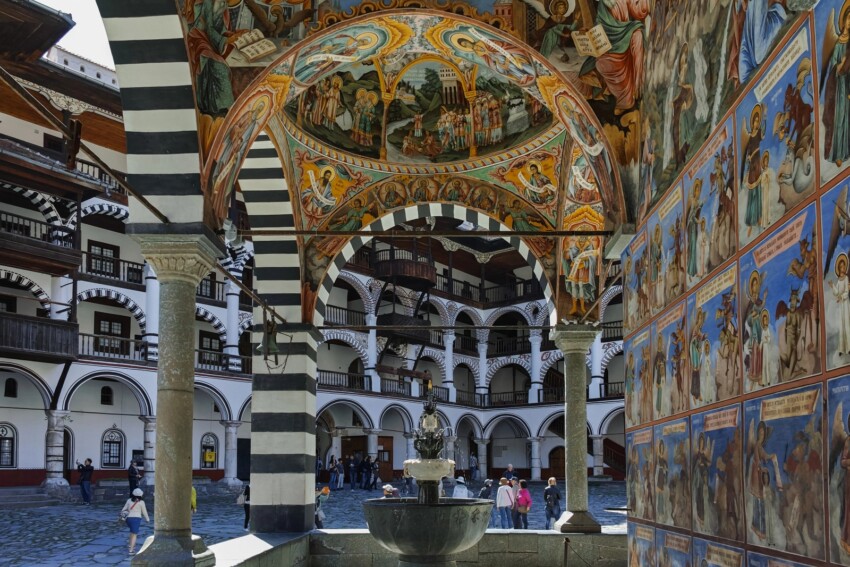
The visual impact of Rila Monastery begins before you even pass through the main entrance: the external portico, running around the entire perimeter of the ground floor, is entirely covered with frescoes extending over 1,200 square metres of surface. The scenes depicted range from the life of Ivan Rilski to apocalyptic themes of the Last Judgement, from miracles of Orthodox saints to allegories of vices and virtues. The style is that of the late Bulgarian Renaissance, with elongated figures, vivid colours and use of gold that catches the light differently at every hour of the day.
The best vantage point for photographing the ensemble of frescoes is the centre of the internal courtyard, early in the morning when the side light enhances colour details without direct sun reflections. From this position you can also appreciate the verticality of the entire complex: the four storeys of overlapping loggias, with turned wooden columns and barrel-vaulted painted arches, create a scenographic effect of great power.
At the centre of the courtyard stands the monastery’s main church, dedicated to the Nativity of the Virgin and built between 1834 and 1837 to designs by master Pavel of Krimovo. The three main domes and two side bell towers are clad in dark lead, a detail that creates a striking colour contrast with the light facades of the surrounding residential buildings. The exterior of the church is decorated with three overlapping porticos of painted arches, among which stand out scenes of Bulgarian monastic life and portraits of donors who funded the post-fire reconstruction.
The interior is even more extraordinary: the coffered ceiling of the central nave is entirely frescoed with New Testament scenes, while the side walls host one of the most complete iconographies in the history of Bulgarian Orthodoxy. The wooden iconostasis, created between 1839 and 1842 by craftsmen from the Debar school, stands 10 metres high and 14 metres wide: every centimetre is hand-carved with vegetable motifs, fantastical animals and sacred figures, without a single piece repeating itself. It took four years of continuous work to complete it and today it is considered the absolute masterpiece of wooden carving from the Bulgarian Renaissance.
In the internal courtyard, beside the main church, stands the isolated Tower of Hrelyo, the only structure of the original medieval complex to survive the 1833 fire. Built in 1335 at the behest of the local feudal lord Hrelyo Dragovol — who later became a monk and took the name Hariton — the tower stands 23 metres high, built of exposed stone, with a square footprint and four storeys connected by internal wooden staircases. On the fifth floor is a small chapel dedicated to the Transfiguration of Christ, with 14th-century frescoes that are partially preserved: they are among the oldest paintings surviving within the complex.
The tower was originally equipped with a drawbridge and served as a last refuge in case of attack: a defensive function that speaks to how exposed the monastery was to raids during the centuries of Ottoman occupation. Today access to the tower is permitted only during certain hours of the day and with limited groups for conservation reasons: it is advisable to check availability at the monastery entrance.
In the eastern wing of the complex is the Rila Monastery Museum, which houses over 35,000 objects accumulated over a thousand years of monastic history. The collection ranges from 14th and 15th-century icons to illuminated manuscripts, from liturgical vessels in gold and silver to embroidered textiles, from medieval seals to historical photographs of the monastery before and after the 1833 fire. The most celebrated piece in the collection is the Cross of Rafael, carved between 1790 and 1802 by the monk Rafael of Bansko: a wooden crucifix made from walnut, 81 cm tall, decorated with 104 biblical scenes and over 650 tiny figures, some the size of a grain of rice. It is said that Rafael lost his eyesight because of the demanding detailed work.
The museum is housed in rooms that preserve original 19th-century furnishings, with wooden floors, coffered ceilings and windows with the characteristic greenish glass of the period. The visit takes approximately 45 minutes and the ticket is separate from the monastery complex entrance.
Rila Monastery is home to an active monastic community of around twenty monks, who live in cells distributed across the four storeys of residential buildings. Some of these areas are accessible to visitors: the corridors of the upper loggias offer privileged views of the internal courtyard and surrounding mountains, and allow you to observe the architectural structure of the complex in its three-dimensionality, impossible to grasp from the courtyard level alone.
The monastery also has a small refectory open to visitors, where you can see the long wooden tables and benches where the monks eat their meals in silence. During certain times of the year it is possible to purchase handicrafts made by the monastic community — honey, herbal liqueurs, hand-painted icons — directly in the internal courtyard.
Just outside the main entrance of the monastery, in the small external courtyard, are a series of fountains fed by spring water flowing from the Rila Mountains. The water is cool even in the height of summer and is considered sacred in the Orthodox tradition: pilgrims visiting the monastery wash their faces and hands before entering, a purification ritual that has repeated unchanged for centuries. The external courtyard also hosts a number of funerary plaques of medieval monks and donors, with inscriptions in ancient Cyrillic script.
The stream flowing a few metres from the monastery walls is a natural stopping point during the warm season: the water is icy cold all year round, the surrounding vegetation is dense and the sound of running water contributes to the atmosphere of contemplation that characterises the place.
The founding of Rila Monastery is traditionally attributed to Ivan Rilski, a hermit monk born around 876 near Sofia who withdrew to the Rila mountains to lead a life of prayer and asceticism. Ivan lived for decades in a cave — still visitable today about 12 km from the current monastery — and around him gradually gathered a small community of disciples. Upon his death in 946, the small community consolidated into a stable settlement, considered the original nucleus of the monastery. Ivan Rilski was canonised almost immediately after his death and is today the patron saint of Bulgaria: his feast day, 19 October, is one of the most revered in the Bulgarian Orthodox calendar.
In subsequent centuries the monastery alternated between periods of prosperity and times of grave crisis. During the Second Bulgarian Empire (1185-1396) it enjoyed the protection of the sovereigns of Tarnovo and became one of the most important cultural centres in the Balkans, with an active scriptorium engaged in copying and illuminating manuscripts. With the Ottoman conquest in 1396 the monastery lost its imperial benefactors, but managed to survive thanks to donations from merchants and local nobility and support from the Christian principalities of Wallachia and Moldavia beyond the Danube. Sultan Murad II granted the monastery a charter of protection in 1466, guaranteeing it partial autonomy that allowed monastic life to continue even during the harshest centuries of Ottoman occupation.
The 1833 fire devastated much of the medieval complex, destroying buildings, furnishings and part of the library. The reconstruction, initiated almost immediately thanks to donations collected throughout the Orthodox world, was completed in 1862 and produced the complex we see today: technically younger than many European churches, but realised with exceptional artistic and craft quality, at a time when Bulgaria was experiencing its own cultural renaissance and preparing for liberation from the Ottoman Empire. The monastery was declared a national cultural monument by the Bulgarian government in 1976 and inscribed on the UNESCO World Heritage List in 1983.
A little-known anecdote concerns the history of Ivan Rilski’s remains: the saint’s relics were taken to Tarnovo in 1194 by Tsar Kaloyan, then to Esztergom in Hungary in 1195 as a diplomatic gift, and finally returned to Bulgaria in 1469, after more than two centuries of absence. Their return to the monastery was celebrated as an event of national significance and further strengthened the bond between the sacred site and Bulgarian identity.
Entrance to the monastery courtyard and main church is free and open year-round. There is a charge for visiting the Monastery Museum and the Tower of Hrelyo. Organised groups with accredited guides receive a discount on the museum ticket.
The monastic complex is open to visitors every day of the year, with no seasonal closures, from 6:00 to 22:00 in summer (April-October) and from 6:00 to 20:00 in winter (November-March). The main church follows the same hours but may be temporarily closed during religious services, which are held every morning between 7:00 and 8:30 and every evening between 18:00 and 19:30. The Monastery Museum is open from 8:30 to 18:30 in summer and from 8:30 to 17:00 in winter.
For a complete visit — courtyard, church, museum and tower — you should allow at least three hours, or four if you want to spend time contemplating the frescoes and in the church. If you also want to take a walk in the surrounding forest or reach Ivan Rilski’s cave, you should add another half day.
The best time to visit the monastery is early morning on weekdays, when organised groups from Sofia have not yet arrived and the courtyard is mainly frequented by pilgrims. Weekends in June, July and August are the busiest: in high season tour coaches start arriving around 10:00 and the courtyard becomes very crowded between 11:00 and 14:00. Winter offers a completely different experience: the monastery surrounded by snow in the Rila Mountains is one of Bulgaria’s most evocative landscapes, with few tourists and an atmosphere of silence and contemplation that is hard to find at other times of year.
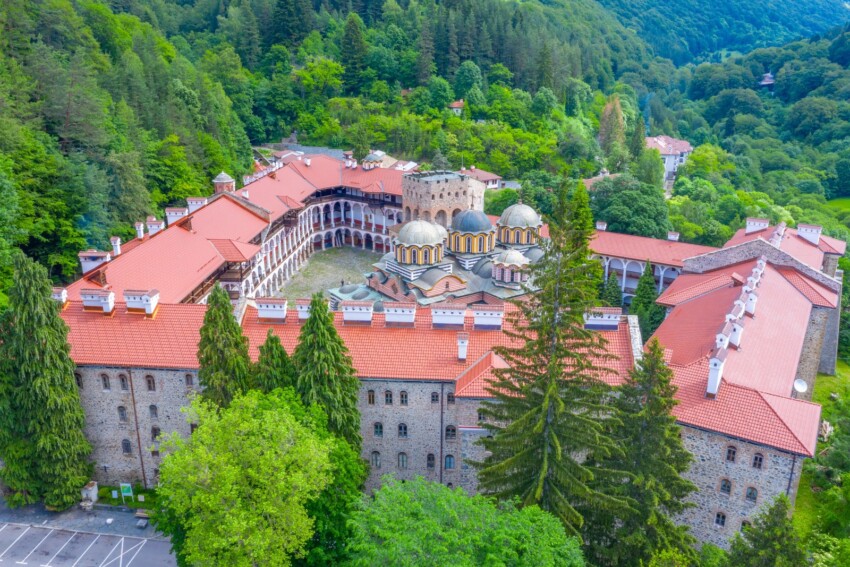
Rila Monastery is not an open-air museum but a living religious community, and this aspect is fundamental to understanding the place in its entirety. The resident monks — around twenty on average — follow the rule of Saint Basil the Great and structure their day around the rhythms of prayer, manual labour and study. They coexist with the daily flow of tourists and pilgrims while maintaining spaces reserved for monastic activities not accessible to the public.
The monastery has pilgrim cells available by reservation at nominal rates: these are simple but clean rooms, equipped with essential facilities, that allow you to experience the monastery in a more authentic way than a daytime visit. Staying overnight at the monastery means waking to the sound of bells at dawn, attending morning services in the near-empty church and enjoying the first hours of the day in the courtyard before the tourists arrive. Reservation should be made well in advance, especially during the summer season, directly through the monastery’s official website.
The main religious festivals celebrated at the monastery are Ivan Rilski’s Day (19 October), which attracts thousands of pilgrims from across Bulgaria, and the Transfiguration Festival (19 August), linked to the chapel of Hrelyo’s Tower. On these occasions services take place in the open courtyard, with participation of the Orthodox clergy from across the region and rituals that have remained unchanged for centuries.
Rila Monastery is located 117 km south of Sofia and cannot be reached directly by train. The most convenient option is to hire a car: from Sofia, take the Struma motorway (A3) heading south until the Kocherinovo exit, then follow the regional road that winds up the Rila river valley for approximately 20 km to the monastery. The journey takes around one hour and forty-five minutes under normal traffic conditions. The road is well-maintained and clearly signposted, though the final kilometres through the mountain valley are narrow with frequent hairpin bends: during winter, four-wheel drive may be necessary after heavy snowfall.
Those travelling by public transport from Sofia have two options. The first is to take a direct bus from Sofia to Rila (the town, not the monastery), departing from Sofia’s western bus station; from Rila, you can then catch a second local bus to the monastery, with two or three services daily. The second option is to reach Dupnitsa by bus or train from Sofia — trains depart from the central station roughly every two hours — and from there take the local shuttle to the monastery. Either way, the total journey takes between two and a half to three and a half hours, including waiting times between connections.
From Plovdiv, Bulgaria’s second city, the monastery is accessible by car in approximately one hour and forty minutes via the road that crosses the northern Rhodope Mountains. There are no direct bus connections between Plovdiv and the monastery. Numerous travel agencies in Sofia and Plovdiv offer organised day tours by coach, often combined with a visit to the town of Rila or Skaklya Waterfalls: a convenient option for those without a car who wish to avoid the downtime associated with public transport.
Entry to the main church requires appropriate dress as a place of worship: shoulders must be covered and visitors should wear trousers or skirts below the knee, regardless of nationality or religion. Free shawls and leg coverings are available at the entrance to the complex for those not dressed appropriately. Photography is permitted in the courtyard and outside the church, but is forbidden inside the main church and Hrelyo’s Tower chapel without explicit permission from the monks.
The complex has cafés and restaurants near the external car park, with a good selection of traditional Bulgarian cuisine. A small shop within the courtyard sells icons, religious books, honey and monastery liqueurs. There is no official left-luggage facility within the monastery: visitors arriving with large rucksacks or suitcases should leave them in their car or at external businesses. Car parking near the monastery is charged during peak season.
For visitors with mobility disabilities, the internal courtyard is accessible via the main entrance with a ramp, but the church has steps at its entrance and the interior is not completely level. Hrelyo’s Tower and the upper galleries of the residential buildings are not wheelchair accessible. The Monastery Museum is partially accessible on the ground floor.
 Hotel
Hotel  Budget accommodations
  Apartments
  Family Hotel
 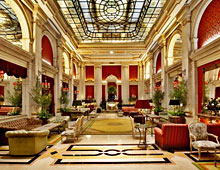 Luxury Hotel