ADEO HOTEL Sport & SPA
Ruse - 5 sq. "Han Kubrat" 5
Book now
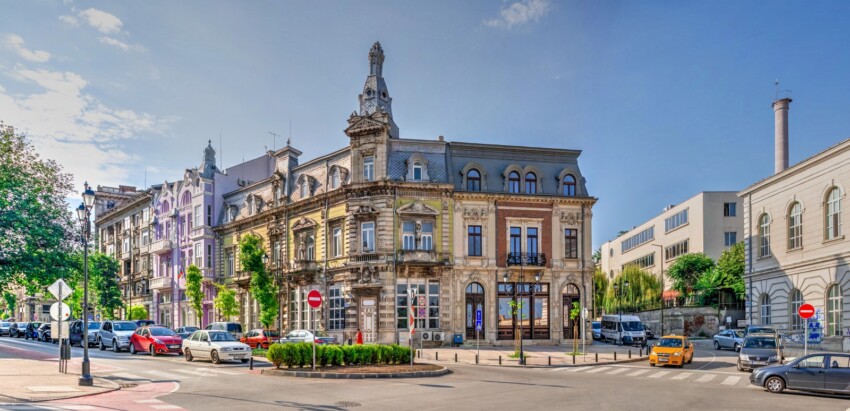
Ruse is Bulgaria’s fifth-largest city by population and the most significant on the Danube, the great river that marks the natural border between Bulgaria and Romania throughout its course. Nicknamed “Little Vienna” for the imposing neoclassical and Art Nouveau architecture of its historic centre, Ruse surprises visitors who expect a transit destination but instead find tree-lined boulevards, squares with fountains, opera houses and 19th-century palaces that would not have looked out of place in the Austro-Hungarian capital that inspired them. It was precisely the presence of European architects, merchants and diplomats — attracted by the lively port activity on the Danube in the second half of the 19th century — that gave Ruse its cosmopolitan character and urban imprint that still distinguishes it from all other Bulgarian cities today.
Founded by the Romans as a military fortress under the name of Sexaginta Prista — “port of sixty boats” — Ruse passed through Byzantine, Bulgarian and Ottoman rule before being reborn as a modern city in 1866, when Ottoman governor Mithat Pasha chose it as the seat of his ambitious modernisation programme: Bulgaria’s first railway was built here, its first modern hospital and the country’s first newspaper. With liberation from the Ottoman Empire in 1878, the city opened to European investment and experienced a period of prosperity that produced the current historic centre.
Ruse is also the gateway to the Rusenski Lom Nature Reserve, a system of karst gorges south of the city featuring medieval rock churches, remains of Thracian fortresses and extraordinary biodiversity. And for those arriving from Romania via the Friendship Bridge — the main Danube crossing between the two countries — Ruse is the first Bulgarian city, a business card that rarely disappoints expectations.
Ruse is comfortably explored on foot: the historic centre is compact, with main monuments concentrated in just a few blocks around the central square and along tree-lined avenues sloping towards the Danube. It’s worth dedicating at least two days to the city, including a half-day for the Rusenski Lom Reserve.
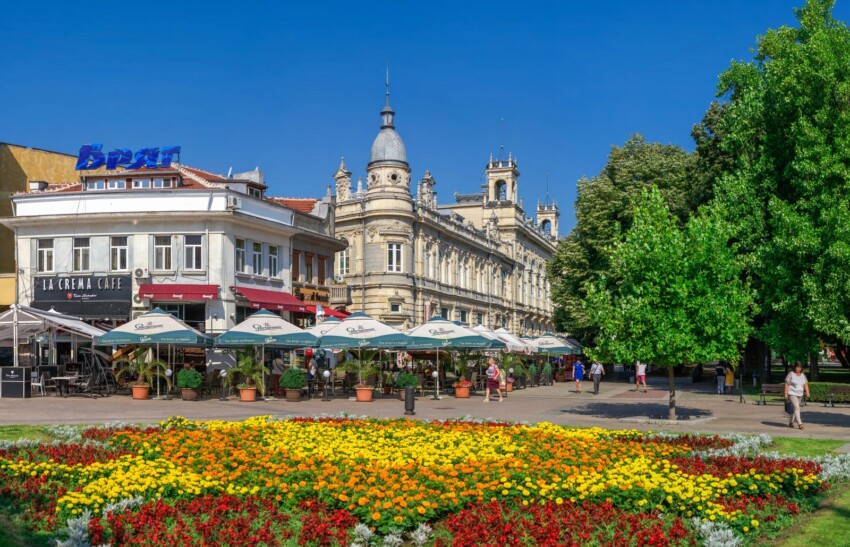
The heart of Ruse is Liberty Square — Ploshtad Svoboda in Bulgarian — a large elliptical urban space with the Monument of Liberty at its centre, a monumental fountain topped by an allegorical female figure holding the broken chains of Ottoman oppression. The square was built in 1885, just a few years after Bulgarian liberation, following Central European urban planning models, and is surrounded by some of the city’s most elegant buildings: the Town Hall, the State Theatre, the Prefectural headquarters and the facades of 19th-century palaces with their bay windows, cast-iron balconies and decorative cornices in eclectic style.
Liberty Square is Ruse’s finest salon in any season: in summer, café tables extend almost to the central fountain, and on weekend evenings families, students and tourists fill the elliptical perimeter with aimless strolls. In winter, when Christmas lights reflect off the white and pastel-yellow building facades, the square takes on the atmosphere of a European postcard from another era. The best vantage point for capturing the whole ensemble is from the north-east corner, with the Monument of Liberty in the foreground and the State Theatre in the background.
The Regional Museum of History of Ruse is housed in the former Palace of Justice, a neoclassical building from 1888 overlooking Aleksandrovska Avenue, the city’s main commercial axis. The collection spans over five thousand years of history of the Lower Danube region: from prehistory through Thracian and Roman civilisations, from the medieval Bulgarian Empire to the Ottoman period through to modern Bulgaria. The most significant pieces include a rich collection of Thracian ceramics from the 5th-4th century BC, Roman coins from the local mint at Nicopolis ad Istrum and rare medieval Bulgarian jewellery.
A section dedicated to Ruse’s modern history chronicles the city’s extraordinary 19th-century development: period photographs, maps, documents and personal objects of the protagonists of urban transformation reconstruct the story of a city that in fifty years transformed from an Ottoman village to a European commercial centre. Particularly interesting is the section on Danube vessels and river commerce that made Ruse one of Bulgaria’s wealthiest cities by the late 19th century.
The Ruse Pantheon, inaugurated in 1978 on the centenary of Bulgarian liberation, is the city’s most imposing monument: a circular building in white marble and grey granite, with a hemispheric dome rising 26 metres above ground level, inspired in form by great mausoleums of the classical tradition. It is dedicated to the memory of Ruse’s Bulgarians who sacrificed themselves for liberation from Ottoman rule, and its internal walls host mosaic portraits of over sixty figures of the Bulgarian National Revival born or who lived in the region.
The Pantheon sits in an elevated position above the centre, in a small wooded park offering good views over the old town’s rooftops. The interior, with light filtering through the dome’s oculus and reflecting off polished marble floors, has a solemn and intimate atmosphere. Nearby are some of the best-preserved Bulgarian Revival houses in Ruse, an interesting architectural contrast with the memorial’s austerity.
Aleksandrovska Avenue is Ruse’s main promenade: a pedestrian axis of about one kilometre traversing the historic centre from square to square, flanked by buildings in eclectic, neoclassical and Art Nouveau styles built between 1870 and 1930. Strolling along this avenue is like leafing through a manual of late 19th-century European architectural history: alternating facades with Ionic columns, Baroque cornices, Liberty floral friezes, bay windows with stained-glass windows and ornate cast-iron portals leading to the internal courtyards of buildings.
Many of these palaces once housed the headquarters of the major banks, shipping companies and European consulates that animated Ruse’s commercial life during the golden age of the Danube port. Today the same facades frame shops, cafés and offices, but external decorations have been largely restored as part of an urban revitalisation programme begun in the 2000s. Café Bulgaria, one of the city’s historic establishments opened in 1909, is located along the avenue and is the best place for a break with traditional Bulgarian pastries in the most authentic architectural setting.
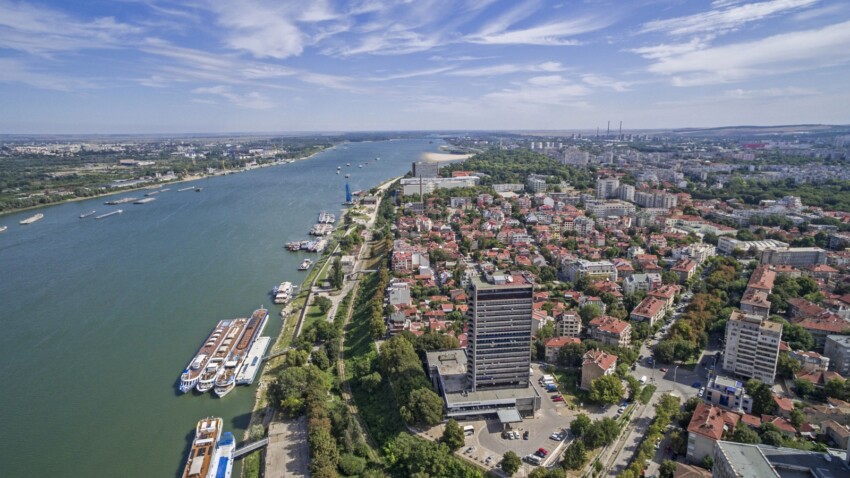
Ruse’s riverside — Pristanishten Boulevard — extends for over two kilometres along the Bulgarian bank of the Danube, with views of the great river and the Romanian shore at Giurgiu opposite. It’s where Ruse residents spend summer evenings: the tree-lined promenade is lined with open-air bars, river fish restaurants and play areas, whilst the mooring of boats for Danube cruises enlivens the port during the tourist season from April to October.
The Danube at Ruse reaches a width of approximately 1,200 metres and is constantly crossed by river barge traffic transporting goods between the Black Sea and Central Europe. From the riverside you can clearly see the Friendship Bridge — Priatelstvo Most — the great steel bridge built in 1954 connecting Ruse with Giurgiu in Romania: for decades it was the only bridge on the Bulgarian stretch of the Danube and remains one of the most important crossings between the two countries today. In the evening, with the bridge lights reflected on the river, the panorama from the riverside is particularly evocative.
About 20 km south of Ruse, within the Rusenski Lom Nature Reserve, the Rock Churches of Ivanovo are one of Bulgaria’s UNESCO sites and one of the Balkans’ most important medieval mural painting complexes. Carved into the yellow limestone cliffs of the Lom River gorges between the 12th and 14th centuries, during the Second Bulgarian Empire period, the churches preserve frescoes of exceptional artistic quality: the elongated figures, expressive drapery and colour palette of the artists from the Tarnovo scriptorium who decorated these rock cavities have been compared in quality to 13th-century Italian painting.
The complex comprises over forty rock-carved sites — churches, hermit cells, refectories and staircases — distributed across about eight kilometres of gorge. The churches open to the public are a nucleus of five or six sites, reached on foot from a car park near Ivanovo village via a trail through the nature reserve. The visit requires reasonable fitness — the trail is uneven and some rock staircases are steep — but the spectacular gorge landscape, with yellow limestone walls rising a hundred metres above the river, makes the walk an experience of great value regardless of the medieval sites.
The Sava Ognyanov State Theatre in Ruse is Bulgaria’s oldest continuously active theatre: founded in 1866 when the city was still under Ottoman rule, it has since established itself as one of the country’s liveliest cultural centres. The current building, constructed in 1902 in neobaroque style to a design by Viennese architect Anton Kolartz, features a facade with columns, triangular pediment and three entrance arches explicitly recalling the great theatres of the Austro-Hungarian Empire. The interior, with its horseshoe-shaped auditorium, tiered boxes and painted ceiling, is among Bulgaria’s finest.
The theatre offers a rich season of drama, opera, ballet and concerts from October to June, with a repertoire including European theatre classics and original Bulgarian productions. Opera performances are particularly appreciated: Ruse’s resident opera company has a long tradition of quality and ticket prices remain affordable by Western European standards. Checking the theatre’s seasonal programme online before your visit is always a good idea.
Ruse’s accommodation offer is concentrated mainly in the historic centre and streets immediately adjacent to Aleksandrovska Avenue: the location is ideal for exploring the city on foot, with Liberty Square, the State Theatre and the riverside all reachable in minutes. This area has both boutique hotels created in 19th-century palaces — with high ceilings, decorated ceilings and solid wood staircases — and mid-range hotels with all modern comforts. This is the best choice for those visiting the city with cultural and architectural interest.
The riverside hosts some properties with direct Danube views, particularly popular in summer when the riverside terrace becomes the city’s most coveted spot. Prices tend to be slightly higher than the centre, but the view of the great river and proximity to the Danube cruise port compensate for the difference. For more budget-conscious options, streets north of the historic centre and near the railway station offer guest houses and small independent hotels at reasonable prices, a ten to fifteen-minute walk from the centre.
Ruse is located in northern Bulgaria, on the southern bank of the Danube, 300 km north-east of Sofia and approximately 70 km west of Silistra. It is the main Danube crossing between Bulgaria and Romania and a regionally important railway hub. The city has no airport of its own: the main reference airports are Sofia and Bucharest, both reachable in about three hours’ drive.
Sofia International Airport (SOF) is about 300 km from Ruse, reachable by car in roughly three hours on the Hemus motorway (A2) heading north-east, the main artery connecting Sofia with the Black Sea coast passing through Ruse. Direct coaches between Sofia and Ruse depart from Sofia’s central bus station with a frequency of four to five journeys daily and take around three and a half hours. The route is also served by comfortable night buses for those arriving late in Sofia and wanting to reach Ruse the next morning.
The Henri Coandă International Airport in Bucharest (OTP) is an excellent alternative for reaching Ruse from Romania, just 90 km away via the Friendship Bridge over the Danube. The transfer by car or taxi from Romania takes about an hour and a quarter, crossing the Giurgiu-Ruse border which usually flows without long queues. Bucharest has far more international flights than Sofia, including many routes from Italy with Tarom, Wizz Air and other low-cost carriers: for those wanting to visit both Romania and northern Bulgaria, this is the most efficient logistical solution.
Ruse is an important railway hub on the corridor connecting Bulgaria with Romania and Central Europe. Trains from Sofia follow the line crossing the Balkan Mountains with a change at Gorna Oryahovitsa and reach Ruse in around four and a half hours. Ruse railway station is just a few minutes’ walk from the historic centre and is a noteworthy Liberty building from 1908. Ruse is also a departure point for international trains to Bucharest — the journey takes about three hours with the railway ferry across the Danube — and regional trains to Varna and the Black Sea coast.
What's the weather at Ruse? Below are the temperatures and the weather forecast at Ruse for the next few days.
Ruse lies in northern Bulgaria, on the southern bank of the Danube, directly across from the Romanian city of Giurgiu. It is 300 km from Sofia, 90 km from Bucharest Airport via the Friendship Bridge, 200 km from Varna on the Black Sea coast, and 90 km from Veliko Tarnovo, Bulgaria's medieval capital.
 Hotel
Hotel  Budget accommodations
 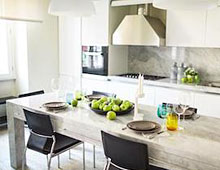 Apartments
  Family Hotel
 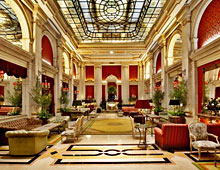 Luxury Hotel