Hotel Campus 90
Varna City - 90 bulevard "Tsar Osvoboditel"
Book now
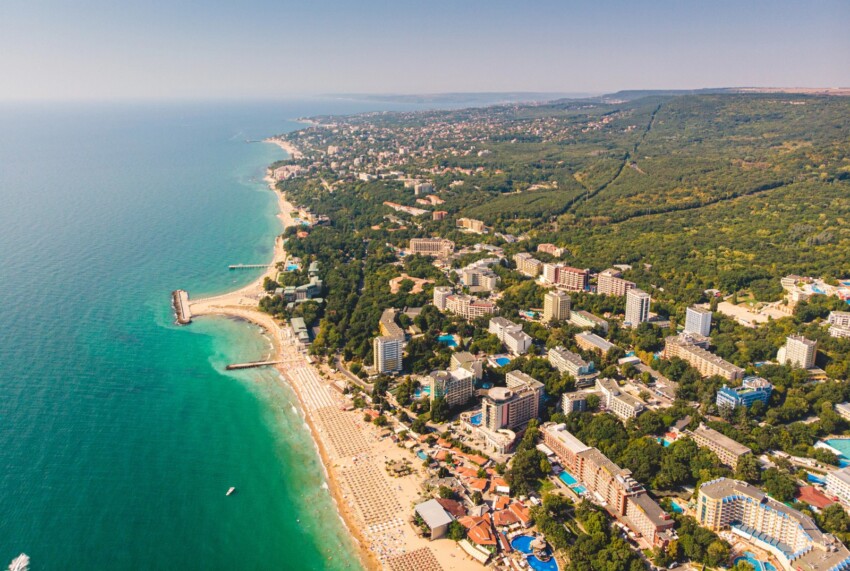
Varna is Bulgaria’s third-largest city by population and the undisputed capital of the Bulgarian Black Sea coast: a millennia-old port that the Greeks called Odessos in the 6th century BC, which the Romans transformed into one of the principal naval bases of the Pontus Euxinus and which medieval Bulgarians contested for centuries against Byzantine emperors. Today, Varna is a city of over 300,000 inhabitants that successfully combines the roles of commercial port, university hub, international beach destination and cultural centre with one of the Balkans’ most important museums. All of this overlooks a sea that reaches 26°C in summer and a four-kilometre city beach within a few minutes’ walk from the centre.
Varna’s appeal lies not merely in its beach and seafront — amongst the finest on the Black Sea — but in an urban fabric that layers epoch upon epoch with natural ease: 2nd–3rd century Roman baths, the largest in the Balkans, sit comfortably alongside the 19th-century Cathedral of the Assumption, a neoclassical City Hall and a vibrant pedestrian shopping quarter. The Archaeological Museum houses the world’s oldest Thracian gold, dating to the 5th millennium BC — a distinction that alone would justify a visit to Varna even without the sea.
The city is the main transport hub of the Bulgarian coast: the international airport receives direct flights from across Europe, the port welcomes cruise ships from April to October, and the railway connects it to Sofia in approximately six hours. It also serves as the natural departure point for exploring the northern coast’s beach resorts — Albena, Golden Sands and Balchik — and for reaching the natural reserves of Lake Varna and Kamchia.
Varna is easily explored on foot: the old town, seafront, port and principal museums are all connected by tree-lined avenues and pedestrian zones that make exploring comfortable and pleasant in every season. The wealth of attractions easily justifies three days of sightseeing, combining culture, nature and seaside relaxation.
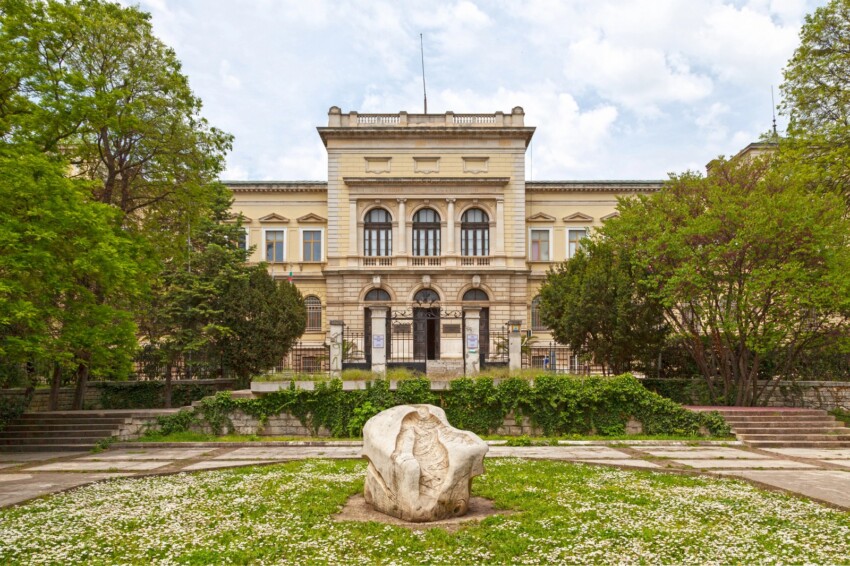
The Varna Archaeological Museum is the country’s most important after Sofia’s and houses one of Europe’s most extraordinary collections: the Varna Treasure, a collection of over 3,000 gold objects dating to the Varna Culture of the 5th millennium BC — between 4600 and 4200 BC — representing the oldest worked gold discovered to date. Unearthed in 1972 during construction work for a canning factory near the city, the treasure comprises diadems, bracelets, necklaces, pendants and decorative appliqués of astonishing technical refinement for a Copper Age civilisation: some pieces display a mastery of goldsmithing that European metallurgists would not achieve for another two thousand years.
The museum is housed in a neoclassical building from 1892 that was Bulgaria’s first girls’ school, in the heart of Varna’s old town. The collection spans two floors and covers five thousand years of the region’s history: from prehistoric times through Thracian and Greek civilisations, Roman Empire to medieval Bulgaria. Particularly rich is the section dedicated to the Greek colony of Odessos, with sculptures, ceramics and inscriptions documenting daily life in a Black Sea polis between the 6th and 1st centuries BC. A visit requires at least two hours to be properly appreciated, and it’s advisable to begin with the Gold Treasure room on the upper floor. For up-to-date information on opening hours and admission, consult the Varna Archaeological Museum’s official website.
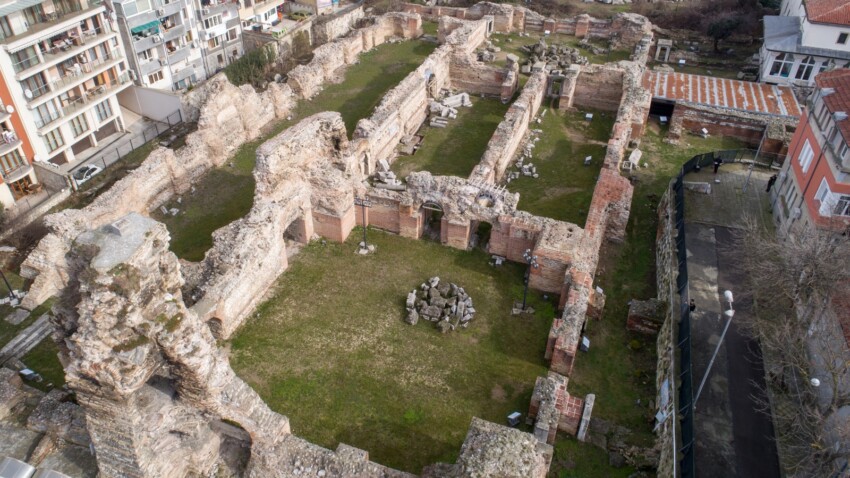
In central Varna, a few blocks from the main square, lies one of the Balkans’ largest Roman bath complexes and the fourth-largest in the entire Roman Empire: built between the late 2nd and early 3rd centuries AD under emperors Septimius Severus and Caracalla, the Baths of Odessos originally covered approximately 7,000 square metres and extended over at least three storeys. Even today, walls survive reaching 18 metres high, along with Roman brick vaults, opus sectile pavements and the complete sequence of rooms from a major bathing complex: the frigidarium, tepidarium, caldarium, gymnasium and changing rooms.
The baths are accessible as an open-air archaeological park, with interpretive panels reconstructing the function of each space. Evening visits are particularly recommended during summer months, when artificial lighting emphasises the monumentality of the ruins and creates atmosphere. The site is just a five-minute walk from the Archaeological Museum, making it natural to combine both visits in a single morning.
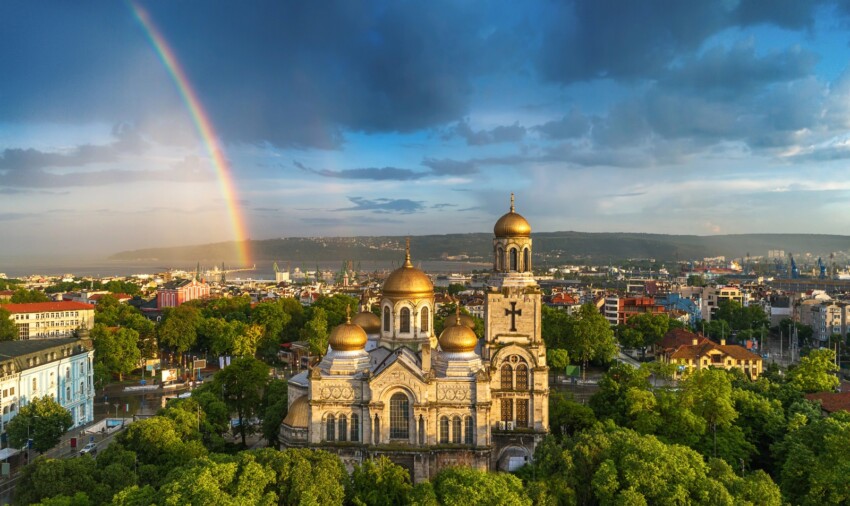
The Cathedral of the Assumption of the Virgin — Uspenie Bogorodichno in Bulgarian — is Varna’s principal Orthodox place of worship and one of Bulgaria’s most majestic religious buildings. Constructed between 1880 and 1886 in neo-Byzantine-Russian style, with five golden domes dominating the old town’s skyline, it was erected to commemorate Bulgarian liberation from Ottoman rule achieved just years earlier, in 1878. The dimensions are considerable: the central nave reaches 30 metres in height and the cathedral can accommodate up to two thousand worshippers.
The interior is entirely decorated with frescoes painted by Bulgarian and Russian artists from the late 19th century into the early 20th: scenes of Christ’s and the Virgin’s lives, portraits of Orthodox saints and geometric decorations of white marble flooring create a stylistically cohesive ensemble. The marble iconostasis with gilded inlays is amongst Bulgaria’s most elaborate. The cathedral overlooks a small wooded square in central Varna that is one of residents’ preferred evening walking spots in summer.
The City Garden of Varna — Gradska Gradina — is the largest and busiest urban park on Bulgaria’s Black Sea coast: a green space of over 70 hectares extending almost unbroken from the central square to the beach, connecting the old town to the sea through tree-lined avenues, fountains, flowerbeds and artificial lakes. Designed in the second half of the 19th century on the model of Central Europe’s great urban parks, the garden hosts an open-air Summer Theatre — one of Bulgaria’s largest with capacity for over two thousand — a Planetarium, a Naval Museum and various cafés and restaurants open from spring through autumn.
The garden becomes Varna’s social hub on summer evenings: families, couples and groups of friends stroll the illuminated avenues, stop at ice-cream and roasted corn stands, enjoy performances at the Summer Theatre or sit on fountain steps listening to street musicians. The seafront — actually a seaside promenade, Boulevard Primorski — runs along the garden’s eastern border for about four kilometres, with a paved walkway directly overlooking the Black Sea and the city beach below.
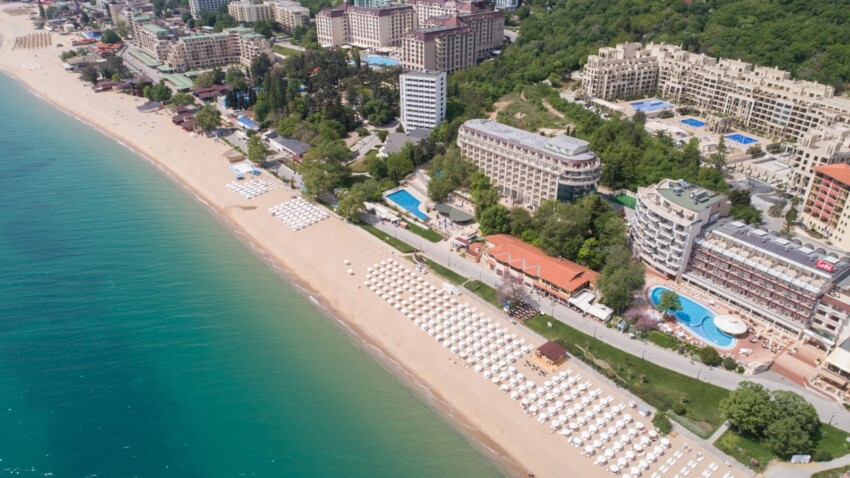
Varna’s central beach stretches for about four kilometres directly below the city’s seafront, accessible from the centre through the City Garden in a fifteen-minute walk or via a small scenic train that runs the park’s main avenue in summer. The sand is golden and fine, the seabed shallow and gently sloping, Black Sea waters in this area reach 26–27°C in July and August. The beach is partly equipped with beach clubs offering umbrellas and sunbeds, partly free, especially at the northern and southern ends.
Unlike Sunny Beach or Golden Sands, Varna’s central beach has the advantage of being integrated into the city’s urban fabric: you swim and then stroll through the old town, visit the museum or lunch at one of the seafront fish restaurants without needing transport. This combination of beach life and city life is Varna’s distinguishing feature compared to the single-function beach resorts elsewhere on Bulgaria’s coast.
Varna’s Port is Bulgaria’s largest and one of the principal ports on the Black Sea, handling over 10 million tonnes of cargo annually. The passenger terminal, active from April to October, welcomes cruise ships of all sizes and fast ferries for coastal excursions. A walk along the commercial dock — accessible to the public in the passenger port section — offers close-up views of moored vessels and port activity that convey Varna’s scale and importance as a Black Sea commercial hub.
Near the port stands Varna’s Aquarium, one of Bulgaria’s oldest: founded in 1912, it displays over 200 species of fish, crustaceans and invertebrates from the Black Sea and Mediterranean in tanks reproducing the region’s various marine environments. It’s particularly appreciated by families with children and requires around an hour to visit. Next to the aquarium, the Naval Museum houses a collection of anchors, cannons, ship models and uniforms from the Bulgarian Navy, with the centrepiece being the torpedo boat Drazki, which sank an Ottoman cruiser in 1912 during the First Balkan War.
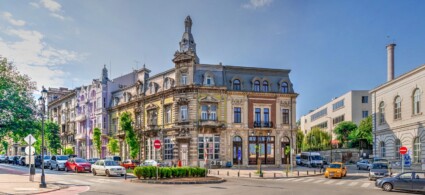
The heart of shopping and daily life in Varna is Knyaz Boris I Street, the main pedestrian axis running through the old town for over a kilometre between the main square and the City Garden. Flanked by shops, cafés, bookshops and pastry shops with outdoor seating, it’s Varna’s version of the urban promenade typical of Bulgaria’s major cities. The buildings lining it are largely from the eclectic late 19th and early 20th centuries, with decorated facades alternating with modern insertions creating a dignified and pleasant urban ensemble.
Near the intersection with Slivnitsa Street stands Varna’s Central Market, a covered market built in the 1920s with a Viennese-inspired steel and glass structure: fresh Black Sea fish, produce from the Dobruja plain and Bulgarian cheeses and cured meats on the ground floor; an eating area with outdoor seating particularly busy at breakfast on the upper floor. The market opens early and closes early afternoon: arriving by 8am lets you find the freshest fish and most authentic atmosphere.
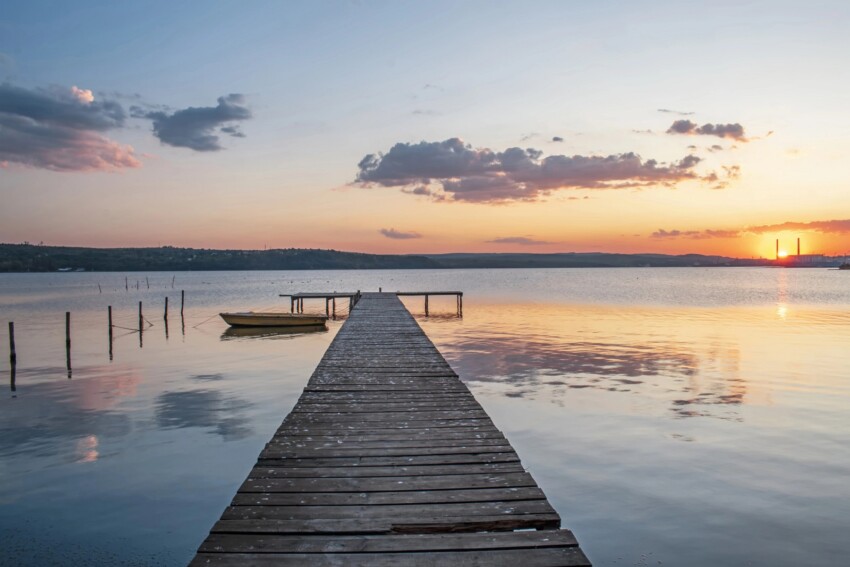
West of the city stretches Lake Varna, a body of water covering approximately 18 km² connected to the Black Sea by an artificial canal dug in 1906 that permits ships to reach the inland port. The lake is surrounded by a nature reserve with reed beds, oak woodlands and marshy shores hosting over 250 bird species during spring and autumn migrations. The lake’s western shores are reachable by bicycle or car from Varna and offer pockets of near-pristine nature just kilometres from the city centre.
The Black Sea Canal — the artificial connection between lake and sea — hosts one of Varna’s most unusual spectacles: large merchant vessels moving slowly through the canal barely 150 metres wide, their hulls seemingly grazing the banks, attract observers and photographers from across the country. The best vantage point for watching ships pass is Asparuhov Bridge, which crosses the canal a few kilometres from its Black Sea entrance.
Varna’s old town, in the area between the Cathedral, Roman Baths and City Garden, is the best option for those wanting to combine culture and beach within easy reach. This is where mid-range and upscale hotels concentrate, some housed in carefully restored 19th-century buildings, positioned to reach the sea in fifteen minutes’ walk through the garden and the Archaeological Museum in five. It’s the preference of culture-focused travellers and those visiting Varna in low season, September to May, when the city returns to its usual rhythms after summer.
The seafront area, with hotels facing directly onto Boulevard Primorski or the beach, is most sought-after in summer: beach access is maximum, the seafront nightlife is at hand and views of the Black Sea from upper rooms are striking. High-season prices are the city’s highest, with noticeable differences compared to the same properties in May or October. For something quieter, the residential Primorski quarter north of the centre offers apartments and small hotels with a more local feel and generally lower prices, ten minutes by bus from the centre.
Varna is the main transport hub on Bulgaria’s Black Sea coast and one of the country’s busiest airports during summer. The city is accessible by direct flights from across Europe, by train from Sofia and by car from eastern Bulgaria. Its position on the north-eastern coast, 470 km from Sofia and approximately 90 km from the Romanian border, makes it equally accessible overland from Romania.
Varna International Airport (VAR) is just 8 km from the city centre, north-west along the motorway towards Sofia. During summer it operates direct flights from dozens of European cities with carriers including Ryanair, Wizz Air, Bulgarian Air, easyJet and numerous British, German and Scandinavian charter airlines. In the low season international flights reduce considerably, though several regular routes remain to Sofia, Vienna and London.
Those unable to find direct flights to Varna can use Sofia International Airport (SOF), 470 km away. The Sofia-Varna route is driveable in approximately four and a half hours on the Hemus motorway (A2), which was completed in full in 2022 and has significantly reduced journey times compared to the old national road. Direct coaches from Sofia to Varna depart from Sofia’s central bus station hourly during peak times and take between five and six hours depending on intermediate stops. The overnight service is particularly convenient for those arriving late in Sofia and wanting to reach Varna the next morning.
The Sofia–Varna railway line is Bulgaria’s longest, covering approximately 520 km and crossing the Balkan Mountains, the Thracian plain and Dobrugia before descending towards the sea. Direct InterCity trains take approximately six and a half hours, with stops at Plovdiv, Stara Zagora and Ruse on the most frequent routes. Varna railway station is located about 1.5 km from the old town, reachable by taxi in minutes. Train travel is favoured by those who prefer to enjoy the Bulgarian landscape without the constraints of flight schedules, particularly on the stretch crossing the Balkan Mountains via Shipka Pass.
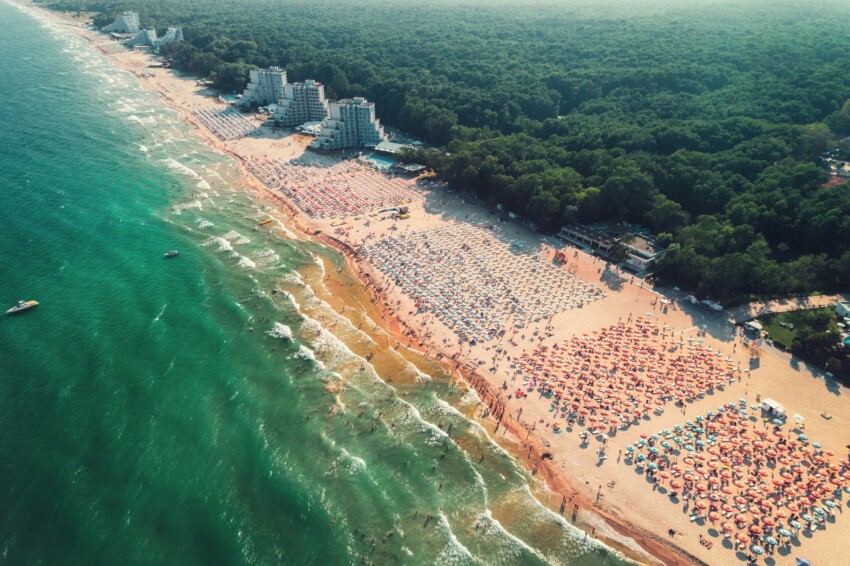
Varna is the ideal starting point for exploring Bulgaria’s northern Black Sea coast and the natural and historical areas of inland Dobrugia. A hired car allows you to move freely between the seaside resorts, nature reserves and medieval sites of the region without relying on public transport, which is often crowded and slow during peak season. Most of the destinations described below are reachable in less than an hour’s drive from Varna.
Just 17 km north of Varna, Golden Sands — Zlatni Pyasatsi in Bulgarian — is Bulgaria’s second-largest seaside resort and the most popular with Northern European tourists after Sunny Beach. The name evokes the golden, fine sand of the roughly 3.5 km beach, one of the finest on Bulgaria’s Black Sea coast. Golden Sands stands out from Sunny Beach for its slightly more orderly layout and the presence, immediately behind the hotels, of the Golden Sands Nature Park: a forest of oak, hornbeam and lime trees covering the hills behind the beach and hosting remarkable biodiversity just metres from the sea.
Some 35 km north of Varna, Albena is a planned seaside resort developed in the 1970s as a state resort and now completely renovated. Hotel facilities are spread across a 300-metre strip between the beach and the road, the beach is in places up to 500 metres wide and is among the most-awarded stretches of Bulgaria’s coast, holding the Blue Flag designation. Albena is primarily geared towards families with children, with beach services and green spaces organised in a way that distinctly sets it apart from the more chaotic coastal destinations. The resort is equipped with tennis courts, Olympic swimming pools, a riding school and a wide range of water sports.
About 42 km north of Varna, the small town of Balchik is known for two things that combine unusually: whitewashed houses perched on the seafront that lend it an almost Mediterranean feel, and the Palace of Queen Marie of Romania, built in the 1920s when Balchik was part of Romania. The palace — a Moorish-style villa with a minaret and terraced botanical gardens descending towards the sea — is today one of the most-visited tourist sites on the Bulgarian coast, featuring a collection of over 3,000 varieties of cacti and succulent plants in the garden. The old town of Balchik, with its whitewashed houses and narrow alleyways dropping down to the harbour, deserves a wander regardless of the palace.
Some 65 km north-east of Varna, Cape Kaliakra is a red limestone promontory extending three kilometres into the Black Sea with sheer cliffs rising up to 70 metres. It is one of Bulgaria’s most spectacular natural sites and hosts the remains of a 14th-century medieval fortress, built during the reign of despot Dobrotitsa to control Black Sea trade routes. The cape is also a nature reserve of European importance: dolphin colonies — three different Black Sea species — frequent the waters offshore during summer, and sea gulls and peregrine falcons nest on the vertical cliff faces.
What's the weather at Varna? Below are the temperatures and the weather forecast at Varna for the next few days.
Varna sits on Bulgaria's north-eastern coast, overlooking the Black Sea, 470 km east of Sofia, 90 km from the Romanian border, 17 km from Golden Sands and 200 km from Ruse on the Danube. It is the principal urban centre on Bulgaria's coast and the third largest city in the entire country.
 Hotel
Hotel  Budget accommodations
  Apartments
  Family Hotel
 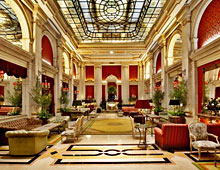 Luxury Hotel