Continental Forum Constanta
Constanţa - 39B-41, Mircea cel Batran St.
Book now
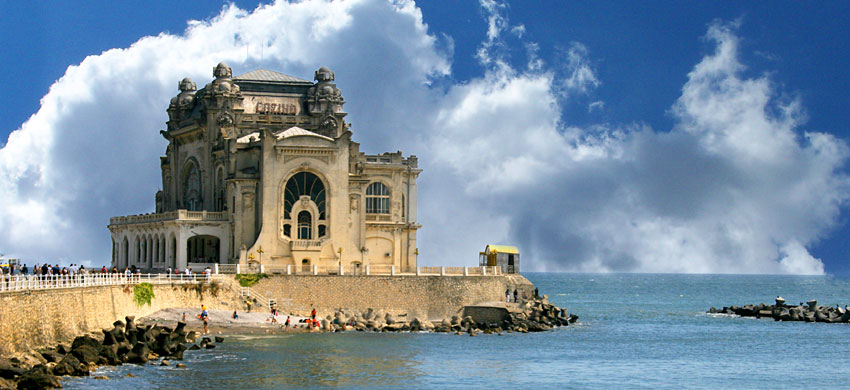
Constanța, or Constanța in Romanian, is Romania’s principal city situated on the Black Sea coast. With a population of approximately 300,000 inhabitants and a metropolitan area of nearly 450,000, it is also the country’s fifth most populous city.
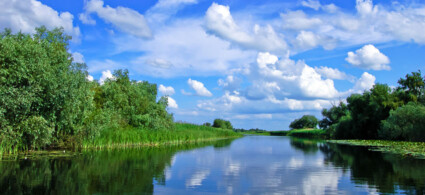
Constanța is internationally renowned for being home to the largest port on the Black Sea, extending across an area of almost 4,000 hectares. However, it would be a mistake to consider it merely a port city: it is, in fact, an important destination for international tourism, primarily thanks to its golden beaches, numerous monuments and its favourable location near the Danube Delta, one of Europe’s most significant natural attractions.
Visiting Constanța offers the chance to experience authentic Romanian life, beyond the excesses of the capital Bucharest and the museum-like cities of the Carpathians. However, you’ll discover a stylish city that looks toward the West whilst remaining rooted in tradition and local customs. A genuine discovery, well worth visiting with an open mind.
Constanța is a thoroughly pleasant city to explore, and makes an excellent base for visiting the Danube Delta to the north and a series of beautiful beaches to the south. During summer, the city fills with tourists—both Romanian and international—who choose it as a holiday destination for its excellent climate and wealth of attractions and activities.
Here are the unmissable attractions in Constanța, both within and beyond the historic centre.
The Constanța Casino is undoubtedly the city’s defining symbol. Built directly overlooking the sea, it is a magnificent palace constructed in the Art Nouveau style, which before the Second World War served as a residence for the Russian imperial family during their visits to the city. The Constanța Casino is one of Romania’s most iconic buildings, designed by architects Daniel Renard and Petre Antonescu. Surrounding the casino is a lovely pedestrian area, where couples, young people and families stroll, particularly at sunset.
The Edificiul Roman cu Mozaic is a large complex spread across three levels, which once connected the upper part of the city to the port. Today, approximately one-third of the original building remains standing, which includes nearly 1,000 square metres of mosaics. The structure dates to the fourth century and eventually became one of the city’s most important commercial centres; archaeologists have found evidence of shops, storage facilities, warehouses and workshops, as well as public baths and an aqueduct.
The city’s Orthodox cathedral, dedicated to Saints Peter and Paul and known locally as the Catedrala Sfinții Apostoli Petru și Pavel din Constanţa, serves as the seat of the Archdiocese of Tomis. Located between Ovidiu Square and the Black Sea, opposite the archbishop’s palace, it was constructed in the late nineteenth century. During the Second World War, aerial bombardments in 1941 destroyed numerous parts of the structure, including the altar, many icons and various paintings. After the war it was restored and reconsecrated between 1951 and 1959.
Today, the Constanța Cathedral is an imposing Orthodox church built in brick in Greco-Romanian style, with a bell tower standing 35 metres high. Inside, you can admire frescoes created by local artists in the early 1960s, an intricately crafted icon of the Virgin Mary and the relics of the Byzantine monk Ausenzio of Bithynia, discovered only in 2001.
The Constanța Aquarium will prove to be a genuine revelation. Built directly facing the casino, it is Romania’s first attraction of this type. It houses over 100 species of marine creatures, which can be admired along the entire guided route. The section dedicated to the Danube Delta is particularly interesting, with this precious environment recreated in miniature to showcase its importance for European ecosystems. The tropical fish hall is the most popular section with younger visitors, featuring vividly coloured fish with appealing appearances.
Constanța is also ideal for art enthusiasts, with 4 museums of primary importance, all well worthy of a visit.
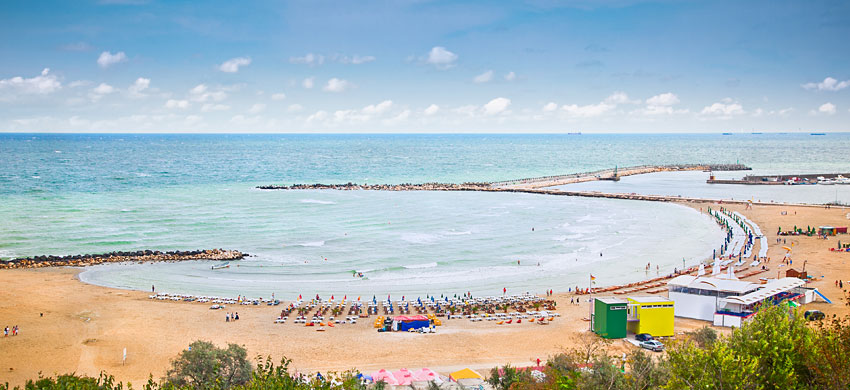
Despite its architectural treasures and quality of life, Constanța remains fundamentally a seaside resort, with a series of sandy beaches stretching one after another. Worth mentioning are the Modern, 3 Papuci and Tataia beaches. These are ideal for families and those seeking tranquillity; those in search of parties and loud music should look 10 kilometres north to the popular resort of Mamaia and its exceptionally long beach, much of which is privately operated by hotels and beach clubs.
Constanța’s beaches are fully equipped with facilities where you can hire parasols and sunbeds and enjoy water sports. At the same time, some sections are free, allowing you to set up your parasol in complete peace.
The historic centre of Constanța is centred on Ovidiu Square and its surroundings, just north of the port. Therefore, this is naturally where you should look for accommodation. Given that hotels in the city have very reasonable prices, with the exception of luxury establishments, you can also venture slightly further north to find lodging near the beach—ideal if you’re choosing Constanța as a seaside holiday destination.
Finally, if your holiday plans revolve around parties, festivities and entertainment, leave Constanța and head several kilometres north of the city, onto the narrow strip of land separating the Black Sea from Siutghiol Lake, where you’ll find the trendy Mamaia with its numerous hotels.
Constanța sits at Romania’s eastern extremity, nestled on the Black Sea coast. It is easily reached by rental car from Bucharest, travelling the entire A2 motorway. The journey covers approximately 230 kilometres, taking just over 2 hours. Alternatively, you can use public transport: Constanța’s bus station is the terminus for numerous bus routes departing from practically every Romanian city, as well as from Istanbul and Sofia.
The city is also served by the railway network: Constanța railway station sees approximately 50 trains arrive and depart daily, coming from Bucharest North, Craiova, Comanești, Timișoara, Iași, Sibiu and Pitești. International trains from Berlin, Budapest, Frankfurt, Sofia, Venice and Vienna also stop at Constanța station.
Finally, Constanța is also home to a small international airport, named after Mihail Kogălniceanu, formerly used by Ryanair. It handles relatively low traffic but is connected to Istanbul and London via Turkish Airlines and Wizz Air respectively.
What's the weather at Constanța? Below are the temperatures and the weather forecast at Constanța for the next few days.
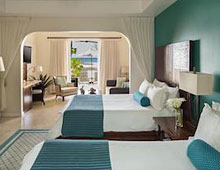 Hotel
Hotel 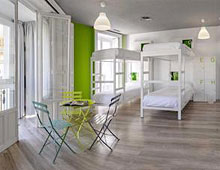 Budget accommodations
 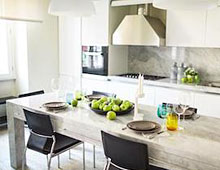 Apartments
  Family Hotel
  Luxury Hotel