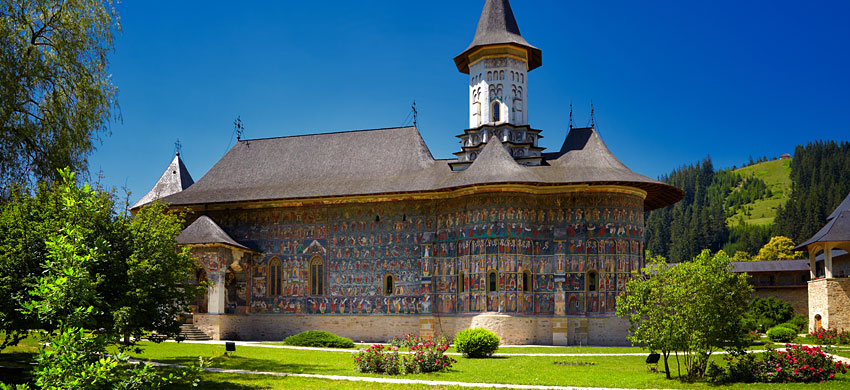
Among Romania’s most spectacular buildings and true treasures of Byzantine art, we find the Painted Monasteries of Bucovina, in the northeast of the country, designated as UNESCO World Heritage Sites. The most impressive are Voronet Monastery, Moldovita Monastery and Sucevita Monastery.
The external frescoes of the Monasteries date back to the 15th and 16th centuries but are far more than simple wall decorations, as they depict biblical scenes populated by figures from the period: across all the building facades you’ll find complete decorative cycles featuring Moldavian princes and rulers standing alongside saints and prophets. The Turks, historical enemies of the Romanians and Christianity, are consigned to Hell and embodied as demons. In this way, the Bible and the lives of the most important Orthodox saints were explained to the villagers through the exceptional use of colour and form.
The monasteries are nestled in an enchanting surrounding landscape that enhances their beauty even further.
Among Romania’s painted monasteries, the stunning Moldovita Monastery is a must-see, located in the Bucovina region in the northeast of the country, where you’ll find the best-preserved external frescoes of these structures inscribed by UNESCO as World Heritage Sites.
Built at the behest of Prince Petru Rares in 1532 and painted 5 years later, the monastery is decorated with magnificent frescoes inspired by a poem dedicated to the Virgin Mary and her divine intervention protecting the city of Constantinople during the Persian attack of 626 AD. In the 1500s, the Ottoman threat loomed large over Moldavia, and this was intended as a plea for similar divine protection.
Decorated primarily in ochre yellow, red, green and blue, the walls of Moldovita Monastery, built deep within the forest, also feature a representation of Christ’s genealogy.
The church combines Byzantine and Gothic elements and features an open portico, 3 apses, an octagonal tower, and a series of small niches—105 in total—each dedicated to an angel. Nearby stands a two-storey building housing the Convent Museum: admire the tapestries woven with gold and silver thread, icons, liturgical books and archaeological artefacts.
The complex is enclosed within a quadrangular fortified wall strengthened with corner towers.
The Sucevita Monastery, inscribed by UNESCO as a World Heritage Site, is located in the northeastern part of Romania, 60 kilometres from the city of Suceava.
Among the country’s finest painted monasteries, the monastery was founded in 1581 by the Bishop of Raduti and later expanded by his brother, the reigning Prince of Moldavia, and is surrounded by defensive walls and towers. A bell tower crowns the church, the last of the 22 frescoed churches of Bucovina to be built.
Frescoed between 1595 and 1604, Sucevita Monastery boasts the greatest number of painted images, although the western side is not decorated. Among the depicted scenes you’ll find the Ladder of Paradise, an ascending path connecting Earth and Heaven, adorned with red-winged angels and intersected by pathways inscribed with the monastic virtues, and the Tree of Jesus.
The church has 5 chambers and two non-identical porticoes constructed in a later phase. The thick walls surrounding the complex measure almost 100 metres per side and are reinforced with buttresses, bastions and 5 towers. Inside is a museum where you can admire historical and artistic objects such as embroidered portraits in silver thread, ecclesiastical silverware, books and illuminated manuscripts.
The most famous of Romania’s painted monasteries is Voronet Monastery, built in 1487 in less than 4 months by Stephen the Great to commemorate a victory against the Turks. Known as the Sistine Chapel of the East, the monastery features an extraordinary variety of frescoes both inside and out, painted 500 years ago, dominated by the colour blue—known as Voronet blue—created with lapis lazuli.
The intricate frescoes depict biblical scenes, including the magnificent Last Judgement and Genesis, prayers and sacred hymns. In the Tree of Jesus, or Tree of Jesse, you can discern portraits of ancient Greek philosophers such as Aristotle and Plato.
The monastery stands along the banks of a river and blends Byzantine and Gothic elements visible in the tower, the Gothic arched windows and the rectangular frames of the doorways.
 Hotel
Hotel  Budget accommodations
  Apartments
  Family Hotel
  Luxury Hotel