Continental Forum Arad
Arad - 310130 Arad, 79-81Revolutiei Blvd
Book now
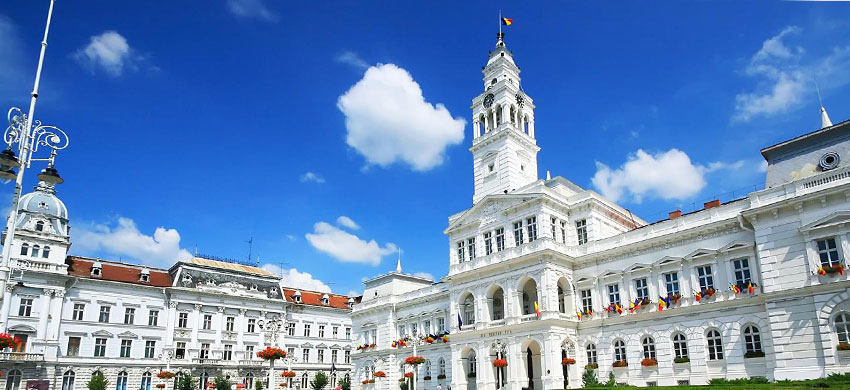
Located at the western edge of Romania, just a handful of kilometres from the Hungarian border and closer to Belgrade than to Bucharest, Arad sits in a privileged position in the heart of Central-Eastern Europe. Over the centuries, this elegant Romanian city has become a major transport hub and the beating heart of the region’s economy and industry.
Today, Arad has a population of around 160,000 and has developed along the right bank of the Mures River since the year 1000. Here you’ll find a multicultural atmosphere, as the city has been part of the Kingdom of Hungary, the Ottoman Empire, the Principality of Transylvania and the Austro-Hungarian Empire before becoming part of Romania in 1920.
In Arad there are a number of rather interesting things to see, including historic palaces built in the late 19th century, Baroque churches and parks where you can enjoy outdoor living. Here’s a list of the best things to see in the city.
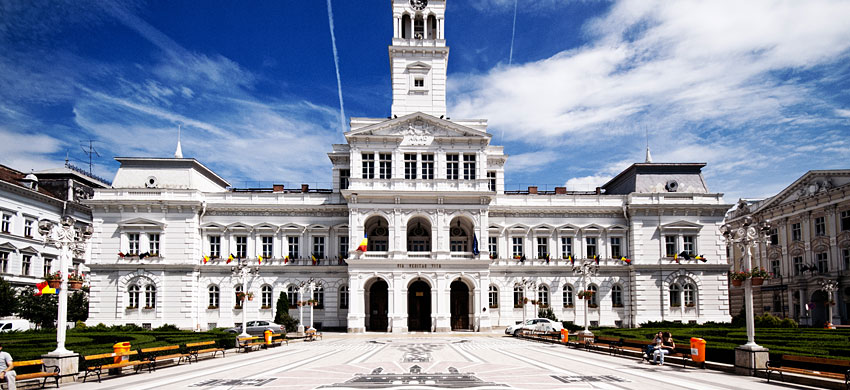
The Arad Town Hall is a building constructed in the city between 1872 and 1875. The palace’s style combines Flemish Neo-Renaissance and late-medieval elements, so that when viewed from afar it bears a striking resemblance to a palace on Brussels’s Grand Place or in Bruges, particularly thanks to the central tower, which stands 54 metres tall and houses a large clock brought from Switzerland in 1878.
The palace overlooks the beautiful Piața Sfatului, which closely resembles the historic centres of some Austrian and Hungarian towns, a testament to Arad’s turbulent past.
The Arad Fortress (Cetatea Arad) occupies practically the entire left bank of the Mures River. It was built in the 18th century on the orders of Empress Maria Theresa of Austria, and throughout its history has served as a prison and military garrison. It has a star-shaped design with six angles and three rows of underground casemates. Connection to the outside originally took place via three bridges, all oriented towards the city and well protected.
Inside are a number of buildings in Baroque style, including a Franciscan church. Today it is home to the B.Mx.RO-HU.M.P., the Romanian-Hungarian joint battalion, which has been based here since 1998.
The Ioan Slavici Classical Theatre, built in the late 19th century in neoclassical style, is historically one of the city’s favourite gathering places for the bourgeoisie. It was inaugurated in 1874 but was destroyed by fire just 9 years later. It was immediately rebuilt, but a second fire broke out in 1955 and destroyed it again. The second reconstruction took 4 years, after which the theatre was completely transformed, both inside and out.
Today, the main façade of the Ioan Slavici Theatre has three doors positioned beneath three arches, situated behind six large columns in Corinthian style. On the façade is also an interesting stone relief measuring 19 metres long and 4 metres high, created by Romanian sculptors Valeriu Brudascu, Livia Cernenski and Emil Vitroel.
The Arad Cathedral of the Holy Trinity, or Catedrala “Sfânta Treime” din Arad in Romanian, is the city’s Orthodox cathedral. It is a very recent building: construction began in 1991 and internal finishing works are still ongoing, although the church’s exterior is complete. It was consecrated in 2008 on St Nicholas Day, before a crowd of celebrating worshippers from across Romania.
This unusual monastery dating from 1760 is located in Arad’s Gai district. The complex includes the bishop’s residence, a church and a series of outbuildings, built in Baroque style. The church was built from wood, sourced from the nearby village of Seliste, and is an excellent example of 18th-century Romanian architecture from the Mures Valley.
In the following map you can see the location of the main places of interest mentioned in this article.
The centre of Arad coincides with the lower section of Bulevardul Revolutiei, and this is where you’re advised to find accommodation, as you’ll be within easy reach of all attractions, entertainment options and services. In any case, it’s right in the centre where you’ll find most of the accommodation options in Arad. There are hotels in various categories, including two 4-star properties and a range of more budget-friendly establishments. Apartments are also available.
Arad has an international airport, but it has been practically abandoned for several years and is now used only by a handful of charter airlines. The easiest way to reach Arad from the UK is therefore to fly to Timișoara Airport, which is about 55 kilometres away.
As for driving, Arad is the first Romanian city you encounter after crossing Slovenia and Hungary, so distances are long but manageable: approximately 11 hours from London and 14 from Edinburgh. You can drive your own car or use one of the numerous coaches that operate services between the UK and Romania.
If you’re already in Romania and decide to visit Arad, you should allow for approximately 7 hours of travel and 550 kilometres from Bucharest, around 9 hours of travel and 800 kilometres from Constanța, and nearly 10 hours from Iași. The closest city to Arad by far is Timișoara, less than 50 kilometres away.
Finally, Arad is an option for a day trip from Budapest, as the two cities are just over 2.5 hours apart.
What's the weather at Arad? Below are the temperatures and the weather forecast at Arad for the next few days.
 Hotel
Hotel  Budget accommodations
  Apartments
  Family Hotel
  Luxury Hotel