Hotel Transilvania
Cluj-Napoca - Regele Ferdinand 20
Book now
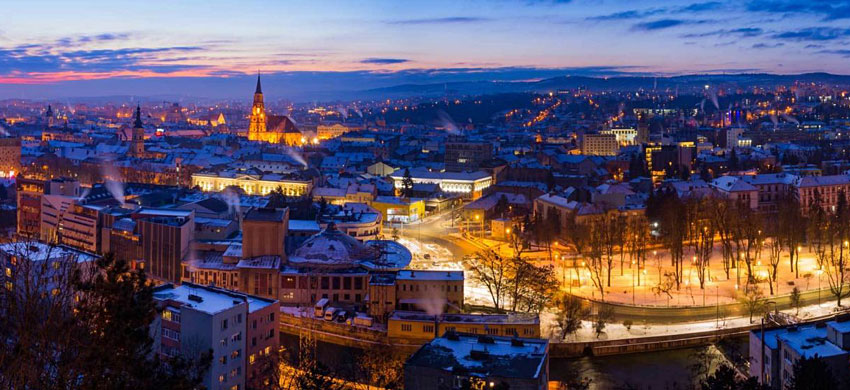
Cluj-Napoca, a city founded on the banks of the Someșul Mic river in Transylvania, is one of Romania’s most important academic, cultural and industrial centres. Cluj-Napoca’s centuries-old multiculturalism is evident in its architecture, culture and gastronomy.
Founded in the 2nd century AD by the Romans, the city is surrounded by hills. The main square is lined with Baroque, Gothic, Renaissance and Neoclassical buildings constructed between the 18th and 19th centuries. Particularly striking is the Church of St Michael, one of the country’s finest examples of Gothic architecture, built between 1350 and 1487, and the Ethnographic Museum of Transylvania is also worth visiting.
Since the late 18th century, Cluj-Napoca has been the capital of Transylvania and today is a modern city with over 300,000 inhabitants and one of Romania’s most vibrant cities, largely thanks to its numerous nightclubs and discos. Cluj is situated approximately 480 kilometres north-west of Bucharest.
There are several attractions to visit in Cluj-Napoca. Here are the main ones, so you don’t miss any.
The beautiful King Ferdinand Boulevard, formerly called Bridge Street and now named after King Ferdinand I, is one of the city’s shopping streets. Numerous elegant buildings constructed between the 18th and 19th centuries line this avenue, including the Berde, Babos, Elian, Urania and Szeky palaces, built in a blend of Baroque, Gothic and Renaissance styles.
Also noteworthy is a cluster of buildings at the corner with the bridge over the Someșul Mic river, constructed in the last decade of the 19th century.
The spacious Unirii Square, meaning Union Square, is Cluj-Napoca’s largest and most important square. It is also one of Romania’s largest squares, measuring 220 metres in length and 160 metres in width.
This is where the city centre begins, and it’s also where the Church of St Michael stands, featuring the tallest bell tower in all of Romania at 80 metres. The church was built starting in 1316, with work continuing until 1487.
Other important city landmarks overlooking Unirii Square include the old town hall, the national art museum, the Josika Palace and the statue of the King of Hungary Matthias Corvinus.
This magnificent cathedral, consecrated in 1933, is Cluj-Napoca’s most important Orthodox church. It was built in the Brâncoveanu style, the typical architectural style of Romanian monasteries and religious buildings that developed in the early 1700s in Wallachia.
The cathedral’s main dome is inspired by the Hagia Sophia basilica in Istanbul and is surrounded by 4 towers; the 18 large stone columns supporting the dome were quarried from the nearby localities of Baciu and Bompotoc. Inside, the magnificent frescoes were painted between 1928 and 1933 by art academy professors Anastasie Demian and Catul Bogdan.
The Cathedral of Our Lady of the Assumption is located in Avram Iancu Square, where you can also admire the National Theatre of Cluj-Napoca and the statue of Avram Iancu.
The Lucian Blaga National Theatre in Cluj-Napoca is one of the most important institutions of its kind in all of Romania. It was built in Neo-Baroque style in the early 1900s to the design of Austrian architects Ferdinand Fellner and Hermann Helmer, who also designed similar buildings in Iași, Oradea and Timișoara.
The theatre’s inauguration took place on 8 September 1906, with a performance of Ferenc Herczeg’s Bujdosók; until 1919, when Cluj was part of the Kingdom of Hungary, it was the seat of the Hungarian national theatre. The beautiful interior auditorium seats 928, and since 2011 the theatre’s director has been Mihai Maniutiu; the main productions staged are original works, drawing inspiration from both classical and modern themes.
The Central Park is the main green space in central Cluj-Napoca. It provides the perfect opportunity to escape the city bustle and enjoy a few peaceful hours, strolling along the tree-lined avenues and relaxing at one of the outdoor cafés.
The park, which underwent extensive restoration in 2012, was founded in the 19th century and sits on the south bank of the Someșul Mic river. It is home to the University of Arts and Design and the Chemistry Faculty of the Babeș-Bolyai University.
Within the park stands the old Cluj-Napoca casino, also restored in 2012, with its elegant architecture adorned with statues and a dark sheet metal roof.
In the following map you can see the location of the main places of interest mentioned in this article.
To make the most of your time in Cluj-Napoca, it’s recommended to stay in the city centre. This way, you’ll have all the tourist attractions within easy reach without needing public transport or a taxi, and you’ll be close to bars, restaurants and nightlife.
There are numerous hotels in all categories, on average considerably cheaper than Western Europe. It’s also possible to choose to stay in an apartment or guesthouse, which in recent years have increased significantly in number.
If you’re arriving late in the evening by plane or departing early in the morning, it’s also possible to sleep in the Someșeni area, near the airport, where you’ll find a range of guesthouses and small apartments.
Cluj-Napoca is located in the Transylvania region, in north-western Romania. You can reach it conveniently by plane from the UK, as the city has an international airport well connected to the UK with convenient direct flights, often very reasonably priced.
You can also reach Cluj-Napoca by car, although the distances are certainly not short: from London it takes approximately 24-26 hours, whilst from continental Europe the journey is considerably shorter. It’s possible to travel overland by relying on numerous coach services that connect Europe and Romania: there are international coach companies such as Flixbus or Eurolines, alongside a range of local tour operators. Factor in a journey of approximately 30-36 hours, due to the numerous stops and deviations to pick up passengers along the route.
For those already in Romania deciding to visit Cluj-Napoca, you should allow approximately 6-7 hours from Bucharest or Iași, approximately 8 hours from Constanța and approximately 4 hours from Timișoara.
What's the weather at Cluj-Napoca? Below are the temperatures and the weather forecast at Cluj-Napoca for the next few days.

 Hotel
Hotel  Budget accommodations
  Apartments
  Family Hotel
  Luxury Hotel