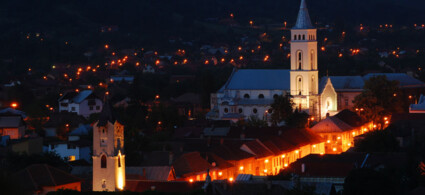
Baia Mare
All the information about Baia Mare: where it is located, what the main attractions are and what to see in the city, so you don't miss a thing.
Read more
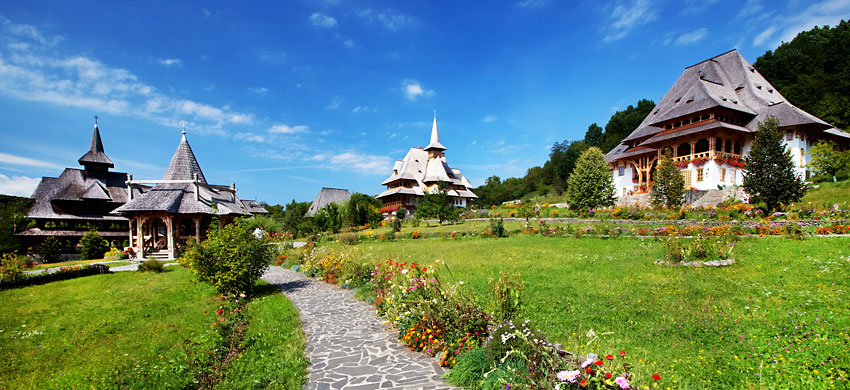
The region of Maramures is located in northern Transylvania, bordering Ukraine, and is a highly mountainous area, rich in forests and valleys. Visiting Maramures means immersing yourself in a breathtaking landscape, a world of mythology and the oldest traditions of Romania.
The region is home to exceptional woodworkers who created the famous wooden churches of Baia Mare, constructed without nails but entirely through joinery, with towers reaching up to 70 metres and roofs covered in wooden shingles. Seven of these churches – at Surdesti, Plopis, Rogoz, Ieud, Poeinile Izei, Barsana, Budesti and Desesti – have been declared UNESCO World Heritage Sites.
Elaborate wooden sculptures also adorn the monumental doors and windows of the region’s dwellings, but the local craftsmanship is equally distinguished by beautiful hand-woven carpets and embroidery that adorns traditional folk clothing.
Finally, Maramures is a territory rich in gold, uranium and other minerals.
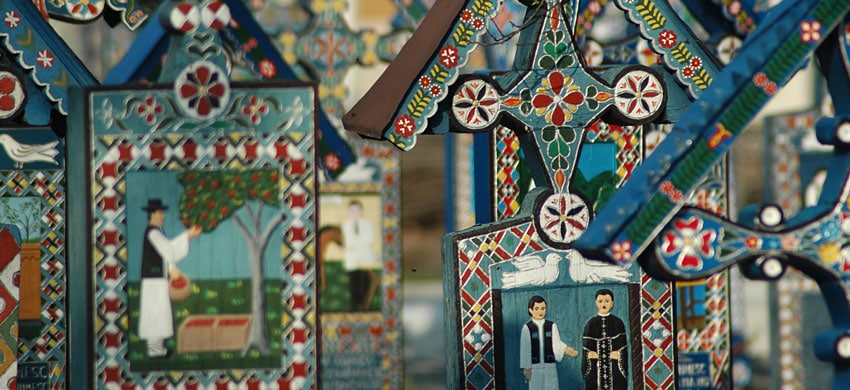
Near the town of Sighetu Marmatiei, in the Maramures region just 4 kilometres from the Ukrainian border, lies Sapanta and its famous cemetery, the Cimitirul Vesel, known as the Merry Cemetery. More than 800 oak crosses painted in vivid colours, particularly blue, and intricately carved, characterise this burial ground – a veritable open-air museum.
This tradition, begun in the mid-1930s by Stan Ioan Pătraş, a woodcarver, stems from the belief of the town’s inhabitants that death is a beginning rather than an end.
Each cross is unique: the carved images capture one of the characteristic attitudes of the deceased, and the ironic and satirical poems, written in archaic language typical of oral tradition, are a message to the living world. At the top of each cross is a relief depicting a scene from the deceased’s life. The scenes are simple and naïve in style, yet immortalise a relevant aspect, virtue or flaw of the departed. There are women spinning wool, weaving carpets, baking bread, and men carving wood, ploughing the land, herding sheep, playing their instruments, slaughtering animals, and so on.
Near the cemetery, at the Peri Monastery, stands Europe’s tallest wooden tower.
Among the 8 wooden churches of Maramures with their distinctive roofs and towering bell towers, declared UNESCO World Heritage Sites, don’t miss the Surdesti Church, south of Baia Mare, one of the world’s tallest oak structures thanks to its 72-metre bell tower.
Built in 1724 with skilfully interlaced wooden beams and without the use of any metal, the Greek Catholic Church of Surdesti dominates the landscape. The decorated roof and portico, with two orders of arches superimposed along the western side, make the complex particularly striking. Inside the church are painted scenes from the Old and New Testaments.
Not far away stands the Ieud Church, the oldest of the region’s wooden churches, constructed in 1364 from pine and fir.
 Hotel
Hotel  Budget accommodations
  Apartments
  Family Hotel
  Luxury Hotel