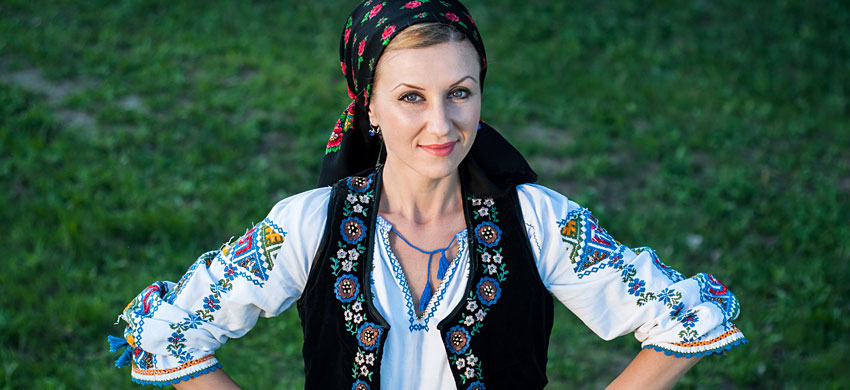
These festivals typically mark the changing of the seasons and the agricultural cycles of bygone times, such as the Harvest Festival, the First Sheep Shearing and the Grape Harvest. Others are Christian celebrations that have their roots in ancient pagan rituals. The Romanian people are deeply attached to tradition and participate in these festivals with great enthusiasm and warmth.
The winter festival season begins on 6 December with Saint Nicholas Day, when children who have been well-behaved throughout the year receive gifts, or a stick placed in their shoes if they are to be punished.
During the Christmas festivities, Romanian children dressed in traditional clothes visit houses for Colindatul, sung greetings, in exchange for a traditional braided sweet ring, a symbol of prosperity. Among the most popular carols are “Mos Ajunul” (Father New Year’s Eve) and “Steaua” (The Star).
The Plugul is an ancient folk song with rural themes that young people sing in spring to celebrate the beginning of the new year. The Plugul accompanies a symbolic plough being drawn through the garden at home as a sign of good fortune.
The origins of the Goat Festival date back to ancient times and the pagan ritual of animal sacrifice to the gods. Over the years, the sacrifice has been abandoned and the ceremony now takes the form of a collective ritual in which grain is thrown on the goat as a gesture of blessing and prosperity for the new year.
On Epiphany in Romania, the Boboteaza is celebrated, commemorating the baptism of Jesus in the Jordan River. During the celebrations, the icy waters of rivers and lakes are blessed: the priest throws a crucifix into the water and men dive to retrieve it. The belief is that whoever recovers it will be free from illness for the entire year. On 7 January, Saint John’s Day is celebrated, marking the final day of festivities.
In Romania, Easter is a deeply felt celebration and believers fast for the forty days beforehand to purify body and spirit. Holy Week opens with “Flower Sunday” when the Passion of Christ is commemorated, then on Maundy Thursday the twelve gospels are read, one for each hour of the day. On Saturday evening, the striking Midnight Mass is celebrated.
Throughout the week, houses are painted, gardens tidied and preparations begin for the Easter meal, during which all guests wear new clothes. Children receive painted eggs, true works of art, which the head of the household cracks against those of the person next to them, exclaiming: Hristos a inviat, Christ is risen, while the other responds Adevarat a inviat, truly he is risen.
The Sanziene Festival or Dragaica is celebrated on 24 June and is the most spectacular pagan festival included in the calendar of Orthodox Christian festivals in Romania. Sanziene is a festival connected to the myth of the earth’s fertility and young women gather the Sanziene plant to wash themselves in its dew and remain eternally beautiful and youthful.
The Martisor Festival marks the arrival of spring and is celebrated on 1 March. The festival originates from the legend of a young Romanian who sacrificed his life to free the sun from winter. During Martisor, a pendant with an intertwined thread in two colours is gifted: red representing blood and white representing snow. The pendant is a good luck charm that wards off illness and the evil eye.
On 30 November, Saint Andrew is celebrated, the patron saint of Romania and the man who brought Christianity to these regions. On the night, known as the night of the wolf that brings winter, the night of spirits or the night of sorcery, all windows and doors of houses are locked and rubbed with garlic to keep spirits at bay. Saint Andrew’s Night is also when young women can learn about their future by peering into the bottom of a well by candlelight.
The myth of Dragobete, similar to Cupid, is celebrated on 24 February, when nature awakens for spring and girls run through the village streets pursued by boys. If a boy catches the girl he fancies and she kisses him, their engagement is official.
 Hotel
Hotel  Budget accommodations
  Apartments
  Family Hotel
  Luxury Hotel