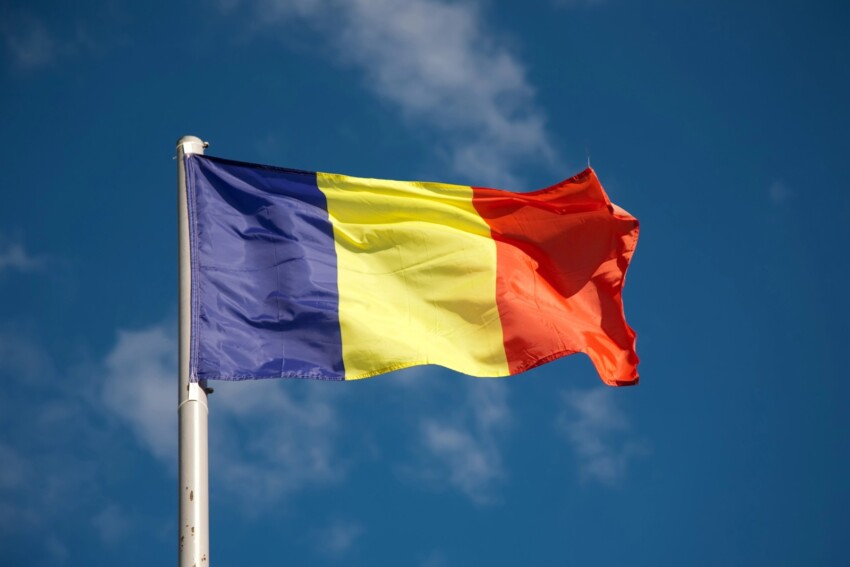
The Romanian tricolour — blue, yellow and red arranged vertically — is one of the most recognisable symbols of Eastern Europe and carries with it centuries of history, struggles for independence and national identity. Yet, despite its apparent simplicity, Romania’s flag conceals a historical and symbolic depth that few truly understand. Understanding its origins means understanding Romania itself: a country that achieved unity with difficulty, through revolutions, wars and radical political transformations.
If you’re planning a trip to Romania, recognising and understanding the tricolour will help you engage with the local culture with greater awareness. You’ll see it flying everywhere, from the facades of government buildings in Bucharest to the medieval villages of Transylvania, often accompanied by a deeply felt sense of national pride.
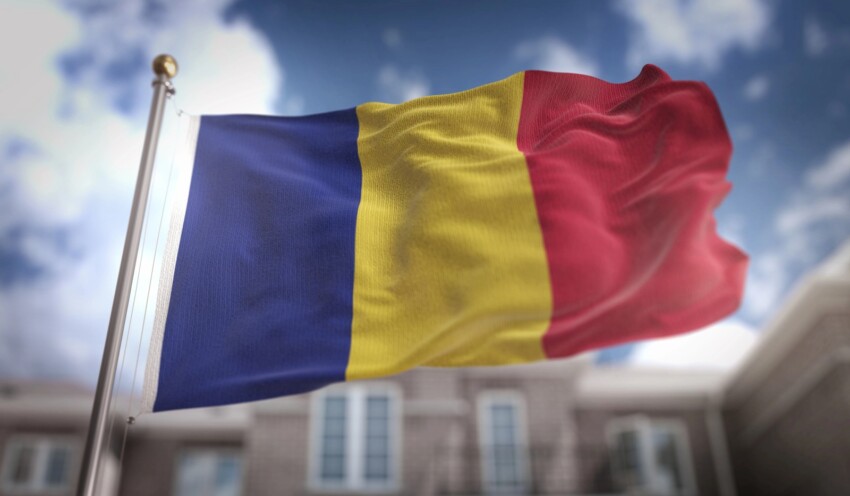
The Romanian flag is a vertical tricolour consisting of three bands of equal size: cobalt blue on the hoist side, chrome yellow in the centre and vermillion red on the fly side. The official width-to-length ratio is 2:3, proportioned to ensure that the three bands are exactly the same size.
Since 1989, following the Revolution that ended Nicolae Ceaușescu’s regime, the flag has borne no emblem or coat of arms in the centre. This choice was no accident: during the revolution, protesters literally tore the communist emblem from the flag, creating what became a tremendously powerful symbol of rupture with the past. The “holed” flags are now preserved in museums as historical relics of extraordinary emotional force.
The three colours of the Romanian tricolour were not chosen arbitrarily. Each carries a traditional meaning rooted in the country’s history and culture.
Blue represents freedom and the open sky, symbolising the Romanian people’s aspirations towards independence and sovereignty. Yellow — the most visible and central — evokes the country’s natural resources, the wealth of the fields and prosperity. Red recalls the blood shed by patriots in battles for national unity and in the most dramatic moments of Romanian history.
That said, the symbolic association of colours with specific values has been consolidated over time through popular usage rather than through an official definition, and interpretations may vary slightly depending on the source.
The origins of the Romanian tricolour flag date back to the revolutionary period of 1848, when nationalist movements spread across Europe. In Wallachia and Moldavia, revolutionaries adopted the blue-yellow-red tricolour as a symbol of their claims for freedom and unity, drawing inspiration in part from the principles of the French Revolution and the nationalist movements that stirred Europe in those years.
The tricolour appeared officially for the first time during the Wallachian Revolution of 1848, when patriots raised it as the flag of the revolt against Ottoman rule and Russian influence. Although crushed in blood that year, the revolution sowed the seeds of Romanian national identity that would flourish in the following decades.
With the union of Wallachia and Moldavia in 1859 under Alexandru Ioan Cuza, the tricolour began to assert itself as a symbol of the unified Romanian state. However, it was with the ascension to the throne of Carol I of Hohenzollern and the Constitution of 1866 that the flag received its first formal recognition, becoming the symbol of the modern Romanian state.
Independence from Ottoman sovereignty, proclaimed in 1877 and internationally recognised in 1878 at the Congress of Berlin, further consolidated the tricolour’s value as an identity symbol. Greater Romania in 1918, born from the union of Transylvania, Bessarabia and Bukovina with the old kingdom, used the same tricolour as a symbol of the unity achieved after centuries of division.
From the proclamation of the People’s Republic of Romania in 1948, the flag was modified with the addition of an emblem in the centre, following the model of Soviet flags. The emblem changed several times over the years, reflecting the regime’s transformations: mountains, forests, the rising sun, the red star and other symbols succeeded one another in the tricolour’s central section.
The final emblem, introduced in 1965 under Ceaușescu with the proclamation of the Socialist Republic of Romania, remained in use until the December 1989 revolution. That month, images of protesters tearing the emblem from flags made their way around the world, becoming one of the most powerful symbols of the fall of communist regimes in Eastern Europe.
With Decree-Law No. 2 of 27 December 1989, the Romanian provisional government established that the national flag would return to the simple vertical blue-yellow-red tricolour, without any emblem. This choice, ratified by the 1991 Constitution, marked the definitive return to the historical roots of the national symbol, freed from any reference to the communist era.
A topic that regularly sparks debate is the striking similarity between Romania’s flag and that of Chad. The two tricolours are practically identical to the naked eye: Chad uses blue, yellow and red in the same vertical positions. The difference lies in colour shades — Chad’s blue is slightly darker — and in the dimensional ratio, but in practice the two flags are almost indistinguishable.
Chad adopted its tricolour in 1960, at the moment of independence from France, drawing inspiration from the French tricolour but choosing pan-African colours. Romania, of course, has been using its tricolour for over a century and a half. The question of the “duplicate” flag has been raised several times at international level without leading to definitive solutions: both countries maintain their colours.
In Romania the tricolour is omnipresent, not only on official occasions. 1 December, Romania’s National Day commemorating the Great Union of 1918, sees every corner of the country decorated with blue, yellow and red. The most important celebrations take place in Alba Iulia, the city where the union of Transylvania with Romania was proclaimed.
The tricolour is also deeply felt in the sporting context, where football supporters and those of other sports wave the national flag with great enthusiasm. In Bucharest, during international matches, the tricolour fills the stadiums creating a vibrant atmosphere that foreign fans remember for a long time.
In historic cities such as Brașov, Sibiu or Sighișoara, the flag flies alongside those of the European Union — of which Romania has been a member since 2007 — on town halls and restored historic buildings, testifying to a country that looks towards Europe without forgetting its own roots.
 Hotel
Hotel  Budget accommodations
  Apartments
  Family Hotel
  Luxury Hotel