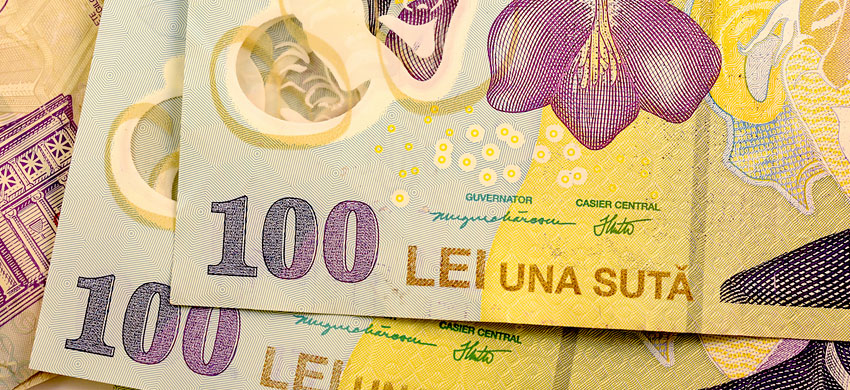
Romania is part of the European Union but has not yet adopted the Euro; for this reason, during your holiday you’ll need to exchange money to obtain the local currency, the leu (plural lei). Its official code is RON, and the exchange rate is subject to variation, although since 2009 it has remained fairly stable at around 4.20 to 4.70 lei per 1 euro.
The Romanian leu is divided into 100 bani, which represent its cents; it’s worth noting that the word “bani” in Romanian actually means “money“! The leu is available in coins of 1, 5, 10 and 50 bani, and in banknotes of 1, 5, 10, 50, 100, 200 and 500 lei.
Romania is required to replace its currency with the Euro once it meets the six convergence criteria defined by the EU. However, to date these have not yet been met and won’t be in the near future, so Romania’s planned date for joining the Eurozone is 2024, though this could be postponed further.
If you’re worried about exchanging money once you arrive in Romania, don’t fret! Exchange offices are everywhere in the city. Cash machines or credit cards are generally accepted, but it’s always handy to have some local currency in your pocket, especially if you decide to travel into the interior of the country. As a last resort, you’ll always have the option to pay in euros: very often shopkeepers, taxi drivers or restaurant owners will accept it, but at an unfavourable exchange rate.
We recommend exchanging only what you strictly need, or no more than 50 euros, at the airport as soon as you land, and exchanging the rest of your money at the exchange office that applies the best rate: spend a few minutes in town comparing the different rates of various offices, and go to the most convenient one.
Very often exchange offices in Romania don’t apply commissions, but always check before proceeding with the transaction. If you can, ask the counter explicitly how many lei you’ll receive in exchange for the euros you’re presenting, so you know the effective exchange rate in advance.
Remember also that you can withdraw lei at cash machines, which are now available practically everywhere. Before you leave, however, check with your bank for any commission that will be charged. If it’s significant, we recommend withdrawing as much money as possible, so you only pay it once.
Finally, as often happens when travelling in Eastern Europe, watch out for the black market: you’ll certainly find people who seem very keen to exchange your money, but beware of possible scams, and especially beware of the exchange rate they’ll apply. We strongly advise against this practice, as it’s both disadvantageous and illegal.
Cash machines and credit cards are now very widespread in Romania, although locals prefer to use cash. Cash machines work as they do in the UK: you’ll insert your card into the reader and enter your PIN, and you’ll be asked for the amount you wish to withdraw. Watch out for commissions, which won’t be shown on screen, but a notification will simply appear.
Many hotels, restaurants, museums, attractions and major shops accept credit cards from Visa or Mastercard networks, whilst American Express is less widely used. If in doubt, always ask, but above all verify before departure that your card is enabled for transactions abroad, if you’ve never taken it out of the UK before.
As general advice, before your departure contact the organisation that issued your credit card and get the emergency phone number valid abroad. If you lose your credit card, or worse if it’s stolen, call it immediately and follow the blocking procedure. This will protect you from unwanted expenses and endless disputes from the outset, but it’s also important to file a report with the local police authorities.
The leu is the currency of Romania. It’s divided into 100 bani, and has been in effect since 1867. During its history it was initially a strong currency, then fell dramatically after the First World War, plummeting incredibly after the Second World War, so much so that in 1947 the Romanian national bank was forced to issue a second leu, which was worth 20,000 old lei, in a process that became known as the marea stabilizare, meaning “great stabilisation”.
Unfortunately, this move didn’t bear the expected fruit, so in 1952 a third new leu came into effect, which was exchanged at varying rates between 20 and 400 “second” lei per 1 leu. This currency lasted until 2005, when for the fourth time a new leu appeared, exchanged for 10,000 “third” lei.
The word leu in the Romanian language means lion, and derives from the ancient Dutch thaler from the late 1500s, which featured a representation of a lion on one side. For this reason, the Dutch thaler (daalder) was called leeuwendaalder (where leeuwen means lion).
The abbreviation of leeuwendaalder, namely leu, was subsequently borrowed by three countries in the Balkan region to denote their currencies: they are Romania, Moldova and Bulgaria, where however it took the name lev.
The coins of the Romanian leu are in circulation in denominations of 1 ban, 5 bani, 10 bani and 50 bani. Whilst the first three have remained unchanged since their issue date of 1 July 2005, the 50 bani denomination has been issued in no fewer than 6 series, the latest of which was released in 2015, fortunately remaining unchanged in size.
The original Romanian leu banknotes from 2005 have denominations of 1, 5, 10, 50, 100 and 500 lei. The following year, in 2006, the 200 lei banknote was introduced. In 2018, a new series entered circulation for all denominations: the banknotes feature on one side a prominent figure from Romanian history associated with a plant; on the other, a building or symbol of the country. In particular:
 Hotel
Hotel  Budget accommodations
  Apartments
  Family Hotel
  Luxury Hotel