Peleș Castle: Entry Ticket
105 reviews
As far as European castles go, Peleș is pretty young. In fact, it was the first castle to be fully powered by electricity, and running water wasn't an afterthought.
Buy now
From 33,00€ per person
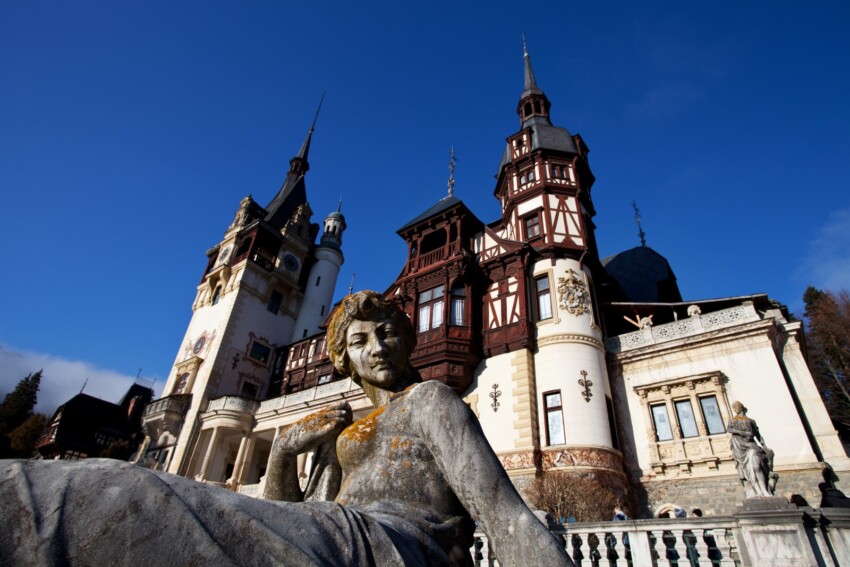
In the Prahova Valley, 120 kilometres north of the capital Bucharest, lies the enchanting town of Sinaia. This historic village, nicknamed the pearl of the Carpathians, sits at 800 metres altitude and is immersed in breathtaking mountain scenery. Sinaia takes its name from one of its cultural sites, Sinaia Monastery, built in the 17th century in Brancovan style at the behest of a Romanian nobleman following a pilgrimage to Mount Sinai in Egypt.
The most interesting place to visit in Sinaia is Peleș Castle, constructed in the second half of the 19th century in imitation of Bavarian castle style and richly decorated both inside and out. Nearby stands Pelișor Castle, also called Little Peleș, built in art nouveau style with 70 rooms furnished with Viennese furniture and Tiffany and Lalique vases.
Sinaia is also one of Romania’s most renowned ski resorts and boasts beautiful hiking trails, well-marked and beautifully maintained, winding through the Bucegi Mountains and the plateau. Unusual rock formations called La Sfinge and Babele, also known as The Old Ladies, are equally shrouded in countless legends.
Sinaia, the pearl of the Carpathians, is a small mountain town, and there are things to see both locally and in the surrounding areas. Here are the best ones to make the most of your holiday time.
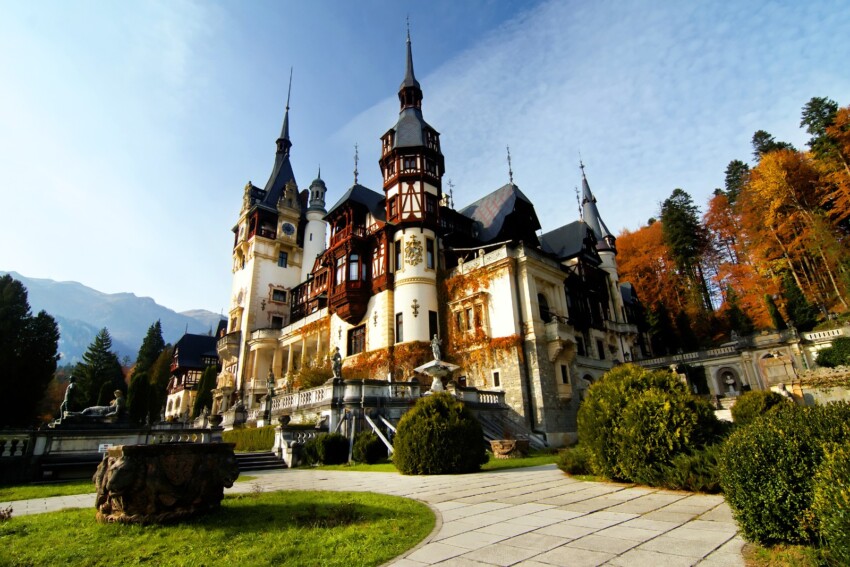
The magnificent Peleș Castle is one of the most beautiful and important monuments in all of Romania. Built at the behest of King Carol I between 1873 and 1914 in neo-Renaissance style with touches of Gothic, it stands north-west of Sinaia’s centre, nestled on the mountainside.
The construction cost, converted to today’s currency, is estimated at approximately 120 million euros; the project was designed by German architects Johannes Schultz, Carol Benesch and Karel Liman, drawing inspiration from the celebrated Neuschwanstein Castle in Bavaria. In fact, by its form and purpose, Peleș Castle is a palace, not a castle, extending over 3,200 square metres with over 170 rooms, many of them inspired by themes and styles from around the world. All rooms are richly furnished and decorated down to the smallest detail.
Visits to Peleș Castle are conducted via 3 guided tours. Of these, the shortest includes only the ground floor, the intermediate duration tour adds the first floor, and the complete tour allows a full visit of the castle. The castle is open Tuesday to Sunday, with varying opening hours but closing at 5 p.m.
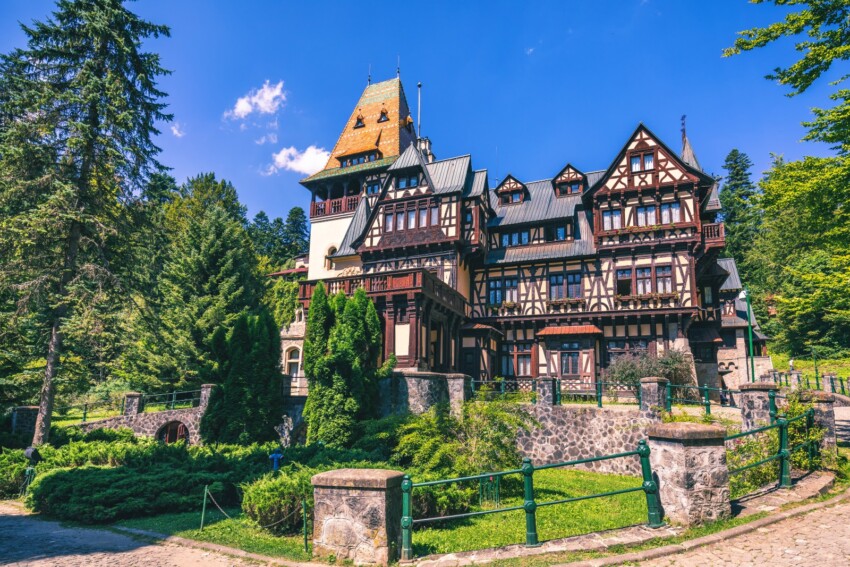
Pelișor Castle is the second of Sinaia’s castles, part of the complex that also houses Peleș Castle. Its construction began in 1899 and was completed four years later, on the orders of King Carol I as a residence for his nephew, the future King Ferdinand, and his consort Queen Maria.
Like Peleș, Pelișor is in fact a palace. It has 99 rooms, fewer than Peleș’s 170. Inside the sumptuous rooms, however, Queen Maria’s personal touch is evident, with furnishings and decorative items full of character. Of all the rooms that make up Pelișor Castle, the most important are the Holul de onoare (Hall of Honour), with its beautiful glass and steel skylight, King Ferdinand I’s study, with German neo-Renaissance furniture, and the golden bedroom, richly decorated on its walls too.
Between 1912 and 1913, at the initiative of King Carol I, a sumptuous palace was built in Sinaia’s Dimitrie Park to serve as the town’s casino. Construction work was supervised by architect Petre Antonescu, who also designed the building.
The majority stake in Sinaia Casino was held by the Baron de Marcay, who also owned a share in Monte Carlo Casino. The opening ceremony was celebrated with fireworks and a piano concert by George Enescu, and the venue quickly became one of the area’s main attractions.
After the 1940s, when the communist regime came to power, Sinaia Casino ceased operations and was subsequently converted into a conference centre. Inside the building there is also a concert hall, renowned for its acoustics and fine architecture, with a seating capacity of 400.
Sinaia Monastery was built in the late 17th century at the behest of Prince Mihail Cantacuzino, who wished to establish a residence for 12 monks, the same number as the Apostles. It is dedicated to Saint Catherine and is still inhabited today by Orthodox monks.
It was indeed Sinaia Monastery that gave the town its name, and it consists of two courtyards surrounded by a series of buildings. In the centre of each of the two courtyards stands a small church built in Byzantine style: these are the Biserica Veche (Old Church, from 1695 and only restored in 2016) and the Biserica Mare (Great Church, from 1846).
The Sinaia Monastery complex was created by architect George Mandrea, in a mix of Moldavian and Brancovan styles. Inside, there are frescoes and mosaics in neo-Byzantine style; the main one displays a series of allegorical figures connected to Romanian history.
Within the Sinaia Monastery complex there is also a museum, opened in 1895, which at the time was the first to display religious objects in Romania. Today, the monastery museum houses a collection of icons and crosses dating from the 17th century, the first Bible written in Romanian and a series of precious objects. The museum is open daily except Monday, though in winter months opening is reserved for groups of more than 20 people.
Villa Luminiș, or the George Enescu memorial house, is located in the Cumpatu area, on the right bank of the Prahova River. It was the home of Romanian composer and musician George Enescu, built in the 1920s in Brancovan style.
Enescu lived here from 1926 to 1946, when he was forced to leave Romania due to political events in the country following the disastrous aftermath of the Second World War. While in Paris, he signed a document stating his wish to donate Villa Luminiș so that it could become a haven for Romanian and foreign artists.
In the following map you can see the location of the main places of interest mentioned in this article.
Sinaia is a town of 11,000 inhabitants, stretching north-south along National Road 1, to the left of the Prahova River. Hotels and apartments are found throughout the town and there are plenty of them, given its strong tourist appeal.
There are 6 luxury hotels and over 20 four-star hotels, for a total of over 100 accommodation providers across the town. There are also many apartments and guest houses that locals rent out to tourists. Staying in Sinaia is fairly economical, though more expensive than other towns or locations in Romania, precisely because of the high flow of tourists to the area.
Sinaia is easily reached by car hire from Bucharest, a journey of less than 2 hours and just over 120 kilometres heading north. From Otopeni Airport it takes just 1 hour and 20 minutes, as it is located on the northern edge of the city, at the entrance to National Road 1, which leads directly to Sinaia.
You can also reach it from the country’s two other main airports, Timișoara and Cluj-Napoca, though the distances are considerably greater, at 6 and 5 hours of travel respectively. If you are already in the Carpathian or Transylvania region, Sinaia is a good stop to visit, being approximately 2.5 hours from Sighișoara, 3 hours from Sibiu and less than an hour from Brașov.
Finally, if you decide to visit Sinaia directly from the United Kingdom, the journey will be quite long: you should allow for 20 hours from London and 24 hours from Edinburgh, crossing France, Switzerland, Austria and Hungary, and entering Romania from the Nadlac border, near Arad.
What's the weather at Sinaia? Below are the temperatures and the weather forecast at Sinaia for the next few days.
 Hotel
Hotel 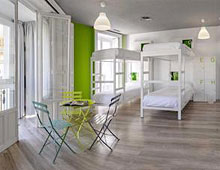 Budget accommodations
 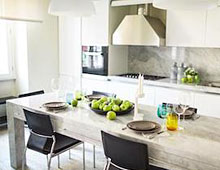 Apartments
 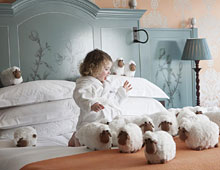 Family Hotel
 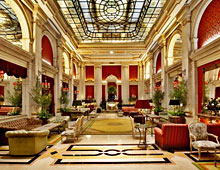 Luxury Hotel