Bestseller
Bucharest: Dracula's Castle, Peleș Castle & Brașov Day Trip
From 31,00 €
Buy the ticket
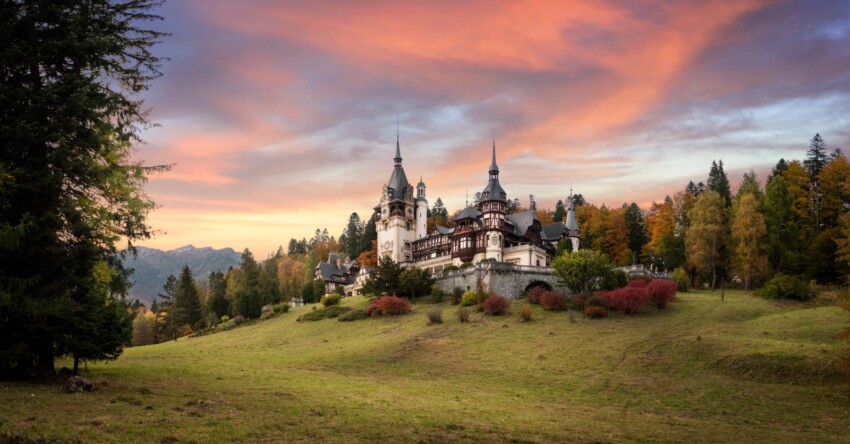
With its 160 lavishly decorated apartments, neo-Renaissance towers rising above the forested peaks of the Carpathians in Wallachia, and an art collection exceeding 35,000 works, Peleș Castle (Castelul Peleș) is considered one of Europe’s most extraordinary royal palaces. Located in Sinaia, at 1,000 metres altitude, this summer residence of Romania’s kings impresses with its attention to detail, from the oak wood carvings to the stained-glass windows created by Bohemian and Viennese craftsmen.
The castle stands at the heart of a 12-hectare park, surrounded by forests of firs and beeches that blaze with extraordinary colour in autumn. This is neither a medieval fortress nor a baroque manor house: Peleș is an eclectic building constructed between 1873 and 1914, which skilfully blends elements of German Renaissance, Flemish Gothic and Austrian Art Nouveau. The result is architecture that appears to have stepped straight out of a fairytale.
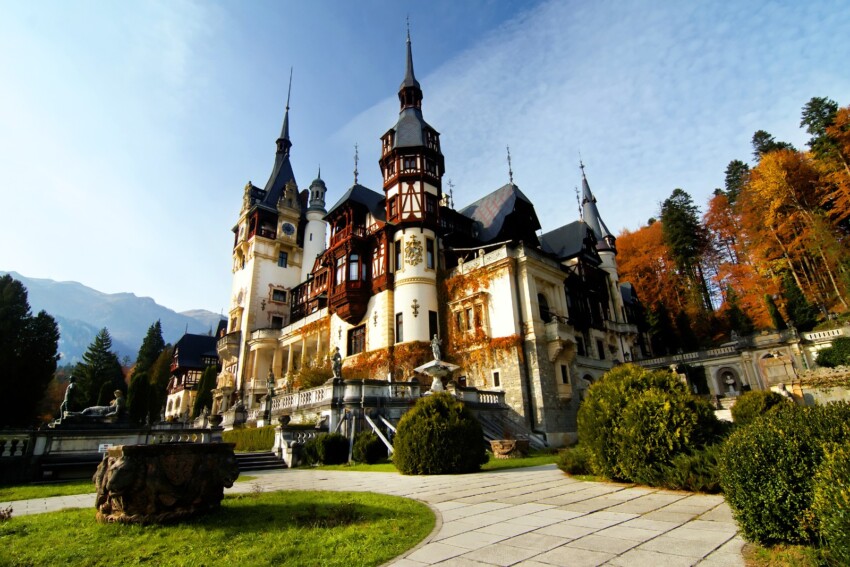
The standard tour covers 35 of the castle’s 160 rooms, spread across three floors. Each room is a self-contained work of art, designed with a coherent stylistic theme reflecting King Carol I’s travels and collecting passions. Dedicate at least two hours to the guided tour: it’s the only way to access the interiors.
The castle’s calling card is the Hall of Honour (Sala de Onoare), the grand central double-height salon that serves as the building’s distributive heart. The coffered oak ceiling, 12 metres high, is supported by solid wood columns decorated with foliate motifs. The polychrome marble floor and polychrome stained glass that filters the light create an effect of solemn magnificence.
This hall was used for official ceremonies and state receptions. On the walls hang 16th and 17th-century Flemish tapestries, alongside original armour from the same period. A detail that always surprises visitors: the steam heating system—cutting-edge for the late 19th century—is still visible in the decorative panels concealing the radiators.
Two of the most photographed rooms in the castle are the Florentine Room and the Turkish Room, located on the first floor and testament to King Carol I’s eclectic approach to interior design. The Florentine Room is lined with white Carrara marble and furnished with Italian Renaissance-style furniture: chairs in crimson velvet, carved sideboards, and a monumental fireplace topped with a fresco depicting 15th-century Florence.
The Turkish Room, meanwhile, represents the Orientalist fashion typical of late 19th-century European aristocracy. The walls are lined with Ottoman tiles and Persian carpets, while low divans with embroidered cushions create an atmosphere of “Arabian Nights”. This is one of the palace’s most Instagram-worthy rooms: arrive early in the morning to photograph it without the crowds from organised groups.
For military history enthusiasts, the Armoury is the highlight of the visit. It houses one of Europe’s most important collections of weapons and armour: over 4,000 pieces spanning the 14th to 19th centuries, from armouries in Germany, Italy, Persia and Japan. Complete knight’s armour is displayed on mannequins arranged in battle order, while the walls are covered with a mosaic of lances, swords, halberds and shields.
An exceptional piece is King Carol I’s tournament armour, made in Milan in 1870 by Lombard master armoursmiths. The hall also houses a rare collection of flintlock pistols and rifles from the 17th-18th centuries, many of which belonged to European noble families. The guide will show you the original mechanisms still in perfect working order.
The Council Chamber (Camera de Consiliu) was the decision-making heart of the court: it was here that the king held government meetings during summer stays in Sinaia. The long solid walnut table, surrounded by sixteen leather-upholstered chairs, is original. On the walls hang oil portraits of monarchs and princes from European royal houses related to Carol I: Hohenzollern, Coburg, Windsor.
The royal apartments on the second floor—accessible only with the premium tour ticket—reveal the private side of court life. Queen Maria’s bedroom is particularly moving: the Art Nouveau furnishings with the embroidered canopy have remained unchanged since 1914. The private bathroom with marble baths and gilt-bronze taps is one of the few surviving examples of Edwardian luxury in Romania.
Few know that within the castle is a small private theatre with 60 seats, Romania’s first theatre equipped with electric lighting (1883). King Carol I was passionate about opera and chamber music: the theatre hosted private performances by artists invited from Vienna and Bucharest. The original red velvet curtain and Edison bulb lighting system—restored in 2019—are still visible.
The theatre is not always included in the standard tour: check when purchasing your ticket whether it’s open to the public, as it’s periodically closed for private events and restoration work.
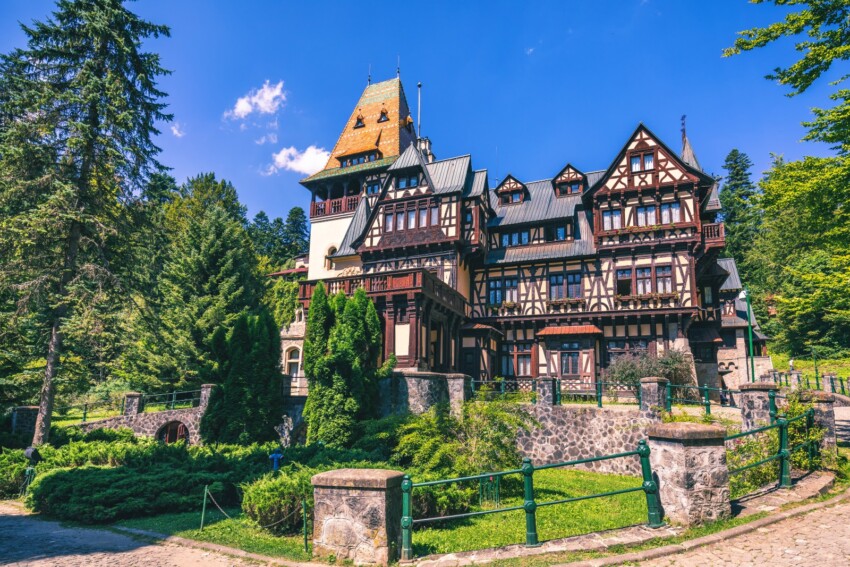
About 300 metres from the main castle stands Pelișor (“little Peleș”), an independent residence built between 1899 and 1903 for Crown Prince Ferdinand and his consort Maria. Stylistically, the building is the opposite of Peleș: Queen Maria, trained in art and a great champion of Art Nouveau, transformed the interiors into a manifesto of European Art Nouveau design.
The Golden Room at Pelișor, entirely lined with genuine gold leaf over plaster, is considered one of Europe’s most intact Art Nouveau interiors. The Pelișor ticket is separate from the Peleș ticket: allow at least an additional hour for your visit.
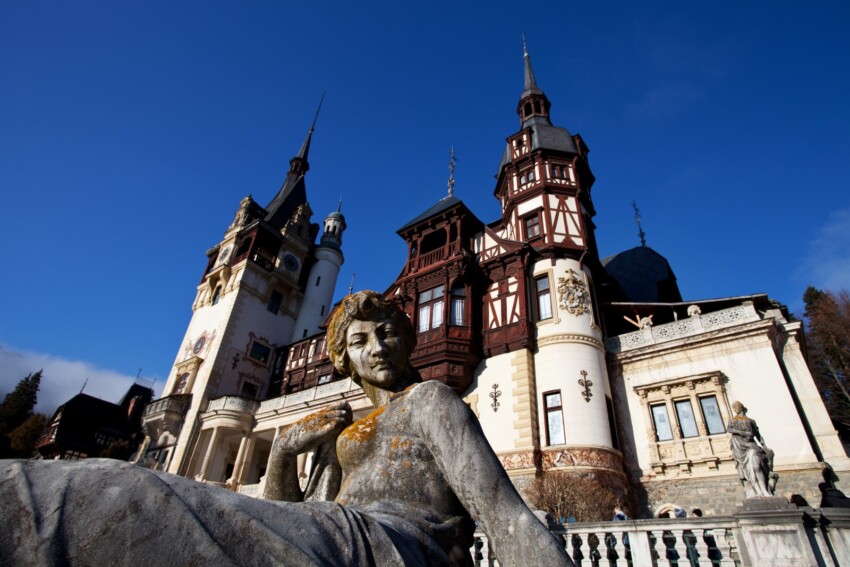
The history of Peleș Castle begins in the summer of 1866, when Prince Carol I of Hohenzollern-Sigmaringen—recently elected ruler of Romania with the backing of Europe’s great powers—rides through the Prahova river valley in search of a location for a summer residence. When he sees the panorama of the Sinaia valley, with its coniferous forests and cool mountain air, he immediately decides that this is where he will build his home.
Work begins in 1873 under German architect Wilhelm von Doderer, succeeded in 1883 by Karel Liman. Construction lasts over forty years, in successive phases: the original nucleus is completed in 1883, but the side wings, towers and interior decorations are completed between 1893 and 1914, the year of Carol I’s death. The castle becomes a permanent building site following the king’s evolving taste and the increasing financial resources of the Romanian state.
Carol I was a cultured monarch with refined taste, educated in German courts and deeply influenced by the Romantic architecture of Bavaria’s Ludwig II. It’s no coincidence that Peleș recalls, in some ways, Neuschwanstein: both express the same late 19th-century German Romanticism. Unlike the Bavarian castle, however, Peleș was conceived as a genuinely inhabited residence, equipped with all the modern comforts of the era: central steam heating, electricity (1883), hydraulic lift (1888) and fire-fighting system.
During World War I, the castle was used as a military hospital by Queen Maria, who personally organised care for wounded soldiers. This episode cemented the royal family’s emotional bond with Sinaia. In the following years, the castle continued to be the preferred summer residence of the Romanian Hohenzollerns until 1947, when the communist regime of Gheorghe Gheorghiu-Dej forced King Michael I to abdicate and go into exile.
Following nationalisation, the castle was transformed into a state museum in 1953. Dictator Nicolae Ceaușescu occasionally used it for diplomatic receptions, but banned public access for extended periods. Only after the 1989 Revolution was the castle permanently opened to visitors. In 2007 and 2013, legal disputes arose between the Romanian state and King Michael I over property restitution, never definitively resolved before the monarch’s death in 2017.
Peleș Castle offers different levels of visit. The standard ticket (Level 1) grants access to 35 rooms on the main floor, whilst the premium ticket (Level 2) also includes the royal apartments on the second floor. The tour is compulsory guided: self-guided visits are not permitted.
The Pelișor ticket is separate: there is also a combined Peleș + Pelișor ticket at a slightly reduced price.
In high season (July-August) and spring and autumn weekends, online booking is strongly recommended. Tours are limited by group size and tickets can sell out during peak hours.
The castle grounds are freely accessible during opening hours. You can stroll the paths, admire the external facades and enjoy the panoramic terrace without purchasing an interior ticket. A good alternative if the castle is sold out or if you prefer to enjoy the exterior.
If you’re based in Bucharest, or flying in and without a hire car, the best and most popular way to visit Peleș Castle is on a day tour from the Romanian capital. The bestselling tour is as follows—it’s one of the most economical with the highest reviews: we highly recommend it! It also includes a visit to the more famous Bran Castle.
Conversely, if you’re travelling to Peleș Castle by your own transport, perhaps during a Transylvania tour, purchase just the admission ticket.
The castle observes different hours depending on the season. From June to September (high season) it’s open daily from 9:00 to 17:00, with last admission at 16:15. From October to May it’s closed on Tuesdays; on other days opening hours are 9:00-17:00. The castle is closed on 1 January and 25-26 December.
Winter in Sinaia has a particular charm: the snow-covered castle is an extraordinary photographic sight. Bear in mind, however, that winter Sinaia is also a busy ski resort, so weekends in January and February can be crowded.
A complete visit to Peleș alone with the standard guided tour requires approximately 90-120 minutes. If you add Pelișor, allow another 45-60 minutes. Including time for the grounds and exterior photographs, a half-day is the minimum recommended time. If you also wish to visit Sinaia’s historic centre and Sinaia Monastery, plan a full day.
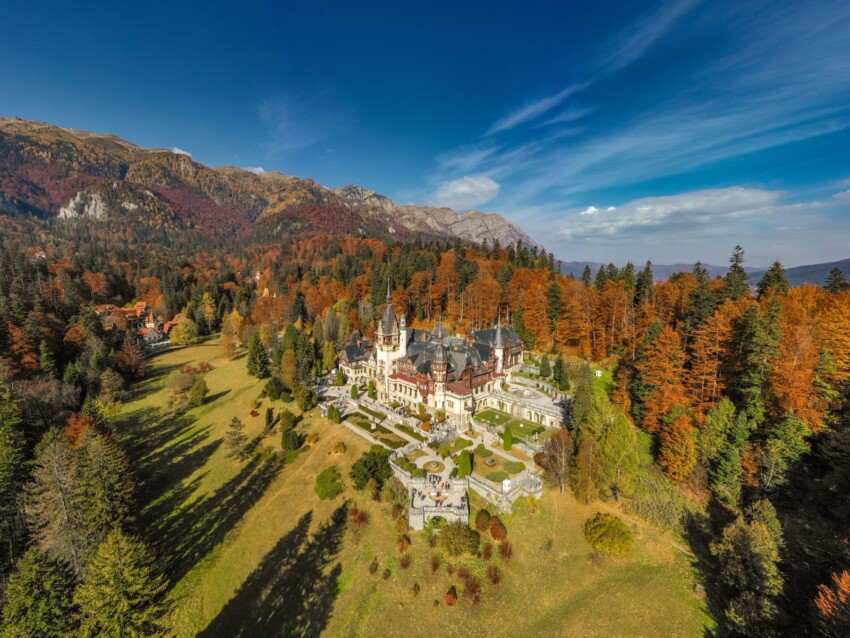
Peleș Castle is located in the heart of Sinaia, just 500 metres from the railway station. The town is easily accessible from Bucharest and from the main cities of Transylvania.
Train is the most convenient and recommended way to reach Sinaia from Bucharest. InterCity and InterRegio trains run by CFR depart from Gara de Nord station in Bucharest every one to two hours and take approximately 75–90 minutes to reach Sinaia. A second-class ticket costs around 35–45 lei (€7–9). Sinaia station is just 10–15 minutes’ walk uphill from the castle: follow the well-signposted footpath that runs through the town park.
By car, the route from Bucharest is approximately 130 km along the A3 motorway and then the national road DN1 through the Prahova Valley. Journey time is around 1 hour 45 minutes without traffic, though summer weekend congestion on the motorway can add considerably to this. Paid public car parks are available near the castle, but they fill up quickly: aim to arrive by 9:00 am. Alternatively, park near the railway station (easier to find a space) and walk to the castle.
From Brașov, the distance is approximately 50 km along the DN1: the journey takes about 45 minutes and the scenery through the Prahova Valley is spectacular in itself. If you’re driving from Transylvania, you can combine a visit to Peleș with the Transfăgărășan Road, which is reachable in around an hour from Sinaia.
Numerous private coach companies operate services from Autogara Filaret in Bucharest to Sinaia with frequent departures throughout the day. The journey takes approximately 2 hours and a ticket costs around 25–30 lei. The bus stop in Sinaia is in the town centre, about 15 minutes’ walk from the castle. This option is economical but less reliable than the train.
If you’re based in Brașov, local buses serve the Prahova Valley with stops at Sinaia: the journey takes around an hour. If you prefer the flexibility of your own transport, car hire in Romania is an excellent option for exploring Sinaia and the surrounding area.
 Hotel
Hotel 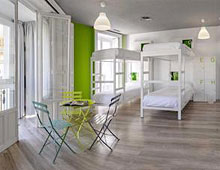 Budget accommodations
 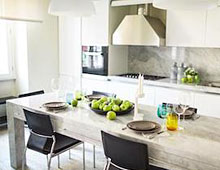 Apartments
 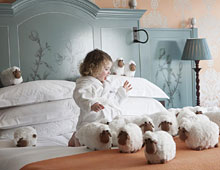 Family Hotel
 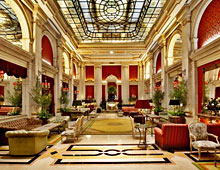 Luxury Hotel