Bestseller
Bucharest: Salt Mine Day Trip to Slănic
From 49,00 €
Buy the ticket
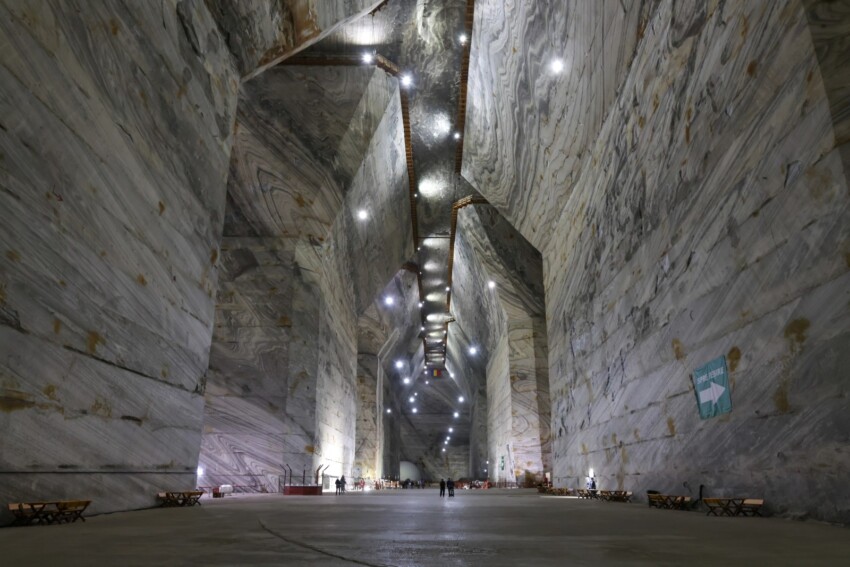
Approximately 100 km north of Bucharest, hidden among the wooded hills of Prahova County, lies one of the most spectacular underground sites in all of Eastern Europe. The Slănic Prahova Salt Mine, also known as the Unirea Mine, is one of the continent’s largest rock salt mines: its galleries reach heights of 54 metres, widths of 32 metres and extend for over 200 metres in length, creating underground spaces of almost cathedral-like proportions.
What makes this mine unique is not only the architectural scale of its spaces, but its dual function: it is simultaneously a visually striking tourist attraction and a recognised speleotherapy centre, where thousands of people spend extended periods each year to treat chronic respiratory conditions. The underground air, saturated with salt particles, with a constant temperature of 12°C and relative humidity around 70%, offers microclimatic conditions found nowhere else in any naturally occurring environment accessible to the public.
A visit to the Unirea Mine is not simply a walk through a gallery: it is an immersion into an underground world that astounds with its dimensions, atmosphere and variety of environments you traverse. Here are the most significant highlights not to miss.
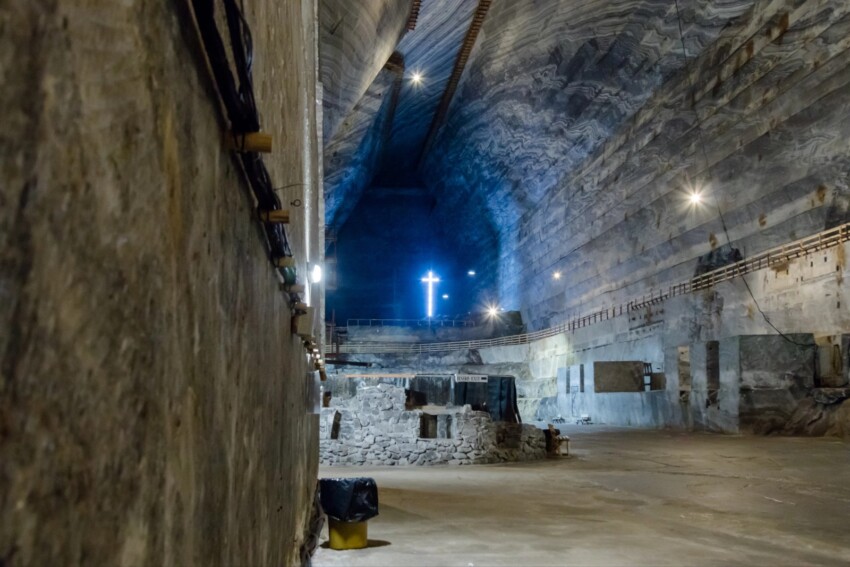
Descending by lift to approximately 208 metres below the surface, you suddenly find yourself facing a chamber of extraordinary proportions. The grey-beige rock salt walls soar 54 metres towards a vault that disappears into darkness, lit by an artificial lighting system that highlights the crystalline surfaces of the salt. The dimensions are so unusual for an underground space that the initial visual impact is almost disorienting: you have the sensation of having entered a cathedral carved into rock.
The main chamber is the heart of the visit and the place where you best sense the site’s extractive history. The marks of mining tools are still visible on the walls, along with traces left by miners over decades of activity. The raking light on the salt surfaces reveals a granular and almost luminescent texture, with darker veining that marks the different geological layers formed over millions of years. The best time to photograph the main chamber is from the entrance, when the contrast between the darkness of the access corridor and the diffused light of the cavern creates a striking perspective effect.
A significant portion of the mine is reserved for speleotherapy treatments, a therapy based on prolonged inhalation of air saturated with sodium chloride in the form of microparticles. Visitors not undergoing specific treatments can nonetheless enjoy this particular atmosphere simply by spending time in the galleries during their visit.
The areas dedicated to therapy are equipped with deck chairs and loungers, where patients spend hours in a relaxed position whilst breathing in the salt-laden air. The microclimatic conditions of the mine — stable temperature, absence of allergens, atmospheric pressure slightly higher than outside, low concentration of bacteria and fungi — make it an ideal environment for those suffering from bronchial asthma, chronic bronchitis, sinusitis and respiratory allergies. Several studies published by Romanian research institutes have documented significant improvements in patients after stays of 2-3 weeks in the mine galleries.
Even for those without specific conditions, spending time in this microclimate is an experience of profound relaxation: the absence of external noise, the cool and constant temperature and the air quality create conditions of sensory stillness difficult to find elsewhere.
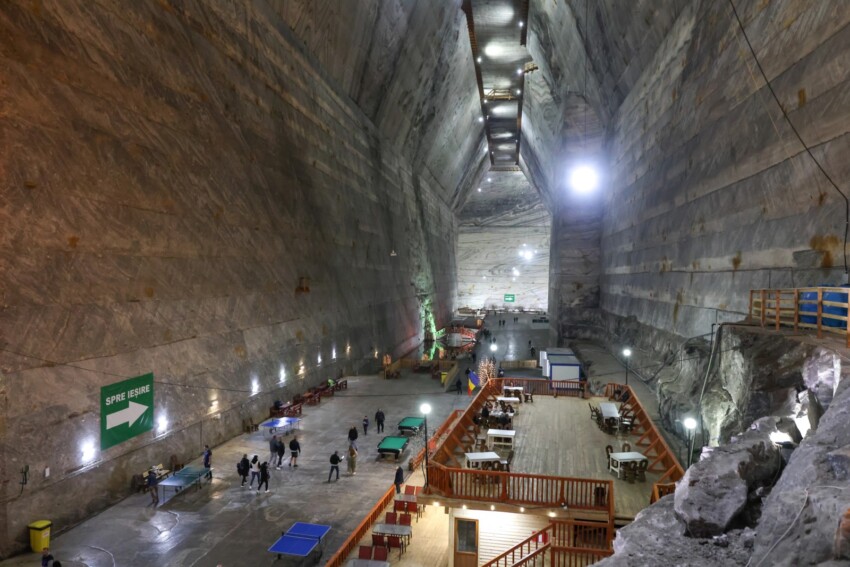
One of the most surprising aspects of the Slănic Prahova Salt Mine is the presence, within the galleries, of areas dedicated to sports and recreational activities. This is not a recent or superficial addition: the practice of physical activity in speleotherapy environments is well-established throughout Romania’s mining tradition and that of other Eastern European countries, as movement enhances the benefits of salt air inhalation.
Among the facilities present are table tennis tables, mini-golf courses, a volleyball court and spaces for free play. The presence of these activities makes a visit to the mine suitable for families with children, who can alternate between moments of exploring the galleries and active play. The idea of playing table tennis 200 metres below the surface, in an enormous salt chamber, is an experience children are unlikely to forget.
For adult visitors, the sporting aspect also provides an excellent reason to extend their stay in the gallery and maximise exposure to the therapeutic air, transforming a tourist visit into a complete wellness experience.
Just a few minutes’ walk from the underground mine entrance, on the surface, lies one of the most photographed natural curiosities in the area: the Green Lake of Slănic, known in Romanian as Lacul Verde. It is a saltwater lake formed at the point where, in 1880, the roof of an older salt mine, the so-called Carol Mine, collapsed.
The lake’s waters have an intense and brilliant green colouration, due to the particular salt concentration and the presence of halophytic algae adapted to the hypersaline environment. The mirror-like surface reflects the sky and surrounding vegetation, creating a very striking colour contrast. The salt concentration is so high that it is virtually impossible to sink: the body floats with the same ease as in the Dead Sea, although swimming is not permitted for safety and conservation reasons.
Green Lake is one of Slănic’s most iconic locations and certainly deserves a photographic stop. The morning light, when the still-low sun creates golden reflections on the water’s green surface, is the most interesting moment for landscape photography.
In the immediate vicinity of Green Lake stand the ruins of Carol Mine, the nineteenth-century mining facility whose collapse gave rise to the lake itself. What remains of the masonry structures — arches, pillars, perimeter walls — is partially swallowed by vegetation and has taken on an almost romantic appearance, similar to that of a medieval ruin immersed in greenery.
The Carol Mine ruins are not accessible inside for safety reasons, but the surrounding area is freely accessible and offers very interesting views, especially for those who enjoy industrial photography and the so-called urban exploration. The juxtaposition of the crumbling brick structures, the lush green vegetation and the emerald colour of the lake creates a scene of great visual intensity.
The ruins site reminds us how salt extraction at Slănic has a long and not always linear history, marked by dramatic events that profoundly changed the local landscape.
Within the mine complex is a small exhibition area dedicated to the history of rock salt extraction at Slănic and in Prahova County. Among the materials on display are original tools used by miners, period photographs documenting the phases of manual gallery excavation, historical maps of tunnels and shafts, and informational panels illustrating the salt extraction and processing process.
The exhibition is modest in size, but offers valuable historical context that helps understand the economic and social significance of the mine for the local community. Before tourism, salt was the primary resource of the Slănic area, and the miners who worked there constituted a professional category of great importance in the rural economy of Wallachia.
The presence of salt at Slănic is documented at least from the seventeenth century, when the first written mentions attest to the existence of mining activities in the area. The zone was part of the possessions of the Principality of Wallachia, and salt — then an extremely precious necessity — represented a source of strategic wealth for the reigning princes. Archive documents mention Slănic as early as 1688, when Prince Constantin Brâncoveanu officially recognised local mining activities and regulated their exploitation.
During the eighteenth and nineteenth centuries extraction intensified progressively, with the opening of new shafts and galleries as the demand for salt grew with the demographic and commercial expansion of the region. It was during this period that the Carol Mine was developed, which remained active for several decades before giving way in 1880, when the roof of the main gallery suddenly collapsed, giving rise to the saltwater basin we today know as Green Lake. The incident caused no casualties, but marked the end of that mining phase and prompted authorities to design facilities with more advanced engineering techniques.
The Unirea Mine, the one that welcomes visitors today, was opened in 1943, during the Second World War. The original project envisioned large galleries, with very wide cross-sections — a choice dictated by reasons of extraction efficiency that proved to be an unexpected advantage for the tourist destination. The enormous chambers carved into the rock salt are precisely those that today strike visitors with their majestic proportions.
After the nationalisation of the mining industry in the communist era, the Unirea Mine continued to operate as an extraction facility until the 1970s, when the reserves of commercially exploitable salt in the main galleries became exhausted. Rather than proceeding with the site’s definitive closure, Romanian authorities decided to reconvert the galleries to therapeutic and tourist use, inaugurating that speleotherapy vocation that has made Slănic Prahova famous throughout the region.
A little-known anecdote concerns the use of the galleries during the Cold War: the enormous underground chambers of the Unirea Mine, due to their structural stability and protected location, were used for several years as a repository for cultural assets and State archives, as part of the civil protection plans drawn up by Nicolae Ceaușescu’s regime. It is not the first time a salt mine has been chosen to preserve precious documents: its characteristics of constant temperature and humidity make it a naturally preservative environment.
Today the mine operates as a mixed facility, simultaneously hosting daily tourist traffic and therapeutic stays of patients who spend entire weeks there. This dual use, which might seem difficult to reconcile, works through the division of spaces: some galleries are reserved for therapy, others are open to all visitors.
Access to the Slănic Prahova Unirea Mine is paid. The standard adult ticket costs approximately 30-40 Romanian lei, whilst the reduced ticket for children, students and seniors is around 15-20 lei. Tickets are purchased at the ticket office at the entrance, near the lift shaft access, with no possibility of advance booking for individual visitors. On summer weekends and during public holidays, queues can form during the middle of the day: arriving early in the morning or late afternoon is the best strategy to avoid waiting.
A valid alternative to organising independently is to participate in a guided tour departing from Bucharest. Various agencies offer full-day excursions that include round-trip transport from the capital, mine admission and guidance in English or other languages, with the possibility of combining the visit with other stops in the area such as Sinaia or Peleș Castle. This solution is particularly convenient for those without a rental car who wish to enjoy the experience without worrying about logistics: tours are booked online well in advance, especially in summer when places sell out quickly.
The Slănic Prahova Salt Mine is open to the public year-round, with hours varying slightly depending on the season. In summer (May to September) it generally opens from 9:00 to 17:00, with last admission permitted about an hour before closing. In winter (October to April) hours are reduced, with opening from 9:00 to 15:00 or 16:00. The mine is open on public holidays, but it is advisable to check for any extraordinary closures before travelling, particularly during the Christmas and New Year period.
For a complete tourist visit, including lift descent, exploration of the main galleries, time in the sports activities area and return to the surface, you should allow at least 2 hours. Those who also wish to visit Green Lake and the Carol Mine ruins, located on the surface a few minutes’ walk away, should add at least another 30-45 minutes. With a leisurely pace and photo stops, half a day is the ideal amount of time to fully enjoy the entire site.
The best time to visit the mine is on weekday mornings, when visitor numbers are more manageable and the gallery atmosphere is more intimate. Summer weekends, especially July and August, attract many visitors from Bucharest and nearby cities: during these periods the galleries can become crowded, with noise effects that contrast with the quietness you would expect to find in an underground environment. Entry is not recommended for people with severe claustrophobia, although the gallery dimensions are so vast as to make the environment anything but oppressive.
Slănic is located in Prahova County, approximately 100 km north of Bucharest and around 40 km north-west of Ploiești. The town is accessible by various means of transport, though private vehicle remains the most convenient option.
A car is the most practical way to reach Slănic Prahova, especially if you’re travelling from Bucharest or planning to combine your visit with other stops in the area, such as Sinaia or the Romanian Carpathians. From Bucharest, take the national road DN1 towards Ploiești, then turn towards Băicoi and follow the DN1A to Vălenii de Munte, from where Slănic is about 20 minutes away. The total journey from Bucharest takes approximately 1 hour and 45 minutes in normal traffic conditions.
From Ploiești the journey is shorter: heading north on the DN1A, you’ll reach Slănic in approximately 50-60 minutes. Parking near the mine entrance is available, though it can become congested during peak summer periods. If you want to explore the region with complete freedom, car hire in Romania is a very convenient option, given that public transport to Slănic is limited.
From Bucharest there are bus connections to Slănic Prahova, departing from Filaret station. The bus journey takes approximately 2 hours and 30 minutes and is available mainly on weekdays. Services are infrequent and schedules change seasonally, so it’s essential to check the latest information at the station or on online booking portals before planning your trip.
From Ploiești there are more frequent local connections to Slănic, also accessible by private minibus (maxi-taxi). From Ploiești you can reach Slănic in approximately 1 hour. Ploiești itself is easily accessible from Bucharest by frequent trains from Nord station, with journey times of around 1 hour.
There is no direct railway line to Slănic Prahova. The closest option is to get off at Ploiești on trains departing from Bucharest Nord, then continue by bus or maxi-taxi. For those travelling from other parts of Romania, Ploiești is well connected to the national rail network.
The temperature inside the mine remains constantly around 12°C throughout the year, regardless of the season above ground. In summer, when it can exceed 30°C outside, the temperature contrast is very pronounced. It’s essential to bring a jumper or light jacket, even when visiting in the height of summer. Footwear should be comfortable with a non-slip sole, as the gallery floors can be damp and uneven.
Yes, Slănic Prahova Salt Mine is very family-friendly. The gallery dimensions don’t create a sense of claustrophobia, the environment is safe and monitored, and play areas with table tennis, mini-golf and other games ensure an active and engaging experience. Children find the experience of descending by lift 200 metres down and exploring vast underground chambers very stimulating. However, it’s worth considering how very young children might react to the change in pressure during the lift descent.
A standard tour of the main galleries takes approximately 1 hour and 30 minutes. Those who want to spend time in the play areas, explore all the publicly accessible galleries at a leisurely pace and enjoy the salt-laden air for longer can easily spend 2-3 hours without getting bored. Adding a visit to Green Lake and the ruins of Carol mine on the surface, half a day is the recommended time for a complete experience.
There are small refreshment areas within the galleries where you can buy drinks and snacks. There’s no proper restaurant, but the offering is adequate for a break. Those wanting a full meal should either bring packed food from home (picnics are permitted) or go back to the surface and visit one of the bars and restaurants in Slănic town centre, just a few minutes from the mine entrance.
Absolutely. Slănic Prahova’s location in the heart of Prahova County makes it an excellent base or stopping point for exploring some of Romania’s most interesting destinations. Approximately 50 km away is Sinaia, home to the famous Peleș Castle, and the ski resorts of Predeal and Bușteni. For those interested in historic mines, a visit to the Turda Salt Mine in Transylvania allows you to compare two fascinating mining sites with very different characteristics.
 Hotel
Hotel  Budget accommodations
  Apartments
  Family Hotel
  Luxury Hotel